
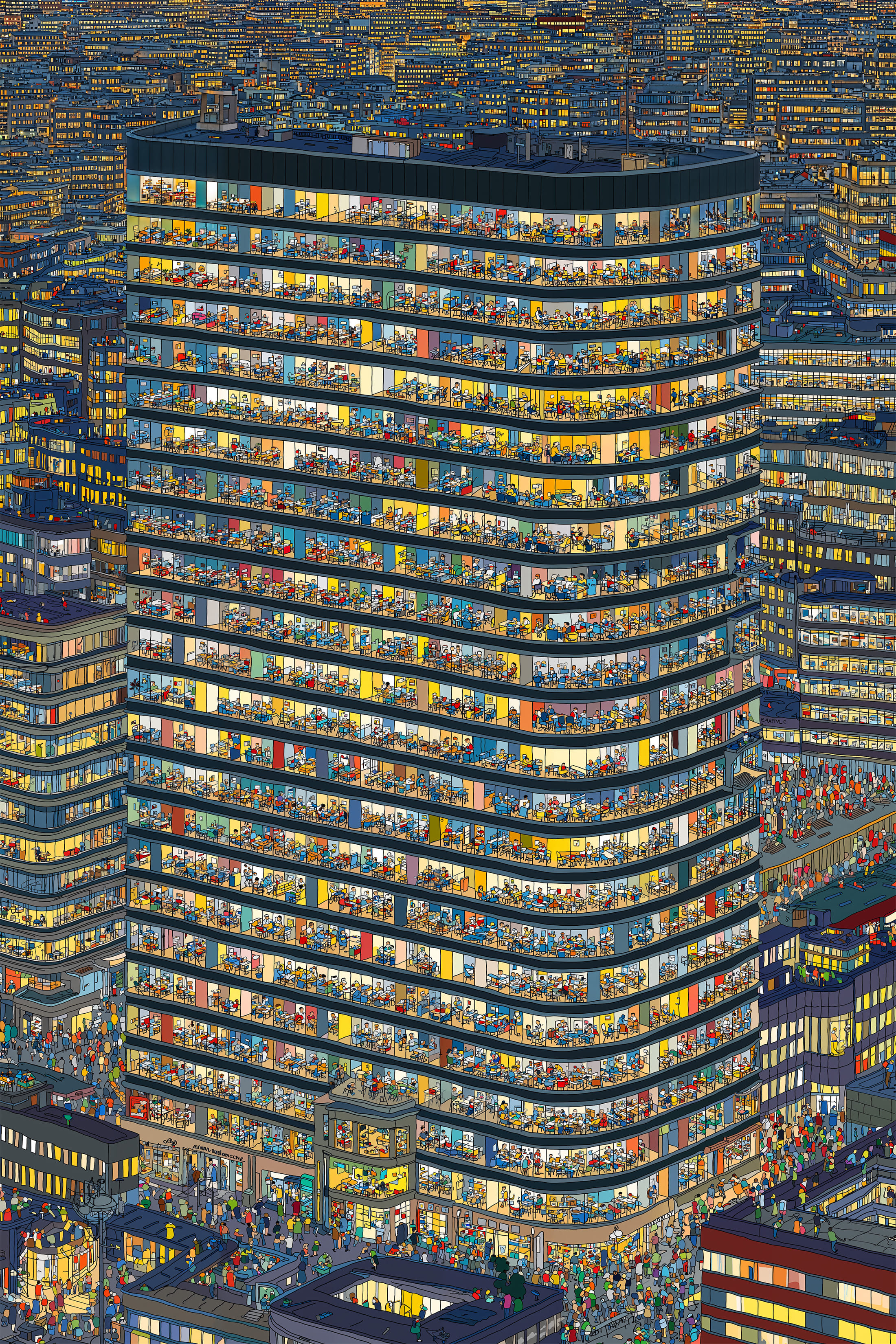
Vertical Societies, Tower No. 1 by Richard Nadler. Image credit: Richard Nadler.
In an era when AI-generated imagery can feel increasingly frictionless, Richard Nadler is pursuing a far more deliberate path. The Munich-based digital artist, who left a career in London’s banking world to immerse himself in contemporary art, approaches artificial intelligence not as a shortcut but as a collaborator — one shaped through custom-trained models, iterative experimentation, and the tactile influence of hand-drawn sketches.
In our conversation, Nadler reflects on the tension between authorship and automation, the enduring value of human intuition in digital practice, and why he believes meaningful AI art still demands patience, craft, and a strong personal point of view.
Architecture, nature, and the complex human presence within them are recurring themes in your pieces. What is your main inspiration for new art creations?
My work begins where memory and observation meet. I’m drawn to the spaces where architecture and human presence become inseparable — where buildings stop being containers and start becoming portraits of the people who fill them.
The inspiration usually arrives as a single image I can’t shake. A tower that holds thousands of lives stacked on top of each other. A bridge so densely inhabited that crossing and dwelling become the same act. These aren’t fantasies for me. They’re concentrated versions of what I already see when I walk through a city.
I’m interested in scale not as spectacle but as a way to make visible what daily life makes invisible. When you put 10,000 windows in one frame, the question isn’t “wow, how many people?” It’s “where am I in this picture?”
Vertical Societies collection by Richard Nadler. Image credit: Richard Nadler.
One of your collections, ArchiTextures, was inspired by a trip to the midcentury-modern architectural mecca of Palm Springs. What is your relationship to architecture?
Architecture, for me, is the most honest record of how a culture wants to be remembered. Palm Springs holds a particular kind of optimism — the postwar belief that good design could solve loneliness, that a glass wall onto a desert could make the future feel possible. ArchiTextures came out of standing in those buildings and feeling the weight of a promise that hasn’t quite aged the way they hoped.
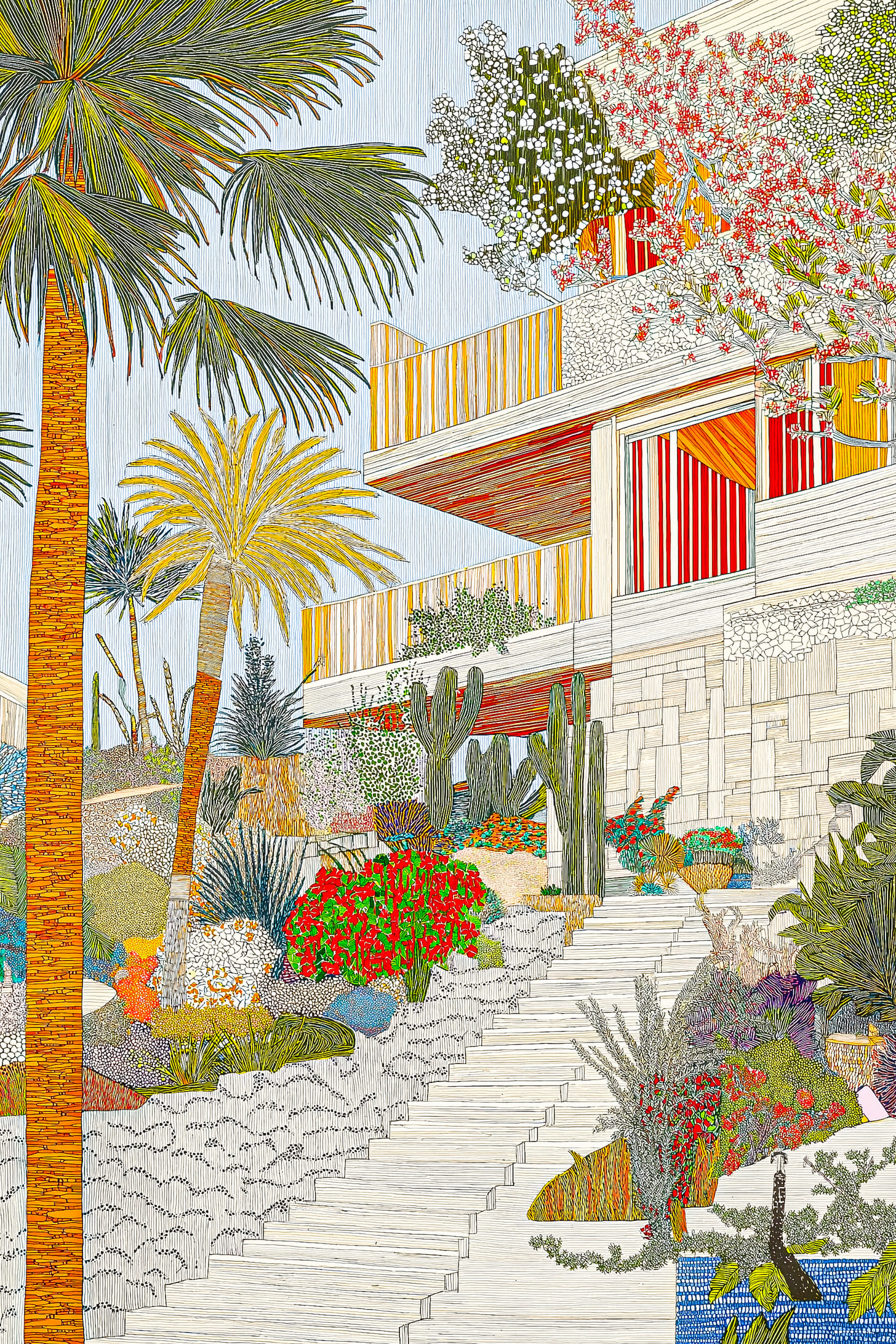
ArchiTextures No. 90 by Richard Nadler. Image credit: Richard Nadler.
I’m not an architect. I approach buildings the way I approach people: with attention to what they say without speaking. The way a roofline angles toward the mountain. The way a window frames exactly what someone wanted you to see. These are decisions, and decisions carry meaning even when the maker has been gone for decades.
What pulls me back to architecture again and again is that it’s the one art form you cannot avoid living inside.
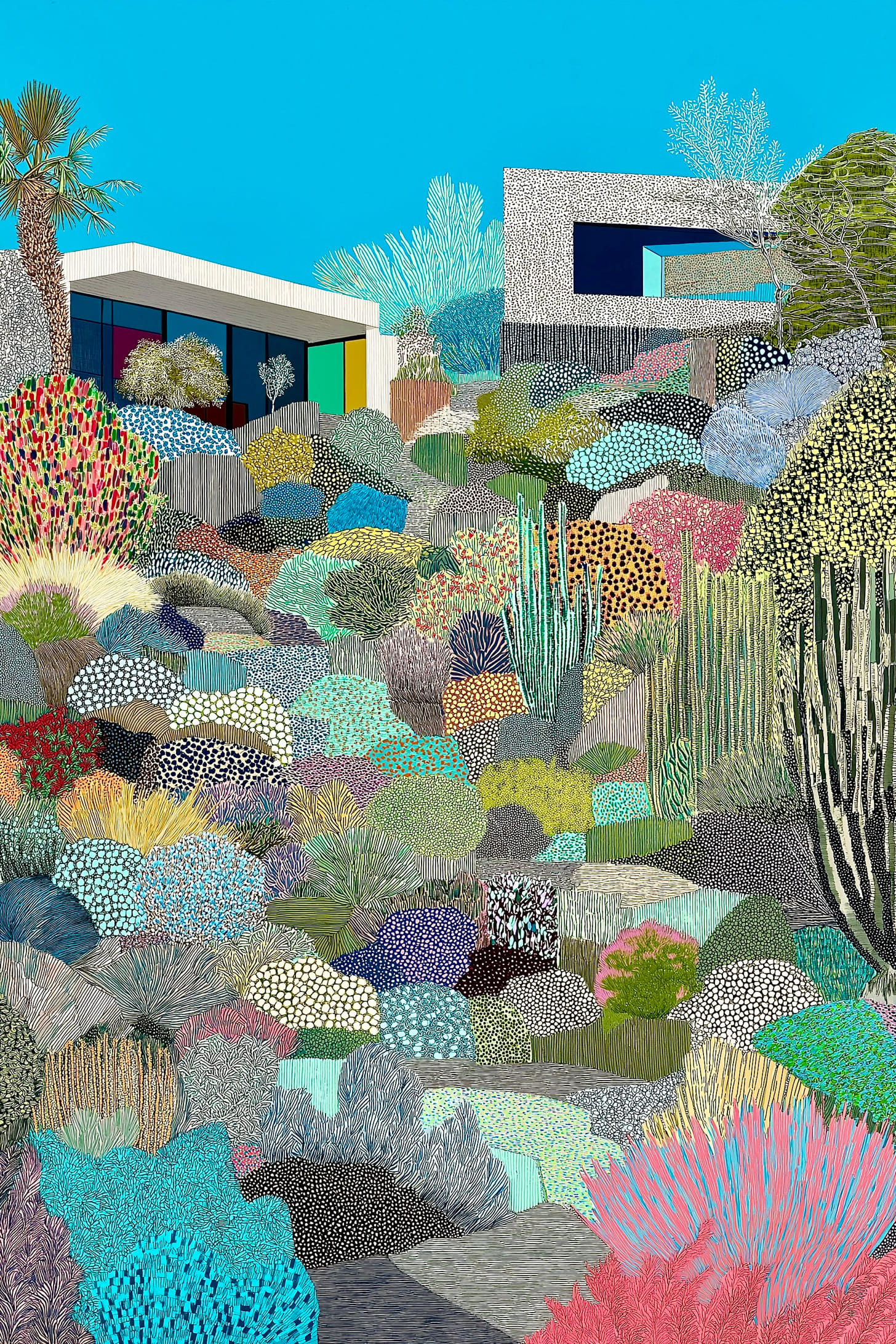
ArchiTextures No. 5 by Richard Nadler. Image credit: Richard Nadler.
Urban life and the question of scale are other popular themes in your work, depicting densely populated skyscrapers, stadiums, and arenas. Do you have particular buildings in the real world in mind when you conceptualize these pieces?
Sometimes yes, sometimes no.
The skyscrapers in my Tower series carry traces of buildings I’ve walked past hundreds of times in Munich, Tokyo, New York. Not as direct portraits but as accumulated impressions. The proportions, the way light catches a facade at dusk, the rhythm of windows — these get internalized over years, then resurface in the work.
I’m not an architect. I approach buildings the way I approach people: with attention to what they say without speaking.
Stadiums and arenas are different. There I’m working from a more collective image — the Maracanã, the Olympic Stadium, places that exist in the cultural imagination even for people who’ve never been. I’m interested in how these structures become temporary cities, how 90,000 strangers briefly share something they cannot fully articulate.
What I’m always looking for is the moment a building stops being infrastructure and becomes a stage for being human together — or alone, in plain sight.
Collective Pulse collection by Richard Nadler. Image credit: Richard Nadler.
You state on your website that you don’t use “AI as a shortcut” for simple prompt-entering, but instead, you build custom models and feed them your sketches. Could you share a bit more about your process and the technical details behind it?
The work begins long before the machine is involved. There’s an initial human phase where the piece is defined as an idea, a feeling, sometimes a single sentence. The conceptual sketch comes first — not a literal drawing but a kind of internal blueprint for what the work needs to do emotionally.
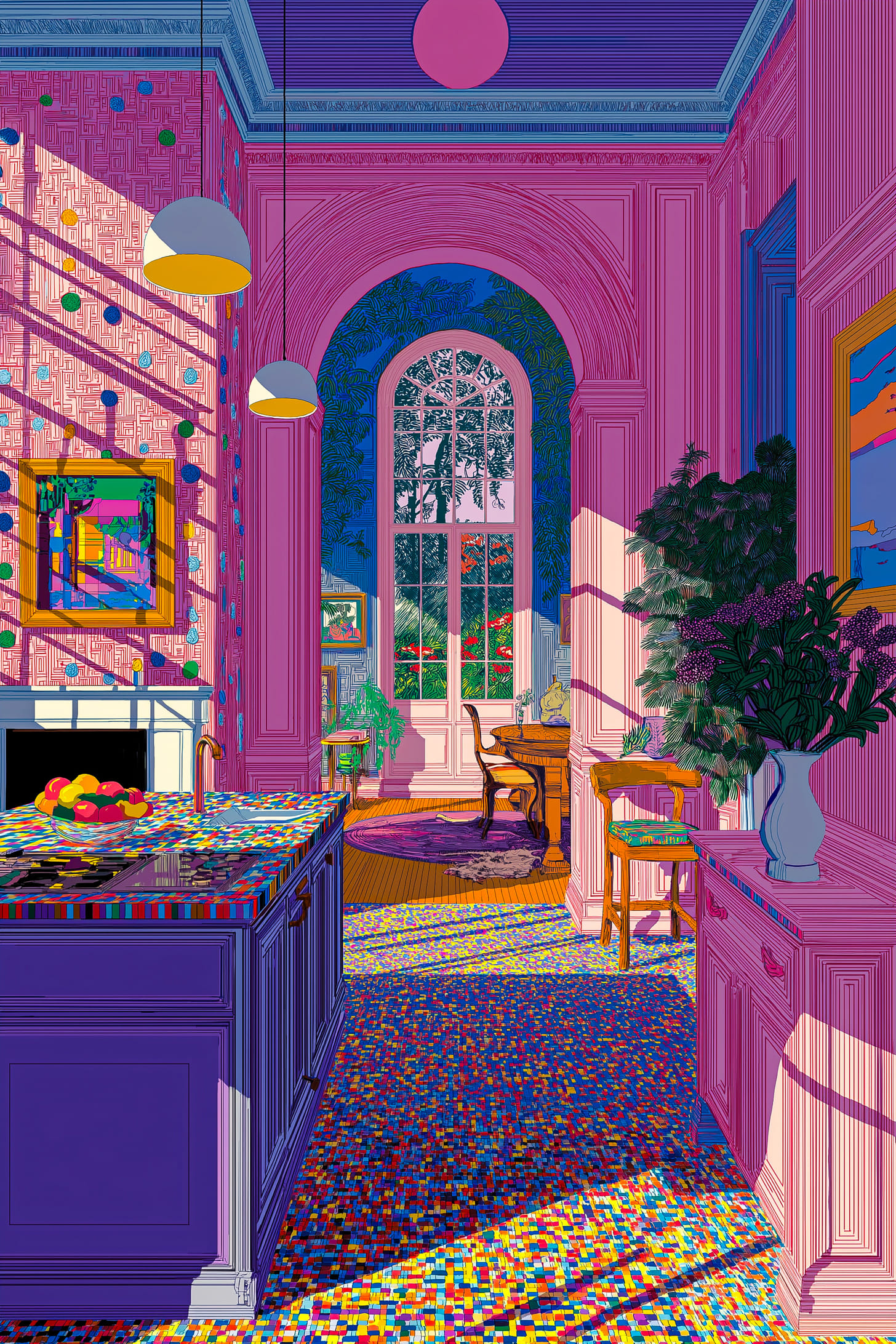
HabiTextures No. 45 by Richard Nadler. Image credit: Richard Nadler.
Only then does the technical work begin. For each series, I build a custom diffusion model from scratch, trained on references I’ve gathered over months — architectural drawings, photographs, embroidery textures, light studies. A typical collection produces between 10,000 and 30,000 outputs before I find the pieces that hold what I was looking for. Some series take three months. Some take a year.
What I refuse is the shortcut version — typing a prompt into a generic model and posting whatever appears. That’s not authorship, that’s curation of accidents. The custom model is the difference between using a language and being given words.
The model changes for every series. The authorship doesn’t.
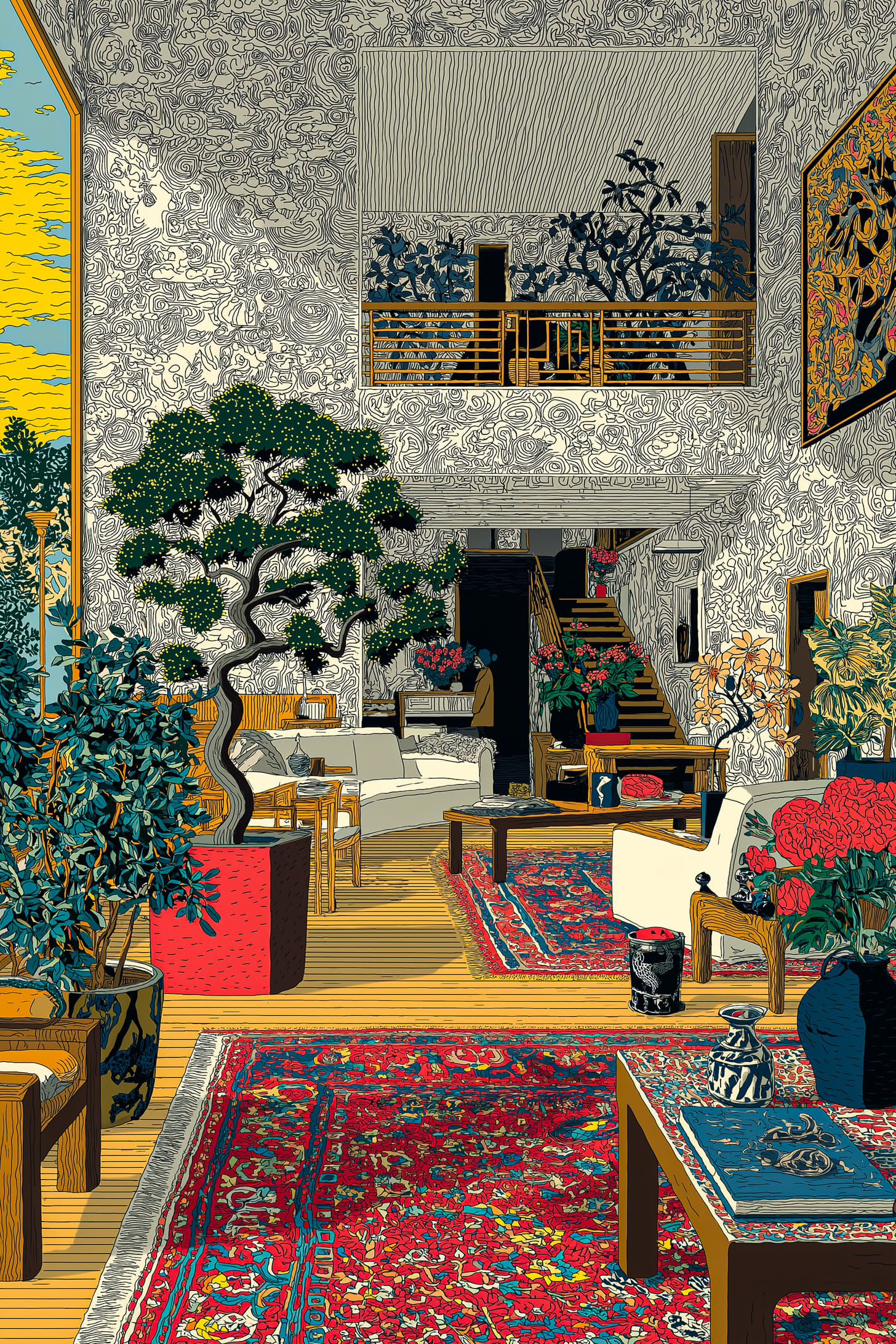
HabiTextures No. 10 by Richard Nadler. Image credit: Richard Nadler.
What are your favorite digital artists and creators you follow?
The artists I return to aren’t all digital, but they all think about what surfaces can hold.
Gerhard Richter for the way he refuses to choose between systems — photographic precision and abstract surface as two languages of the same hand. There’s something in his squeegee paintings that I recognize in my own process: The moment a controlled gesture becomes something neither the artist nor the tool fully decided.
What I’m always looking for is the moment a building stops being infrastructure and becomes a stage for being human together — or alone, in plain sight.
Imi Knoebel for treating color and material as architecture. His work taught me that minimalism isn’t the absence of feeling — it’s the place where feeling has been concentrated until it can no longer be diluted.
Refik Anadol for showing what AI can be when it’s used as a material, not a shortcut. His work makes data feel atmospheric, which is a translation problem most of us are still struggling with.
Beyond these three, I follow architects more than digital artists — the way buildings are conceived is closer to my process than most image-making.
Vertical Societies collection by Richard Nadler. Image credit: Richard Nadler.
Who are the architects you find most inspiring?
The architects who shape my work aren’t necessarily the ones with the cleanest legacies — they’re the ones who treated buildings as social experiments.
The Japanese Metabolists are central to me, especially Kisho Kurokawa and Kenzo Tange. The Nakagin Capsule Tower wasn’t just a building; it was a manifesto about how density could be lived. That same conviction runs through Moshe Safdie‘s Habitat 67 and Le Corbusier‘s Unité d’Habitation — the idea that a single structure could become a vertical village.
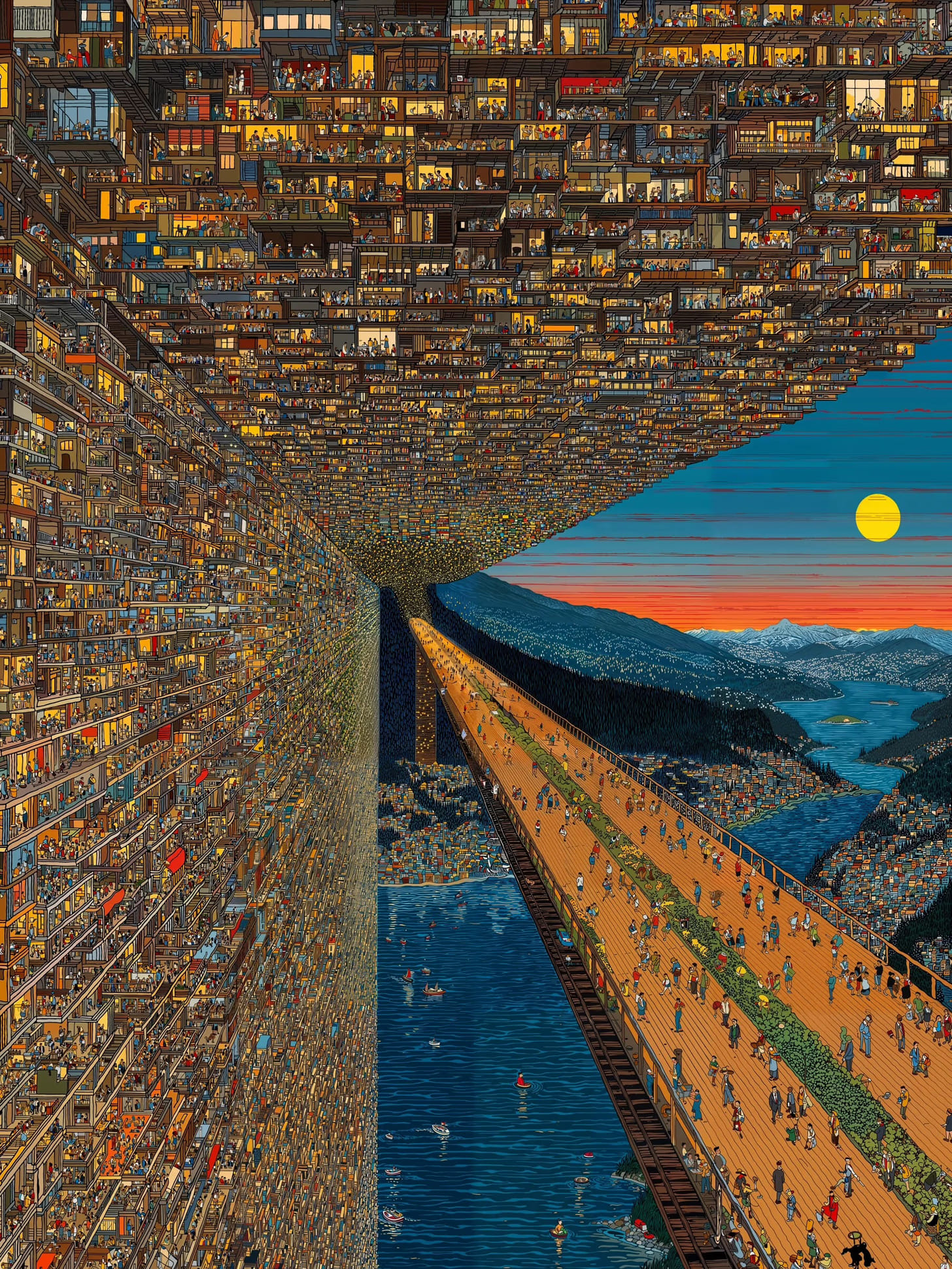
Bridge No. 1 by Richard Nadler. Image credit: Richard Nadler.
Then there are the visionaries who never built, or built only fragments: Paolo Soleri‘s Arcosanti, Yona Friedman‘s spatial cities, Constant’s New Babylon, the work of Archigram. Their unbuilt drawings are closer to my work than any finished building. They imagined cities as machines for collective life, not as collections of private cells.
But I’m equally drawn to the architecture nobody designed — Kowloon Walled City, the favelas of Rio, the rooftop additions of Hong Kong and Cairo. These are the real megastructures. They prove that when humans build at scale together, the result is always denser, weirder, and more alive than any architect could plan.