
Sign up for the Slatest to get the most insightful analysis, criticism, and advice out there, delivered to your inbox daily.
I’ve long been averse to the world of parenting advice. No Mommy blogs, no MomTok, no Momstagram for me. Though I have a 6-year-old, I mostly avoid parenting guides of all kinds. It’s like reading a book about how to write a novel: maybe useful here and there, but ultimately a poor substitute for the work of confronting a blank page and making hard decisions in real time. Isn’t trusting your intuition the goal anyway?
Now, though, I’m pregnant with my second—a second boy, no less—and people have thoughts. Thoughts about my nascent double-boy mom status (“chaos”), thoughts about the age gap (“ideal!” “… oh”) and the workload, given my live-in rising-first-grade helper. “It’s definitely more than double the work,” one friend tells me. “The second one is truly easier,” another emails, “and also likely a demon child if your first is super well behaved.”
Mostly, I appreciate this input. I’d like to believe I’ll be able to negotiate sleep training and Monster Jam trucks clobbering each other over obstacle courses (Team Toro Loco). But I worry: about whether I’ve gravely underestimated the emotional toll of caring for two kids. About whether I have the capacity to be present for both of them, whether I’ll be able to find enough stillness and calm to appreciate what I’ve thus far imagined will only be an exponential increase in love. About balancing my desire to keep being a good mom, and becoming a better mom, with my equal desire to keep being a writer, and growing as that writer.
In the second trimester’s relative calm, I decided I wanted a new project—one that would force me to slow down and reflect on how I’ve been parenting. What might I learn if I were to write directly about being a mother? What could I capture about my son’s last months as an only child? The part of me that’s a sucker for goal-setting and self-transformation also wondered: What if, rather than reject the parenting canon, I were to embrace it? Would my mothering improve before the baby was born?
There is no bigger player in modern parenting advice than Becky Kennedy, or, as Time magazine calls her, “the millennial parent whisperer.” Dr. Becky is a mother of three and a clinical psychologist. She also heads a massive parenting empire under her Good Inside brand, which encompasses a podcast (the No. 1 parenting podcast, on the Apple charts), a popular Instagram page (3.4 million followers), a TikTok account (334.8 million followers), a newsletter, an app, and affiliated merch, including picture books. If you’ve heard terms like deeply feeling kid or sturdy parenting—Dr. Becky emphatically rejects the label gentle parenting as applicable to her work—or overheard a beleaguered mother try to coax her child into deciding to leave the playground without resorting to If you don’t get off that jungle gym right now, the Legos are mine for a week, you’ve been privy to her influence. As of May 19, an app called Good Inside Baby will join the flock, meaning you can use (and pay for) Dr. Becky’s advice before your child has even left your uterus; a promotional image shows a pregnancy test and addresses the viewer’s “joy, panic.”
In February, ahead of my new baby’s arrival, I decided to conduct an experiment. I’d Dr. Becky–pill myself for three weeks, roughly the minimum time it takes to form a habit. I’d limit my Becky-verse contact to the Good Inside app (kid edition), to absorb the purest form of Dr. Becky’s ethos—and to avoid, let’s face it, getting sucked into engaging with Dr. Becky in every medium known to humankind. I’d log my use in a diary on my phone’s Notes app.
I wondered how doing so would change me and my kindergartner. Would I emerge kinder, more resilient—or plagued with unexpected self-consciousness about one of the few areas of my life for which I haven’t felt self-conscious? Better equipped to mother Boy No. 2 or stricken with learned helplessness from being coddled by an expert on my phone day in and day out? Or would I leave even more cynical about the parenting industry—which is, in this instance, charging me $84 for a three-month app subscription? Thus, I entered the Dr. Becky–verse.
Day 0
I download the Good Inside app on pub day for Dr. Becky’s new picture book Leave Me Alone!: A Good Inside Story About Deeply Feeling Kids. An omen among omens: Mid-dog-walk that day, I spot a onesie that reads “Milk Drunk” and shudder at the impulse to recruit our newborns into low-key bacchanalia. In the pie shop, two moms sport matching baby wraps, infants pressed to their chests.
Unpeeling a banana, I open Good Inside (or Gi, as it brands itself, like a missing element from the periodic table), which directs me to the chatbot: “Meet GiGi.” “Ew,” I blurt. My dog stares. The clever acronym (GiGi, get it?), I learn, is “trained by Dr. Becky” and will answer your parenting questions in Dr. Becky’s “voice” any time of day or night. That she presumes such ineptitude and desperation among her legions of users does not bode well.
My Gi profile requires I answer questions about my kid. I dub him Salmon—my son’s favorite maki—and create a fake birthday.
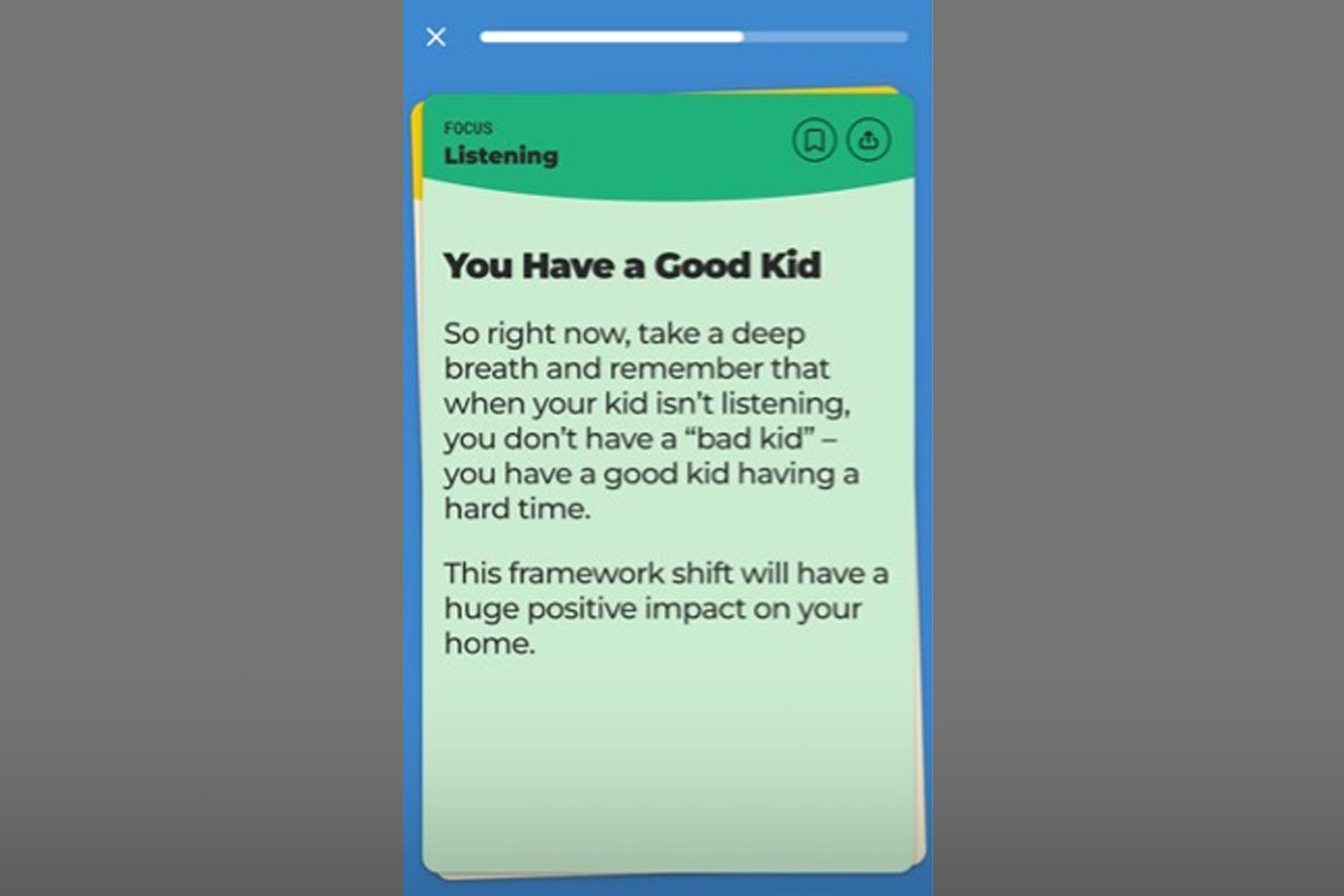
In three minutes, I complete the first deck, “Why Your Kid Tunes You Out.” Swiping through a dozen or so brightly colored cards, I’m told, in what supposedly constitutes a “framework shift”: “You have a good kid.”
Good Inside
Do parents think they have … bad kids, I wonder? By the deck’s end, the app invites me to set a reminder on my phone. I comply. Several hours later, the notification dings as Salmon and my husband have a pillow fight.
Meanwhile, Salmon instructs me to say, “What are you boys doing?”
“What are you boys doing?” I parrot.
“Squirrel flips!” Salmon says. “This is my nut tunnel.”
Day 1
Instead of walking the dog, I watch a short Gi video. Dr. Becky advises her audience to make an “imperfect, incomplete” connection with a friend. I dismiss texts from two friends as I watch, admiring her aquarium-blue turtleneck.

Good Inside
“Here at Good Inside, we care so much about you,” she says, “not just your kid.” And, in keeping: I am distracted by her: her sizable ring, her gorgeous greige blond hair.
Not for long, though. There is more content to mainline. I complete another deck: “Same Team Mindset Game Changer.” I appreciate a suggestion to infuse playfulness into moments of potential frustration, namely “transition moments.” And while I like the idea of “replacing opposition with cooperation,” imagining that I’d vilify my kid turns me off.
The app celebrates my two-day streak; as Dr. Becky might say, I’m “exactly where I’m supposed to be.”
Day 2
The day gets away from me before I have time to consult Dr. Becky about anything. I fall asleep in Salmon’s bunk bed, lulled by Dragon Masters 5: Song of the Poison Dragon. So much for my streak.
Day 3
I resolve to implement something I’ve learned.
“Salmon,” I ask this morning, “can you tell me in your silliest voice what you want in your lunch?”
Salmon races Hot Wheels.
“Salmon,” I try, “do you want barbecue chicken in your lunch?”
Nothing.
At midday, I log in to Gi. Tackling my next deck, “Boundaries Make Jobs Clear,” I learn that parents’ jobs include boundaries and validation; children’s jobs are expressing desires and feelings. Suddenly, something seems useful—the advice to replace “Please stop” with “I won’t let you.” Why don’t I take an active, assertive role more often? This I can work on.
Day 4
I go out of town for a mentor’s funeral. From Forest Park in St. Louis, I FaceTime Salmon. He gives me a virtual hug and convinces me to convince my husband that the pancakes in the freezer should be saved for my return and a new batch prepared for today’s breakfast. On the train back to Chicago, I eat a beet-and-pickled-grape salad and reply to my husband’s texts about Salmon’s day.
I believe I am a good mother. When I say good, I don’t mean smug or perfect. More like secure. Maybe my resistance to parenting content stems from the fact that I don’t want to perform insecurity for a jolt of reassurance.
Still, I am open-minded. What will I learn in “Connection Before Direction”?
Something logical: Validate a child’s experience before asking them to do something different. Less logical is the bonus strategy that the deck offers: Play “no phone” time (PNP time), just being with your child sans device … followed by a plug for GiGi. Isn’t GiGi … on the phone? The irony depresses me. Once, in a fit of saltiness, I ask GiGi about the origin of its name, a question that flummoxes the bot. The thought of consulting it about Salmon repulses me.
Day 6
At 2 a.m., I find Salmon being what he calls a “night-walker,” standing in the kitchen, filling a glass with water. I lead him back to bed, cuddle up beside him. In three hours, I leave for a 12-day writing residency in Hawaii. The residency was lined up before I got pregnant, and even though I hate flying—and especially hate flying un-Xanaxed with a rapidly expanding belly—prioritizing writing time before my June due date has become paramount. While the timing isn’t ideal for my new Gi experiment, I plan to unplug without abandoning Dr. Becky. This arrangement will allow me to immerse myself without being tempted to stare at my phone when I’m with my kid. I’ll be a focused fiction writer and a focused Gi student.
Rain drips down the plane windows; I complete the “Ask and Trust” deck, which opens with a Dr. Becky video.

Good Inside
Trust, levity, playfulness: These techniques resonate. With Salmon, I often propose races: Who’ll get to the bathroom first? Who’ll get up the bunk bed ladder first? I could—and should—add more levity. I note, “Kids listen when they are given trust and agency,” before taking off for Kona.
Day 7
Good Inside from bed on the big island. In a video, Dr. Becky marks Employee Appreciation Week by bemoaning how uncelebrated parents’ wins often are. She’s in a navy sweater; I’m starting to envy her knitwear.
Day 8
I complete a four-minute Good Inside survey that arrived by email. Do I feel less alone? Less lonely? More connected to my kid after using the app? Not really.
Day 10
The survey I completed results in an email from a Good Inside product manager named Steve. Steve offers me a $30 gift card in exchange for a brief interview. I book a call with him for Monday morning—precious residency time but worth it for the Gi intel.
Day 11
At 9:47 this evening, after a virgin mojito and fish tacos, I complete a deck titled “Why Putting Yourself First Is Good for Salmon.”
I’ve been putting myself first (in the form of taking time away to write) since Salmon was 2, and while I don’t have any guilt or insecurity around this, I don’t mind the Dr. Becky stamp of approval.
Day 12
More than halfway through the Gi experiment. I mark the occasion by talking to Product Manager Steve. Steve tells me he works on the mobile app. Understanding how I use the app is the purpose for today’s call.
“What are your thoughts after having signed up?” Steve asks.
I acknowledge the utility of the advice, and how, every third or fourth deck, a phrase or concept will resonate. “Otherwise, it’s a lot of clicking through,” I say.
Steve asks why my engagement is limited to decks—after all, the app includes a Community function. There, I’ve been having technical issues, which I describe to him. When I click on the Community tab, I’m met with an early-internet-looking error screen, I explain. Then I admit that I find it uninspiring—maybe even troubling—to read posts from community members who are “asking the chatbot questions about their kids, which seems ethically wrong to me.”
Steve asks what I hope to get out of the app. I say I want “an insight into why Dr. Becky is a cultural phenomenon and has been since the early days of the pandemic.” I tell him that I want to understand what parents turn to this product for, why they’re paying for it. What that says about what it is to be a parent in the 21st century. I admit, “It strikes me as really sad that so many people are going to this app to, like, figure out how to be with their kids.”
“In your ideal vision, what would your ideal parenting app look like?” he asks.
I tell him there wouldn’t be such an app. “I don’t think it should exist, because I think it takes away from a parent’s time with their kid.” We talk for a bit longer, then I ask how many folks working on this product have children.
“Most of them.” Steve says he’ll follow up with a gift card.
Later, at 9:51 p.m., I return to “How to Turn Defiance Into Cooperation.” Was I the defiant kid with Steve? I feel curmudgeonly and mean, especially when Dr. Becky appears in her most feminine sweater yet—an ivory pointelle knit with scalloped short sleeves—flaunting her Cartier Love bracelet, as she nearly beats her chest, declaring: “I have a good kid.” It’s ridiculous but also earnest. Should the 24k spoils of Kennedy’s monetization bother me so much? Should they detract from her advice, when maybe hearing “I have a good kid” could really help someone?
Day 13
It’s my last day in Hawaii. Eating eggs and avocado on an English muffin, I see that someone I follow has shared a Substack note from neuroscientist Manuela Kouakou:
One of the quietest struggles in parenting:
Your instincts know your child.
But your mind is full of other people’s voices.
Books. Advice. Expectations.
Learning to hear your own signal again takes time.
That evening, after a hike to Green Sand Beach, I complete the “Choice Creates Cooperation” deck. Since being taken by surprise leads to out-of-control feelings and defiance, Dr. Becky suggests using the phrase Totally up to you and making a visual schedule.
Day 16
Now that the retreat bubble has burst and I’m back home, I decide to expand my Good Inside engagement. From my treadmill desk, I attend “Overwhelmed and Burnt Out,” also known as “Burnout Circle,” a 45-minute Zoom meeting led by a Good Inside counselor.
Last night, after we left a session of swimming at the YMCA, Salmon had a meltdown when we tried to go for sushi and learned that there was a 40-minute wait. His tears and anger lasted six minutes, which of course felt like forever while I was driving us away from the negitoro. Notably, I did not lose my calm, and I affirmed how frustrating it was to have to change plans when he had wanted sushi all day—even longer, in fact, because it had been his plan for our first family dinner with me back from Hawaii. I was proud of him for pivoting to pizza, prouder still for how, as we were heading home, he told me that he felt “peaceful, happy, confident, and love.”
I think about the brevity of that difficulty today, as I listen to parents struggling with deeply feeling kids and water-spilling 2-year-olds. The live support is better than I expected—a robust conversation with a talented facilitator asking good follow-ups.
I stay off-camera—all but nine of the 34 attendees do. No group rules are stated; cross talk seems welcome. One person says they don’t want to be a bad parent to their toddler. Another says that they don’t want to feel bad inside.
Clearly, there are repeat attendees. One woman explains that with time, things will start to feel different. Another refers to the growth she has seen in another participant over the past few months. Subtext: Using Good Inside helps.
I’m surprised by how much I enjoy the group. People share serious life experiences—death, diagnoses, homelessness—that they’re parenting through. One mom shares the wisdom that it’s impossible to go through life without challenges. Another wonders whether their deeply feeling kid’s behavior requires police intervention.
I send heart reactions. I send party hats. I log off, feeling oddly connected.
That night, my husband and I go on a date. Over ghee-roasted cauliflower, I tell him about Burnout Circle. He asks how I’d describe Good Inside. “Therapy fast food,” I say.
In my inbox, a $30 Mastercard gift card from Steve. I use it two days later to buy a loaf of rye bread, plus pastries for Salmon and me: ham-and-cheese croissant, cinnamon bun.
Day 18
In the Starbucks drive-thru, I open Gi and linger over a poll about problem behaviors. I wonder if potty language qualifies. With my half-caf almond milk latte, I complete the problem behaviors deck. Such behaviors, I learn, stem from feelings that children “don’t yet have the skills to handle.” What feelings might Salmon be expressing, I wonder, with “Wanna poop on your toots?”
Middeck, Dr. Becky appears in a chartreuse Good Inside sweatshirt—$55 on the Good Inside shop: “the perfect fit for your parenting journey,” according to the site. Have the stealth-wealth sweaters caused a stir? “All problem behaviors come from feelings that overpower skills,” she says, which is also “true for adults,” whose hyperpotent feelings “come out as bad behavior.”
The deck offers an important distinction between “having a hard time” (the preferred Good Inside framing) vs. “giving me a hard time.” Dr. Becky, wearing the Gi sweatshirt again, instructs: “We have to understand before we intervene.” No jewelry this time. “When we level up skills to meet the intensity of their feelings, that’s what changes behavior.”
Day 19
Two days later, I’m away from Salmon again, in Los Angeles for work. Alicia Keys fills the CRV that drives me past MacArthur Park, site of my gravest parenting anxieties. In the park, a sunburned figure itches an arm cast; another slumps on a bench, picking at his eyes. A woman’s breast hangs from her torn shirt. Gulls fly around people as if they’re not there. When I worry about parenting, it is future-looking. What if my ineptitude today sets up Salmon for addiction or instability later? Instability?
At LAX yesterday, I FaceTimed my husband. Salmon said, “Can we not talk now?” Sorry, he told me; he wanted to play with Dad. I loved that.
Now, as I ride through Koreatown, Alicia Keys croons, “Everything’s gonna be all right.” I log in to GI, a deck called “How Boundaries Build Safety.” Boundaries, I read, “embody authority and maintain connection.”
On video, a sweatshirted Dr. Becky advises setting boundaries “early and often” so I feel like a “sturdy” parent and my kid doesn’t feel like a “bad kid.” The reminder to set physical boundaries is a good one—a way to be more proactive. Over the past four weeks of subscribing to Good Inside, I’ve taken this approach more. Rather than making a comment and growing frustrated when Salmon doesn’t respond, I get up and get involved.
Day 20
Back in cold, gray Chicago, I head to the suburbs for a dermatologist appointment to check off a skin-cancer screening before the new baby arrives. An hour’s drive ahead of me—time to tackle all 24 chapters of the Deeply Feeling Kids Workshop (Part 1) that I began at the YMCA. There’s a video component, but I’m driving, so I listen to the audio through the car speaker. I’ve been living with Dr. Becky content for almost a month, including the reminders that pop up on my phone to engage with the content. One I don’t remember setting arrived late last night:

Good Inside
Before my Good Inside ends and I cancel my subscription—which seems inevitable—I owe it to Dr. Becky to hear the gospel of DFKs. The deeply feeling kid is a tentpole of Dr. Becky’s brand. As she told the Bump, “Deeply feeling kids are kids who experience emotions more intensely and more deeply than other kids. That means that they react more strongly to situations. Their feelings last longer.” On the Good Inside podcast, you can listen to episodes with titles such as “Do I Have a DFK?,” “The DFK Story I Haven’t Told—Until Now,” and “When DFKs, Birth Order, and Siblings Collide.” Though there’s an abundance of content about navigating challenges particular to DFKs, the term isn’t tied to a disorder or label. I’m curious. Frankly, the lack of pathologizing appeals to me.

Good Inside
Blasting from my car speaker, Dr. Becky sounds sincere to the point of tearful. She stresses the necessity of buy-in. As instructed, I put my hand on my heart. I repeat aloud: “I have a good kid. I am a good parent.”
The workshop begins with a lesson in emotions and attachment. Dr. Becky points out that when we take kids for swim lessons, we don’t expect them to master swimming after one session. We tolerate their gradual learning—so why don’t we do the same for feelings? This is critical, especially for DFKs, who, I hear, take longer to learn emotional regulation and experience threats as a “tidal wave of feelings inside their own body.”
For the first time, I register Dr. Becky’s affect as angry, indignant. This is a compelling version of her. “You and your child are worthy of better resources,” she says; we’ve been “given the wrong playbook.” I choke up, even as I feel both manipulated (she presumably has the right playbook, and she charges monthly for it) and affirmed. By showing up to this workshop, she says, we are “freaking awesome parents.”
I want to be that freaking awesome parent. When Dr. Becky says to greet guilt that creeps in for not knowing this stuff, I do: “Hi, Guilt.” When she asks me to place a hand on my heart again, I do, repeating, “I am here. I did not mess up my kid forever. My timing is impeccable.” I pass a Target where Salmon once had a meltdown over a Paw Patrol fire truck. “The time to change is always right now.”
DFKs, according to Dr. Becky, are porous. I flash back to yesterday, flying home from L.A. During a brief respite in the turbulence and my attendant panic attack, I stood in the bathroom, stared in the mirror, and examined the hugeness of my literal pores, wondering if there were pregnancy-safe measures to erase them.
Two fears, Dr. Becky explains, accompany DFKs’ porousness:
-
What could overtake me?
-
Will I overtake you?
A triangulation of deep sensitivity, porousness, and fear produces hypervigilance. Dr. Becky frames a strong will and a need to be in control as connected to the DFK’s sense of vulnerability.
The workshop sends me down a hall of mirrors: Is my skepticism about mom blogs and parenting content related to my own porousness, a fear that I’ll lose myself if I let in other people or become receptive to their ideas? This could be a serious limitation to this experiment. Or an important disclaimer.
Even that anxiety over the conditions of the experiment could be symptomatic of my own DFK-ness, given that DFKs “worry … that what feels big and messy and overwhelming is wrong” and are thus shame-prone. Dr. Becky says, “Vulnerability sits next to shame.”
DFKs’ explosions or meltdowns occur during emotional turbulence. I revisit what I tried telling myself yesterday about the flight’s turbulence, how it results from cold and warm air making contact.
As I approach the O’Hare exit on I-294, Dr. Becky says, “More than anything, your kid needs you to become a sturdy pilot during their emotional turbulence,” and everything both crescendos and collapses.
“Imagine you’re a passenger on a very turbulent plane and you’re gripping the armrest for dear life,” she says. Easy: Yesterday, I was not only gripping the armrest but gripping the hand of the flight attendant who was sitting down in the aisle, soothing me as I hyperventilated and wept.
Dr. Becky asks listeners to imagine three different pilots whose voices could come over the PA. Above my car, planes descend, low overhead. I take a deep breath, try to be a steady pilot of my own vehicle, and listen.
One pilot is dismissive. That pilot tells passengers to cool down; they’re making a big deal out of nothing. Dr. Becky admits to having been this pilot with her own DFK. I think about how, growing up, my parents called me a “drama queen.”
The second pilot meets their passengers’ fear with hysteria, shrieking, outburst—that pilot shames their passengers, saying, “I can’t do my job because of YOU.”
The third pilot comes on the PA, voice even and steady. That pilot acknowledges the bumpiness. They say, “I know it’s going to be OK. I’m going to get us through this and get you to your destination safe and sound.”
This, Dr. Becky emphasizes, is the work: becoming that “sturdy pilot” who can let their passengers know: “I believe your intense feelings. I’m not scared of them.” The process of becoming that pilot might take months or years, she explains. But it’s achievable.
I know that months and years mean revenue. Still—I believe her.
Day 21
Salmon wakes me up, screaming, in tears. He has incorrectly built his Lego fire truck. It’s 6 a.m., and he bellows for me. It’s my fault. The truck isn’t right.
I find him at the dining room table, too upset to field my request for the instruction booklet. His lower lip quivers; there’s an expression on his face that my husband and I used to call “sad baby.” Every time he tries to pick up the Legos, a new segment breaks.
It’s time.
“Let’s go to your room get your uniform on and take a break,” I say calmly. I try to remember everything Dr. Becky said in the DFKs workshop about containment—how, if an adult were drunk, out of control, you wouldn’t let them get behind the wheel of a car.
“I hate you,” he says, crying, as I lead him down the hallway. “I want to leave our family.”
In his bedroom, Salmon growls and stomps around. I sit on the rug; I wait. “Presence is an action,” Dr. Becky says. Being present with your kid when they’re emotionally turbulent shows them: You are a sturdy pilot. Their feelings aren’t toxic.
When Salmon is quieter, I say, “You’re part of our family. I love you always, no matter what.”
Eventually, I ask if he can get his uniform on by the count of 40. Slowly, I count. I help him with his red rubber-ducky socks. I say, “It’s still early. Let’s see if we can work on that Lego.”
At the table, he lets me page through the instructions. We backtrack. We find the source of the problem.

Gideon Meyerowitz-Katz
It’s One of the Most Torturous Parts of Caring for a Baby. But the Biggest Payoff is Very Clear.
Read More
It’s not perfect. It wasn’t exactly the Good Inside script. Truth be told, as I led a screaming Salmon to his room, my husband yelled from our bedroom, “Be quiet! This is not acceptable!”
But I got through something. I didn’t lose my composure. I woke up to turbulence and became the steady pilot.
When Salmon’s at school and I’m walking the dog, I listen to the last five minutes of the DFKs workshop. “Pilots don’t try to avoid turbulence and jerk around their planes,” says Dr. Becky. “They know how to handle turbulence.”
Even though Dr. Becky’s profiting off parents’ insecurities and anxieties still makes me uneasy, I’m glad for my brief dalliance with Good Inside. I’m less allergic to parenting advice, for one, and more than that, I’m leaving the app more cognizant of the choices I have as a parent—namely, to embody steadiness and sturdiness, especially during those inevitable periods of dysregulation. Do I plan to sign up for Good Inside Baby during my second son’s final weeks in utero? No. Endlessly forking over subscription dollars for app content seems like too much. Am I glad to feel as if I’m parenting more mindfully in these weeks before his arrival? Yes. And maybe, in a small way, paying is part of the promise of the premise: I’ve invested in becoming a better mother.
Dr. Becky instructs listeners to take a symbolic action—no matter where you are, to take a step forward. Just one. To show you’re on the path to change. I pocket my phone. I’m walking my dog. I take many steps. I cross the street.
Sign up for Slate’s evening newsletter.