
Ukrainian Special Operations Forces are now using German-made Haenel HLR 338 sniper rifles on the battlefield.
We bring you stories from the ground. Your support keeps our team in the field.
According to a report published by Army Media on May 16, the .338 Lapua Magnum rifle system was introduced in 2023 and reportedly tested in combat conditions in Ukraine shortly after entering production.
Ukrainian servicemembers use the rifle at distances ranging from 500 to 1,500 meters. A Special Operations Forces sniper with the callsign “Hunter” described the weapon as designed for long-range engagements rather than close-distance use.
“The caliber at shorter distances will simply tear the target apart. We do not plan to work like that—we operate from 500 to 1,500 meters, depending on the ammunition. This system allows us to carry out the tasks assigned to us,” Hunter said.
The Haenel HLR 338 weighs approximately 7.5 kilograms and features a 60-centimeter barrel. Its overall length reaches 127.5 centimeters, or 102 centimeters with the stock folded.
Ukraine had officially received nearly 500 Haenel rifles and around 500,000 rounds of ammunition for the platform as of January 2025. Military versions of the rifle are produced in .308 Winchester, .338 Lapua Magnum, and 6.5 Creedmoor calibers.
Hunter also noted that the rifles are equipped with Steiner optics from the factory, although some snipers reportedly dislike the reticle design.
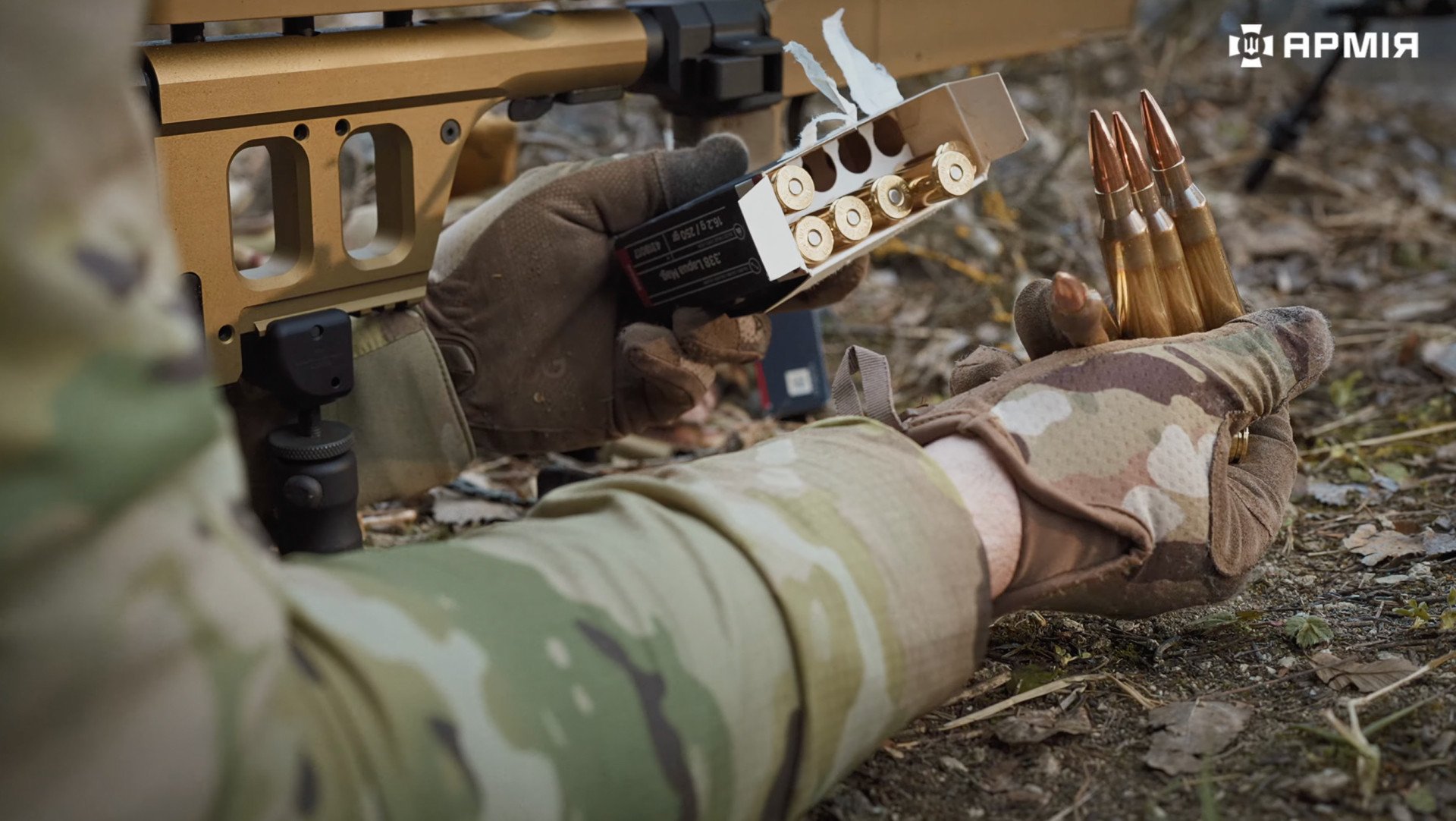
.338 Lapua Magnum ammunition and the Haenel HLR 338 sniper rifle used by Ukrainian Special Operations Forces. (Source: Army Media)
“The manufacturer put effort into it and installed a fairly high-quality optic. They supplied Steiner optics, though with a specific reticle that many snipers do not like because it feels too ‘filled in,’” he said.
The rifle additionally features a 45-degree offset collimator sight intended for rapid target transition. According to the report, components including the suppressor are factory-painted to reduce visibility during combat operations.
Army Media also reported that Ukrainian operators use the rifle for indirect ballistic shots at long range, including firing through limited openings or from behind cover.
“At distances up to one and a half kilometers, you can do things like firing through a ballistic window or from behind an obstacle in order to hit a target with a curved trajectory. Such things are possible,” the servicemember said.
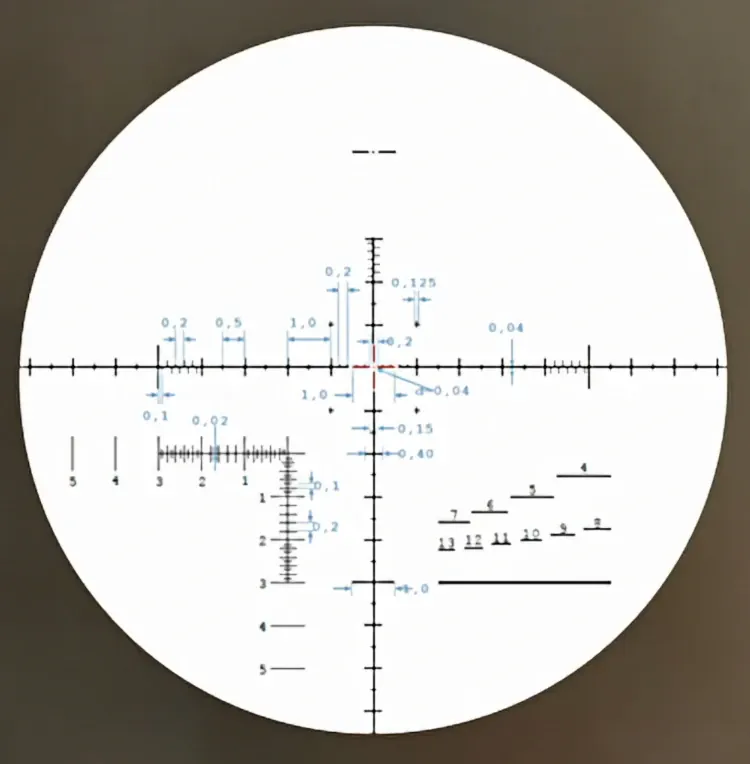
Reticle view from the Steiner optic mounted on the Haenel HLR 338 sniper rifle. (Source: Army Media)
Hunter stated that he had personally fired more than 360 rounds through the rifle system. He also mentioned reports from other operators claiming that some early barrels experienced heavy wear after around 500 shots, though he said he had not encountered the issue himself.
“Overall, it performs very well. But there are colleagues of ours who had some experience with them when they first arrived in Ukraine—there were cases where barrels started falling apart after 500 shots. Personally, I have not dealt with that, so I will not claim it as fact. In general, the bolt group works very well, and the trigger is fairly smooth and soft for a rifle of this caliber,” Hunter said.
Earlier, Ukrainian defense manufacturer Horizon Lord unveiled its new-generation .57 HL sniper rifle, a compact multi-caliber platform developed as part of an integrated “rifle + cartridge” system. According to the company, the rifle demonstrated sub-0.5 MOA accuracy during field testing and can be converted to .416 Barrett for long-range precision engagements.
-9a7b3a98ed5c506e0b77a6663f5727c5.png)
