
NORTHERN Ireland makes over 40% of the world’s mobile rock sorting and crushing equipment.
Most of it is manufactured by a cluster of firms around Dungannon, with Powerscreen probably the best known, although there are other firms across the region.
Even if you are not familiar with this industry, you may have seen its enormous products – like folded-up mechanical dinosaurs – being transported on lorries to Belfast, from where they are shipped to more than 100 countries. It is an extraordinary engineering success story.
Sorting and crushing rock is a huge part of road-building. Because Northern Ireland is at the forefront of this industry, it is also at the forefront of techniques to make it greener.


Using different materials, local materials or recycled materials can significantly reduce overall carbon emissions.
Roads themselves can be recycled, especially their asphalt. Old tyres have been mixed into asphalt for many years; now plant-based materials can be added so asphalt locks in carbon dioxide rather than emitting it. We have companies specialising in all these technologies.
Northern Ireland also has firms specialising in deep soil mixing, where ground is stabilised by injecting columns of soil mixed with rock or concrete.
 Northern Ireland makes over 40% of the world’s mobile rock sorting and crushing equipment (Zigmunds Dizgalvis/Getty Images)
This can reduce construction emissions by up to 70%. Our damp, peaty soil is ideal for the process and there is enormous scope to make more use of it.
Construction produces a large share of the total emissions a road puts out over its lifetime.
For the A5, one-third of total emissions will occur in the five years it will supposedly take to build. The remaining two-thirds will come from traffic (plus a little from lighting and maintenance) over the following 60 years it is designed to last.
If we succeed in making all vehicles electric and all electricity renewable, construction will eventually represent almost all road emissions. So getting those emissions down becomes more significant with every passing year.
All these technical issues have been considered in planning the A5 but it has not been enough. The targets and requirements in Stormont’s Climate Change Act are simply too onerous.
Liz Kimmins, the Sinn Féin infrastructure minister, is appealing the court ruling and she is probably correct that an appeal has to be tried.
The judge found compliance with the Act is possible, despite an implausibly high bar.
But victory must be considered unlikely, leaving Stormont with only two options after the verdict: abandon major road-building entirely, as Wales did in 2023; or change the targets and requirements, as Scotland did with its comparable legislation in 2024.
Speaking in last Saturday’s Irish News, First Minister Michelle O’Neill indicated she is “open” to changing the Act.
 First Minister Michelle O’Neill speaks to The Irish News at her constituncy office in Cookstown PICTURE: COLM LENAGHAN
Nevertheless, this is an increasingly difficult decision for her party.
Last week’s by-elections in Dublin and Galway show how Sinn Féin is caught between left-liberal urban voters and more conservative rural voters.
The A5 is as important to Donegal as to the west of Northern Ireland; in Dublin, the Greens denied Sinn Féin a seat when almost all their votes transferred to the Social Democrats.
The Scottish National Party fell out with its Green partners when it changed its emissions targets but it has continued claiming it will deliver net-zero by the middle of the century. Any fudge at Stormont would presumably do likewise.
The DUP and the UUP have said they will support changing the targets, so the ball is in Sinn Féin’s court.
Whatever the Executive decides to do with the law, it has a win-win political option by promoting Northern Ireland as a centre of environmental road-building and maintenance.
That could justify trying to stick with the existing targets, or justify changing them – Stormont could still produce a positive environmental message.
This should have particular appeal to Sinn Féin. Dungannon is in Mrs O’Neill’s back yard, Ms Kimmins is responsible for all road-building and maintenance, and the party’s economy minister, Caoimhe Archibald, is responsible for science, industry, trade and universities.
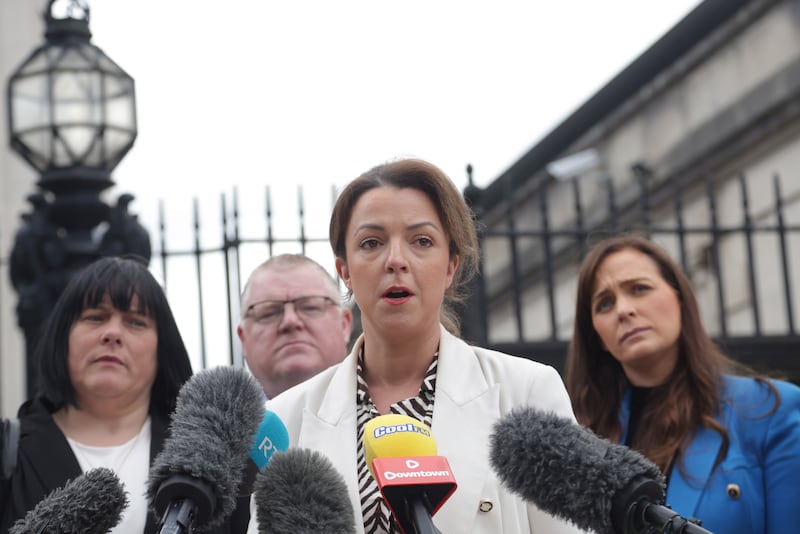 Infrastructure Minister Liz Kimmins speaks to the media following the judgment against the long-delayed A5 road project going ahead in its current form, upholding a legal challenge taken by a group of landowners
PICTURE COLM LENAGHAN
Alliance environment minister Andrew Muir has used technology competitions to help firms and universities find solutions to the crisis in Lough Neagh and other environmental problems.
That is just one example of what Sinn Féin’s ministers should be doing for the roads.
The Greens do not aggressively pursue technical solutions because they do not really want net-zero dual carriageways.
They want no dual carriageways and preferably no industrial society, although to be fair to the Greens in Ireland, north and south, they are less extreme on this than their counterparts in Britain.
Sinn Féin could try bridging the gap between its two sets of voters by presenting itself as the party of pragmatic, technocratic environmentalism, getting roads built while getting emissions down.
Thanks to the strength of industry in Northern Ireland, there is a good chance that message would have some substance behind it.
If you have an opinion on the issues raised in this article and would like to submit a
Letter to the Editor
to be considered for publication,
please click here.
Letters to the Editor are invited on any subject. They should be authenticated with a full name, address and a daytime telephone number.
Pen names are not allowed.