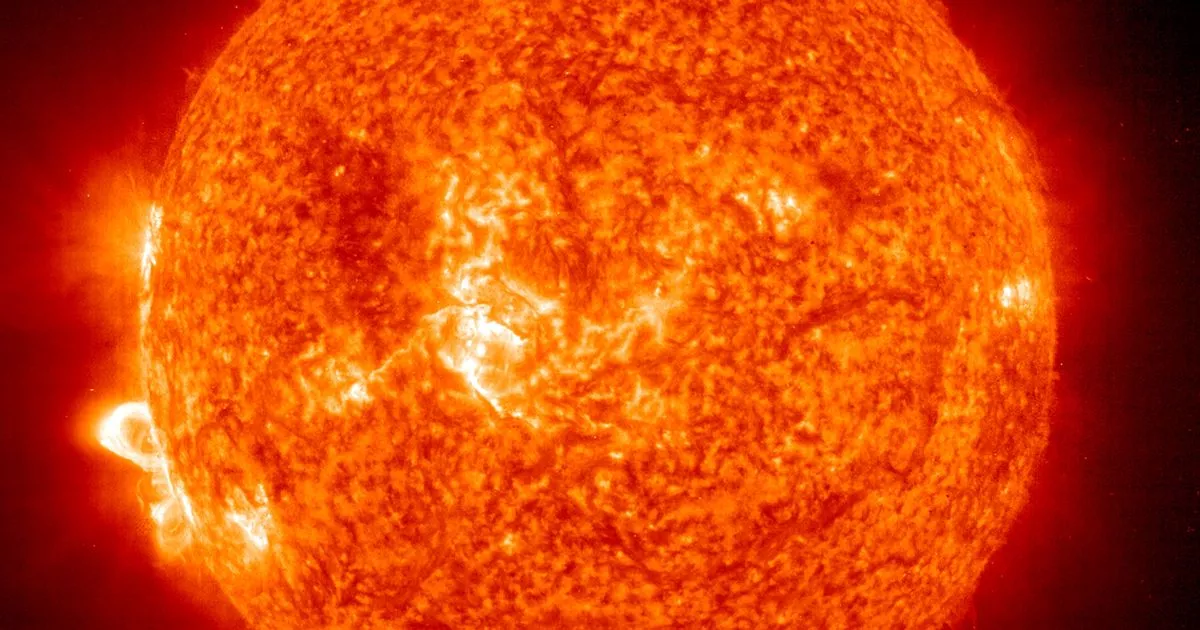
Loops tens of times the size of Earth leap up off the sun’s surface
17:15, 20 May 2025Updated 17:15, 20 May 2025
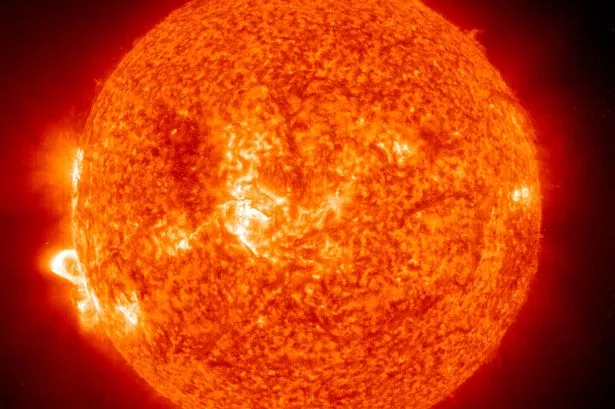 Post-flare loops erupt from Sun’s surface(Image: NASA/Getty)
The sun emitted a strong solar flare on Wednesday, May 14. Solar flares are giant explosions on the sun that send energy, light and high speed particles into space.
These flares are often associated with solar magnetic storms, known as coronal mass ejections (CMEs). The number of solar flares increases approximately every eleven years.
The biggest flares are known as “X-class flares” based on a classification system that divides solar flares according to their strength. The smallest ones are A-class
The biggest X-class flares are by far the largest explosions in the solar system. Explained by NASA, they say: “Loops tens of times the size of Earth leap up off the sun’s surface when the sun’s magnetic fields cross over each other and reconnect.
“In the biggest events, this reconnection process can produce as much energy as a billion hydrogen bombs.”
A flare captured by the Solar Dynamics Observatory last week was a strong one. NASA says: “This flare is classified as an X2.7 flare. X-class denotes the most intense flares, while the number provides more information about its strength.”
High-frequency radio signals were disrupted for around 10 minutes, according to space weather forecasters at the National Oceanic and Atmospheric Administration (NOAA) in the US.
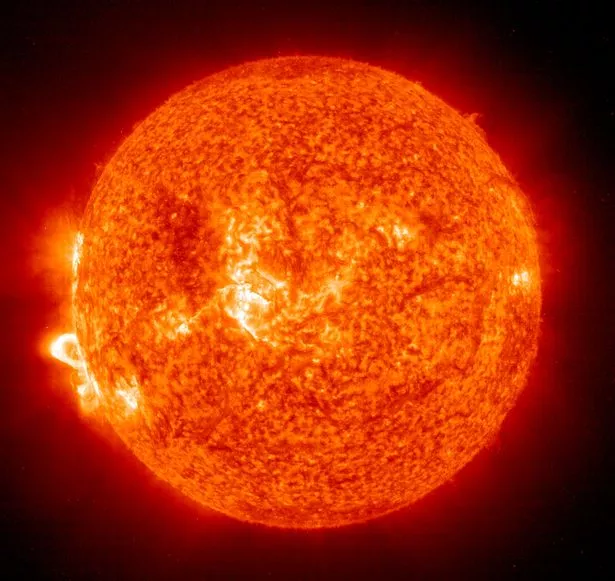 Post-flare loops erupt from Sun’s surface(Image: NASA/Getty)
The sun is currently at the peak of its 11-year activity cycle, known as its solar maximum period. This is a result of the star’s magnetic poles flipping, which causes it to transition to an active and stormy state
The most active region on the sun is currently rotating to face Earth, leading to forecasts of more significant space weather.
NASA observes the sun and our space environment constantly with a fleet of spacecraft that study everything from the sun’s activity to the solar atmosphere and the particles and magnetic fields in the space surrounding Earth.
If they’re directed at Earth, flares and associated CMEs can create long-lasting radiation storms that can harm satellites, communications systems, and even ground-based technologies and power grids, warns NASA.