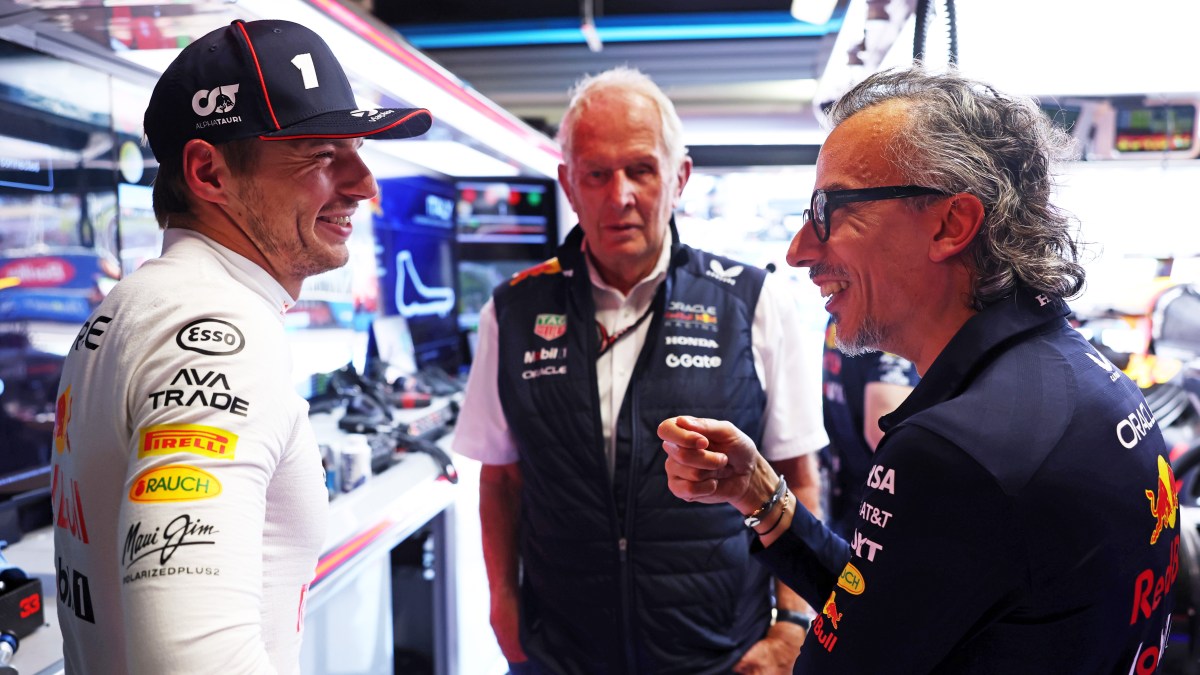
When Red Bull’s team principal and chief executive Laurent Mekies said he had made “zero contribution” to Max Verstappen’s victory in Monza, there were bemused looks on the faces of the gathered media.
So much so that he clarified he was in fact serious. “The answer is a very easy one: the level of [my] contribution is zero,” he said. “And I’m not joking either. It’s 1,500 people working on making that car faster, so the addition of these talents are what make the car faster, make the hundredths, thousandths [of a second], make set-up options available, and make new components available.
While that may well be Mekies’s honestly held opinion, it also tallies with one of the primary reasons that Red Bull chiefs sacked Christian Horner in July, feeling as though he held too much power and influence, and did not give enough credit to others. They knew that, with Mekies, they would not run into the same perceived issues.
The “new” Red Bull are intrinsically different from the old, but with a lot of very similar moving parts. A different figurehead who is almost the polar opposite of his predecessor but working with the same senior staff. A team who seemingly need to rebuild, but who have the best driver on the grid — one who deserves immediate success. A team of disruptors used to dominance, now scrabbling to regain it.
With Mekies, what you see is largely what you get: a mild-mannered 48-year-old former engineer who is well liked within the paddock and is intensely passionate about the sport.
Where Horner was once a regularly visible team boss in the downstairs of the motorhome where VIP guests, media and staff can mingle, Mekies prefers to take a back seat, either in his office or the more private upper deck of the motorhome.
It is a distinct change of philosophy. Max Verstappen has praised the engineering questions Mekies will ask, whereas Horner purposely delegated to those he had hired in those roles.

Horner was more at home in the media spotlight than his successor at Red Bull
DAN MULLAN/GETTY
Mekies does not intend to win any popularity contests, nor, intriguingly, does he appear to particularly like the spotlight at all. That is not uncommon further down the paddock, but it is a different approach compared with other leading teams.
There, at the business end, the air is thinner, the spotlight greater and the knives sharper. In the Frenchman’s early weeks in charge Zak Brown, the McLaren chief executive, popped by for a cup of coffee before race day. He joked that this was not an olive branch he would have extended to Horner (with whom he has a fierce rivalry). The dynamic between the leading teams, then, fundamentally changes with Mekies’s arrival.
Privately, Mekies insists he is happiest as a leader when helping those around him reach their full potential, seeing the small shoots of individuality and diversity of thought from staff that allow for gains in a sport determined by thousandths of a second.
Verstappen won in Monza by 19.2 seconds, the biggest margin of the season (helped by McLaren’s late pitstop and team-order mishap). The low-downforce set-up he chose was particularly effective there, and Red Bull’s level of performance surprised their competitors. Whether it can continue, or whether the advantage was merely track specific, should be apparent this weekend.
Interestingly, the approach used in Monza was very similar to the one favoured by Horner in his final race at Silverstone, where Verstappen qualified on pole before rain scuppered the team’s Sunday. It was even referred to as “a Monza approach” in the garage.
Under Mekies, Red Bull say they have adapted, having recognised their wind-tunnel and simulation data is not always accurate, and are relying more on the feeling from Verstappen when driving the car. Where once they would have typically used lower engine modes on a Friday in practice, more recently they have tried turning them up, to give the most accurate representation of their actual pace going into a weekend.
“We probably think that a lot of it is Monza-specific, but we’ll find out in Baku how much of the learnings with the new components we had [floor upgrade], and with the way we ran the car, can be transferred to other tracks,” Mekies said.
Such was the positivity during Monza that Helmut Marko, the 82-year-old Red Bull senior adviser, suggested they could challenge for victories in each of the eight remaining races. “We can prove here that Monza was not a one-time outlier,” he said.
That appears unlikely, unless an incredible turnaround awaits, given the dominance of McLaren.
In practice sessions on Friday in Baku Verstappen finished sixth and seventh, although both McLarens hit walls and did not set a representative FP2 time.
Baku is not a favourite of Verstappen — in fact it was a track where his former team-mate Sergio Pérez often excelled. Street circuits, and tracks that require the RB21 to ride over bumps, have historically been a weakness.
One driver who is not expected to challenge for victory in Baku, or seemingly anywhere else this season, is Yuki Tsunoda, Red Bull’s second driver. As has been the most likely option for several months, Isack Hadjar is expected to partner Verstappen next year. Tsunoda’s future is uncertain; reuniting with Honda as third Aston Martin driver could be an option if a seat on the grid isn’t available.
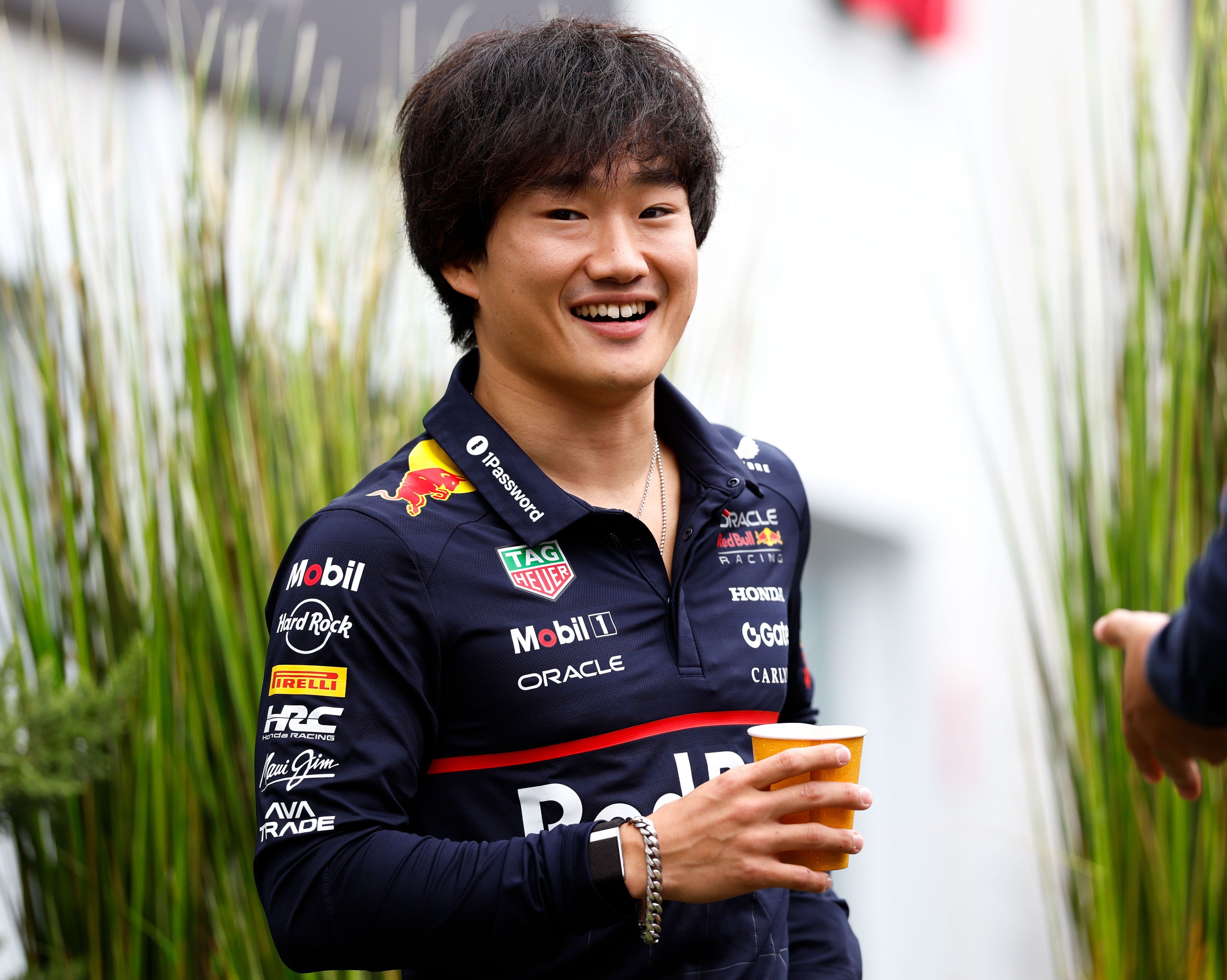
Tsunoda is unlikely to remain Red Bull’s second driver beyond this season
DPP/SHUTTERSTOCK EDITORIAL
The 2026 regulation change will provide a reset and, it is hoped, a Red Bull design that allows two drivers to flourish, rather than the difficulties the second seat has provided in recent campaigns.
Those regulations also mean a first foray for Red Bull into being a “works team” who will produce their own engines.
Before his departure, Horner had begun to temper expectations, saying it would be “embarrassing” for existing power-unit manufacturers like Mercedes or Ferrari to be beaten by the newcomers.
Mekies has struck a similar tone, describing it as “as crazy as it gets” to produce their own power unit. Sources have told The Times that there are concerns over how competitive that engine will be.
Reliability could be an issue for Red Bull and several of the new manufacturers next season, with Mercedes (who will supply themselves, McLaren, Williams and Alpine) widely thought to be the most confident about their engine.
For now, those issues are a longer-term problem. Mekies has been guarded in public, refusing to outline targets or goals, highlighting the importance of the process rather than the winning itself. Baku will provide the first test of whether his team’s new methodology is working.
He need only look at the departure of his predecessor to see that the business can be cut-throat and ruthless. If Mekies does not consistently win, he will eventually depart — or his star driver will instead.