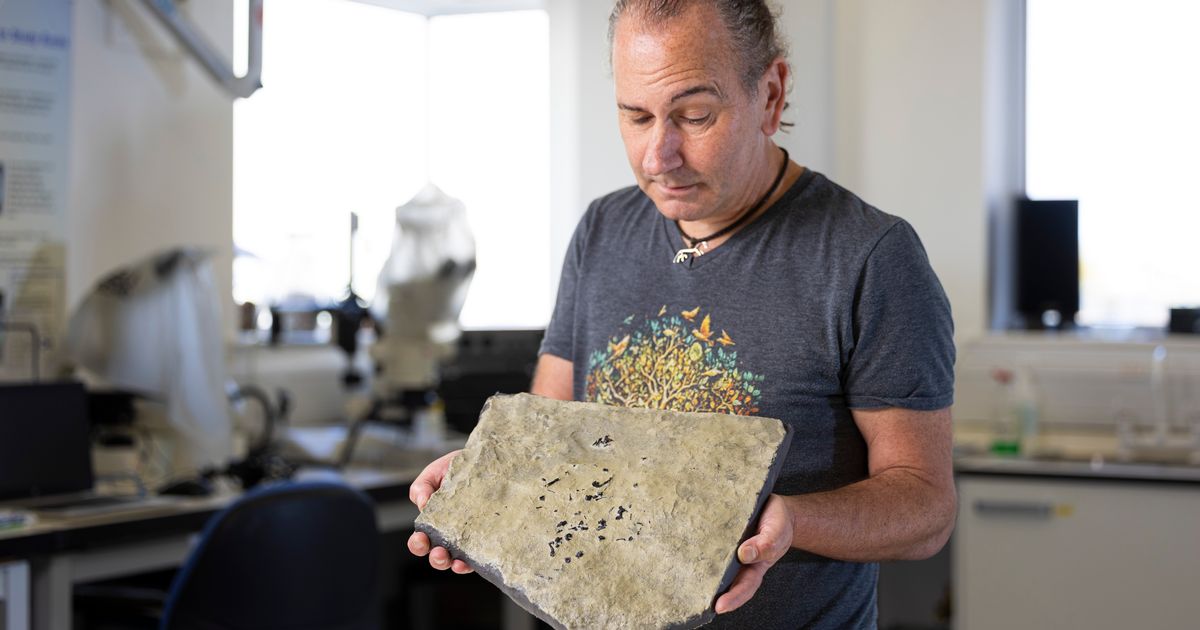
An international team of researchers, which included National Museums Scotland (NMS), uncovered a previously unknown species that lived around 167 million years ago.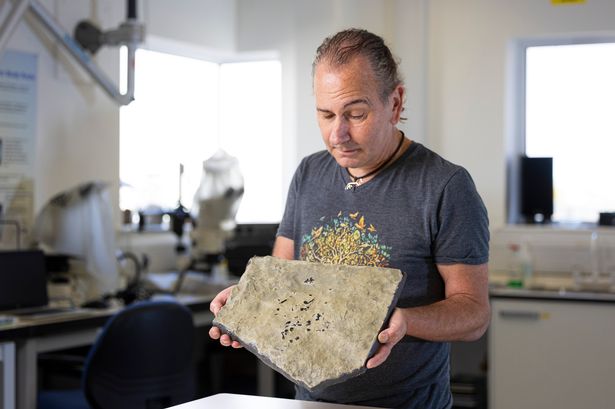 Dr Stig Walsh holding a cast of the Breugnathair elgolensis fossil(Image: Duncan McGlynn/National Museums Scotland/PA Wire )
A fossil discovered on the Isle of Skye has been revealed as a new species of Jurassic reptile which was an ancient ancestor to lizards and snakes.
An international team of researchers, which included National Museums Scotland (NMS), uncovered a previously unknown species that lived around 167 million years ago.
It was given the Gaelic name Breugnathair elgolensis, meaning “false snake of Elgol” – referencing the area of southern Skye where it was discovered.
The reptile had snake-like jaws and highly recurved teeth like a python’s, though the same limbs and proportions as a lizard.
The fossil is among the oldest and most complete Jurassic lizards known to science and is now part of NMS’s national collection.
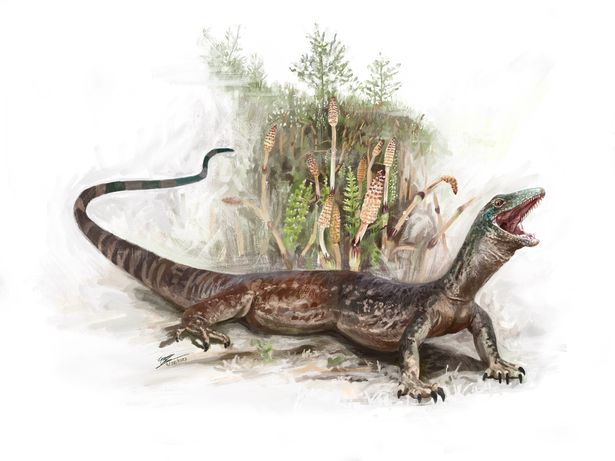 An artist’s impression of a Breugnathair elgolensis(Image: Brennan Stokkermans/National Museums Scotland/PA Wire )
Its anatomy suggests it could be one of the parviraptorids – the predecessors of all lizards and snakes.
Lead author Dr Roger Benson, Curator of Palaeontology at the American Museum of Natural History, said: “Snakes are remarkable animals that evolved long, limbless bodies from lizard-like ancestors.
“Breugnathair has the snake-like feature of the teeth and jaws, but in other ways is surprisingly primitive.
“This might be telling us that snake ancestors were very different to what we expected, or it could instead be evidence for evolution of predatory habits in a primitive, extinct group.”
The fossil was discovered near Elgol by NMS curator Dr Stig Walsh in 2016, and has since undergone detailed scans.
 Join the Daily Record WhatsApp community!
Get the latest news sent straight to your messages by joining our WhatsApp community today.
You’ll receive daily updates on breaking news as well as the top headlines across Scotland.
No one will be able to see who is signed up and no one can send messages except the Daily Record team.
All you have to do is click here if you’re on mobile, select ‘Join Community’ and you’re in!
If you’re on a desktop, simply scan the QR code above with your phone and click ‘Join Community’.
We also treat our community members to special offers, promotions, and adverts from us and our partners. If you don’t like our community, you can check out any time you like.
To leave our community click on the name at the top of your screen and choose ‘exit group’.
If you’re curious, you can read our Privacy Notice.
Palaeontologists have made a number of significant discoveries on Skye in recent years.
Dr Walsh said: “The Isle of Skye is one of the most important Middle Jurassic sites in the world.
“Breugnathair elgolensis is a remarkable addition to the fossil record, helping to rewrite our understanding of the evolution of snakes and lizards.
“We’re delighted to add it to the other amazing finds in the national collection that were discovered in Skye, truly Scotland’s Jurassic Isle.”
Professor Susan Evans of UCL, who co-led the study, said: “The Jurassic fossil deposits on the Isle of Skye are of world importance for our understanding of the early evolution of many living groups, including lizards, which were beginning their diversification at around this time.”