Manchester has proudly been at the heart of each of the industrial revolutions that have transformed the UK over the last 300 years.
From mechanising steam and water for industry and transportation, through the industrialisation of towns for mass production and a new form of modernity, to the almost godlike feat of creating the computers that shaped the world we live in today.
Why Manchester is the heart of the Fourth Industrial Revolution
That world is once again changing with the rise of Artificial Intelligence (AI), and once again raising questions about how we harness new technologies and use them to shape our future. So with the fourth Industrial Revolution having arrived, Manchester is looking once again to be at its beating heart.
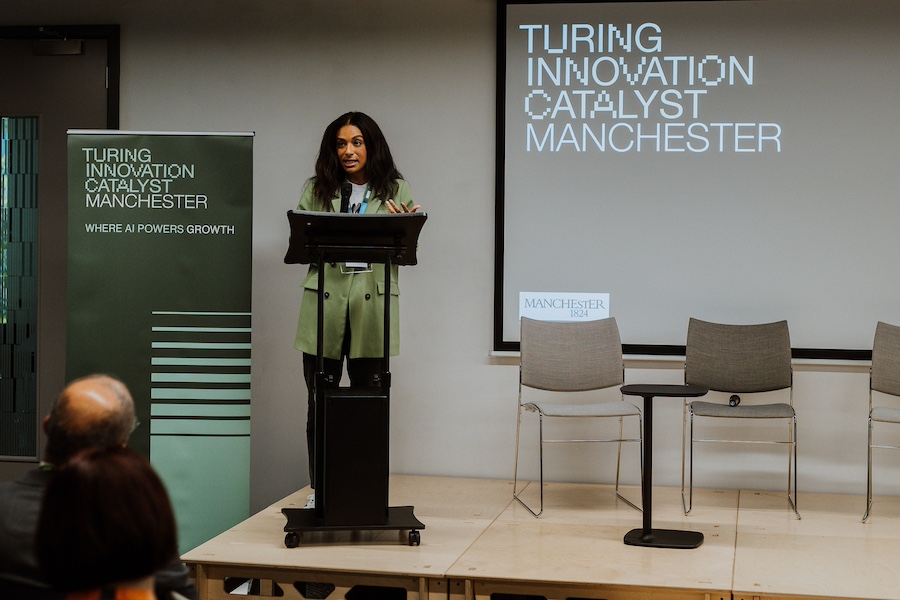
Key to this is the Turing Innovation Catalyst (TIC), courtesy of the University of Manchester’s innovation arm Unit M, partners across local and national government and the private sector.
The goal of the TIC is to support startups looking to innovate in their industries through harnessing the power of AI, and in doing so make the city region a national and global heavyweight in the world of Artificial Intelligence.
The Turing Innovation Catalyst
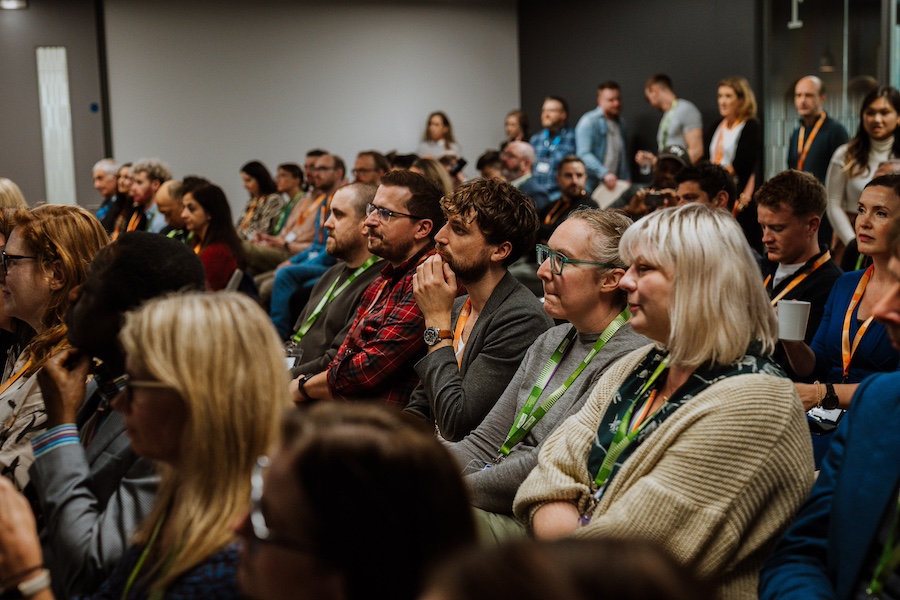 Crowd shot at the opening of the Turing Innovation Catalyst in Manchester
But in a time when work can be done from anywhere across the globe, why is Manchester in particular a good fit for an AI hub and the sort of businesses the TIC supports?
Greater Manchester has long been recognised for its £5bn digital economy, but its strength in artificial intelligence is increasingly what sets it apart, said Misha Khan, Stakeholder and Partnerships Lead at Turing Innovation Catalyst Manchester.
“While Greater Manchester has long been recognised for its £5bn digital economy, the strength of its cluster of AI companies is what really sets it apart,” she explained. Misha points to major local players as proof that the region is becoming a heavyweight in the field.
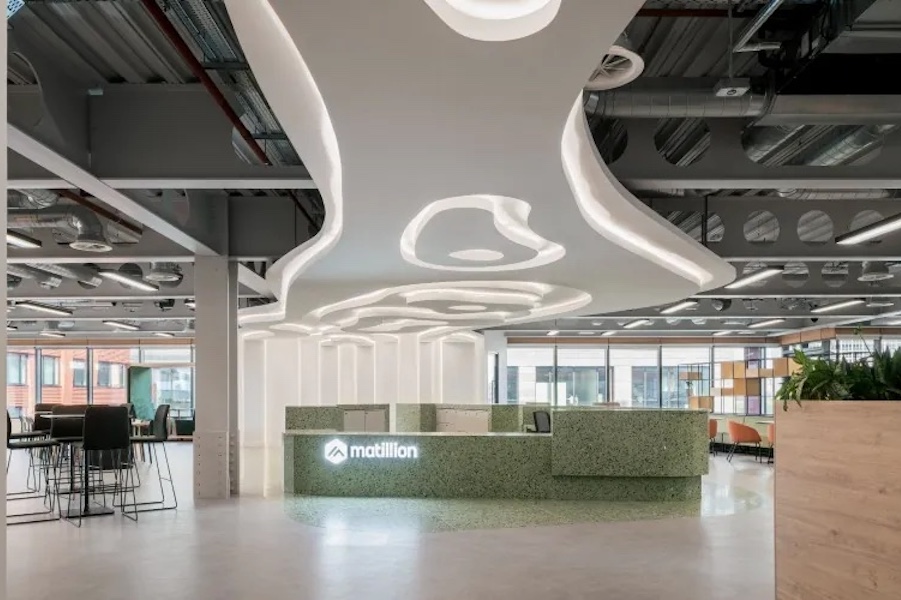 Matillion is now based in Manchester
“With world-leading businesses like Peak and Matillion based here, the region is already making a name for itself. AI companies in Greater Manchester raised $583 million in VC investment from 2021-2023, accounting for 28% of the $2.03bn raised by all tech startups and scaleups over the three-year period.”
She said what truly differentiates the region is not just the capital flowing in, but the collaborative culture behind it. “What stands out most is the collaborative ethos, which ensures that AI innovation in the region isn’t siloed but instead thrives within a connected ecosystem. We are fortunate to have the integration of academic, industry and public sector ambition, and it’s our role at TIC to position Greater Manchester as a city region that leads by example.”
Misha also highlighted the impact of local decision-making powers on innovation momentum. “A pivotal enabler in this journey has been the devolution agenda, the transfer of powers from central government to regional authorities has enabled Manchester’s leaders to tailor its economic and innovation strategies to meet local needs.”
In her view, Manchester had all the ingredients and only needed a platform to pull them together.
“We already had the foundations here: universities with R&D capabilities, a strong pipeline of talent, and the appetite from local government. All we needed was to create the infrastructure for innovation to grow. TIC is directly supporting startups and scaleups to develop talent and commercialise their research.”
Can Manchester compete with London and the Oxford Cambridge Corridor?
 Manchester is a great place to do business. Photo credit: Wesley Harding
So with the tools, the ambition and the willingness to make Manchester a leader in the harnessing of AI, has this drive come soon enough to ensure the city region can compete with the financial might of London and the academic stronghold of the Oxford-Cambridge corridor?
“Whilst London has historically been the tech capital, Greater Manchester’s continued rise shows it can stand shoulder to shoulder with some of the largest global AI hubs,” said Misha. “The ecosystem here is no longer in its infancy. It has attracted significant investment, nurtured cutting-edge companies and developed a highly skilled workforce.
A near $4.2bn industry on our doorstep
“Greater Manchester-based AI companies are now valued over five times higher than they were in 2020, at $4.2bn. Successful scaleups in the region are now reinvesting their know-how and financial returns into the next generation of innovators: not only bolstering the growth of the sector, but also ensuring the ecosystem remains globally competitive in the long term.
“Ultimately, Greater Manchester is already competing with London and the Oxford-Cambridge corridor, and our foundations across collaborative R&D, investor ecosystems and innovation put us in a strong position to be out in front. We believe that with the right investment and support, Greater Manchester’s AI ecosystem has the potential to be worth $15 billion by 2035.”
What sectors do Manchester’s AI companies work in?
 Dr Jon Chippindall from Teachmate AI
So what about the Greater Manchester-based companies looking to be a part of this bright future? What made them apply to the Turing Innovation Catalyst?
One such company is TeachMate AI, whose mission is to ‘equip every teacher with the transformative power of AI to reduce workload and enhance learning’, as CEO and Co-founder Dr Jon Chippindall explained.
“We were actually sent an email about TIC forming by one of the tutors at the University of Manchester that trains teachers, who knew that we wanted to create an AI platform to support teachers, and saw that the Turing Innovation Catalysts were starting, and said maybe we should think about joining. So we went along to their launch event and saw [TIC Director] Liz Scott speak at the launch event and the opportunities that were available, and that’s what made us sign up.”
 Markella Mikkelson from MolMart
Another company harnessing the support of the TIC is MolMart, which uses AI to create ‘diagnostic genomics to allow people the knowledge, information and support to help them make informed decisions about their and their families’ health’. TIC’s ‘Accelerator’ and ‘Engine Room’ programmes helped MolMart avoid early pitfalls on its way to winning Best Health Tech Startup at the Prolific North Tech Awards 2024, as CEO Dr Markella Mikkelson explained.
“I was part of the original TIC AI Accelerator, which was instrumental in helping us get the fundamentals of the business right,” she said. “The TIC Engine Room represents the next phase of our journey: growth and scale. Scaling brings new challenges, and the Engine Room offers access to a wealth of expertise from mentors who have ‘been there and done it’. I wanted to absorb their knowledge and insight so I can make smarter decisions and avoid costly missteps as we grow.”
So why do these two very different innovators see Greater Manchester as such a fitting place for AI innovation and their work in particular?
“Obviously, Manchester has got a fantastic history and heritage with tech development, with Alan Turing creating the very first computer based at Manchester University, and so I think it’s just natural that innovation continues to thrive in Manchester,” said Dr Jon. “I think there’s a particular kind of collaborative culture here, and a real vibe and energy that supports innovation and growth; everyone wants everyone to get on and do well, and the events that we’ve been part of as part of TIC have really reflected that culture.
“We’re teachers working in the region and tackling the problem of excess teacher workload, which many teachers in the region face. So it just resonates. You can apply this to wherever in the country, but all of the teachers in the North West, of which there are a lot, started using TeachMate loved it, and it’s just grown rapidly since then.”
“Manchester’s deep rooted culture of innovation”
This deep-rooted culture of innovation and growth is something Dr Markella agrees makes the city region an ideal place for her work, as she explained.
“Although not a Mancunian myself, I fell in love with the city when I first moved here – it has a vibe and a raw energy that is unique to it,” she said. “Ideas become reality here because the people have the grit and the determination to make things happen. I know people boast about things like “the talent, the Universities etc”, but lots of cities have those and yet they lack the creativity of Manchester. This was the birthplace of the Industrial Revolution: innovation in science and technology is deeply rooted here.”
Having now graduated from start-up to scale-up and looking ahead to the future, what are the hopes for the next five years for these innovative companies?
What’s next for Manchester’s AI revolution?
“Within five years, we aim to be the leading provider of preconception genetic testing in the UK, with established partnerships across the US, EU, and Southeast Asia,” said Dr Markella. “The support and expertise gained through TIC will be a key part of achieving that vision.”
“We are rapidly expanding,” said Dr Jon. “When we joined TIC, there was just me and one other person. We’re now a team of 11, so we’re growing rapidly. We’re in nearly two and a half thousand schools, and we’ve got schools joining the platform from across the globe. Some of the largest international school chains use TeachMate. As a business, we are again scaling rapidly to a fairly large organisation, which is creating jobs for people in the region and supporting teachers across the country and globally.”
With AI increasingly at the heart of how the world works, much like steam was way back when, it seems once again Manchester is making itself instrumental in shaping the future. The revolution has very much arrived.
You can find out more about the Turing Innovation Catalyst by clicking here