Forced labour of children, targeted attacks on workers and seized unions – Russia’s abuses are well-documented and known by the UN labour agency. The ILO must now decide whether to live up to its mission or keep looking away from Ukraine, write Vasyl Andreyev and Luca Cirigliano, union members of the ILO’s Governing Body.
As the war in Ukraine enters its fourth freezing winter, Russian occupation forces continue to impose their rule of terror across illegally seized eastern and southern regions. There, Ukrainian workers and unions face repression, confiscation and coercion.
The International Labour Organization’s (ILO) Governing Body, which convenes from 17 to 27 November, is once again planning to discuss Russia’s aggression. Yet, despite mounting evidence of systematic labour rights violations, the institutional response is beyond inadequate.
The ILO cannot remain silent while its founding principles are trampled. Russia’s violations in Ukraine are a threat to workers’ rights everywhere. With the same resolve they once showed to past dictatorships, democratic powers and the global trade union movement must use the UN labour agency’s oversight mechanisms to hold Putin’s regime to account.
Labour repression under occupation
Reports from the UN human rights office, the ILO, the International Trade Union Confederation and Ukrainian unions all describe a pattern of forced labour, suppression of free association and political indoctrination.
Workers are compelled to accept Russian labour law, re-register under occupation authorities or obtain Russian passports – or risk detention or dismissal. Teachers are banned from teaching Ukrainian history and language, and forced to use pro-Russian curricula. Union property and equipment have been confiscated and handed to Kremlin-backed structures.
These are not incidental wartime excesses but deliberate violations of core ILO conventions – 29 on forced labour, 87 on freedom of association and 98 on the right to organise. Where unions are silenced, democratic life is extinguished.
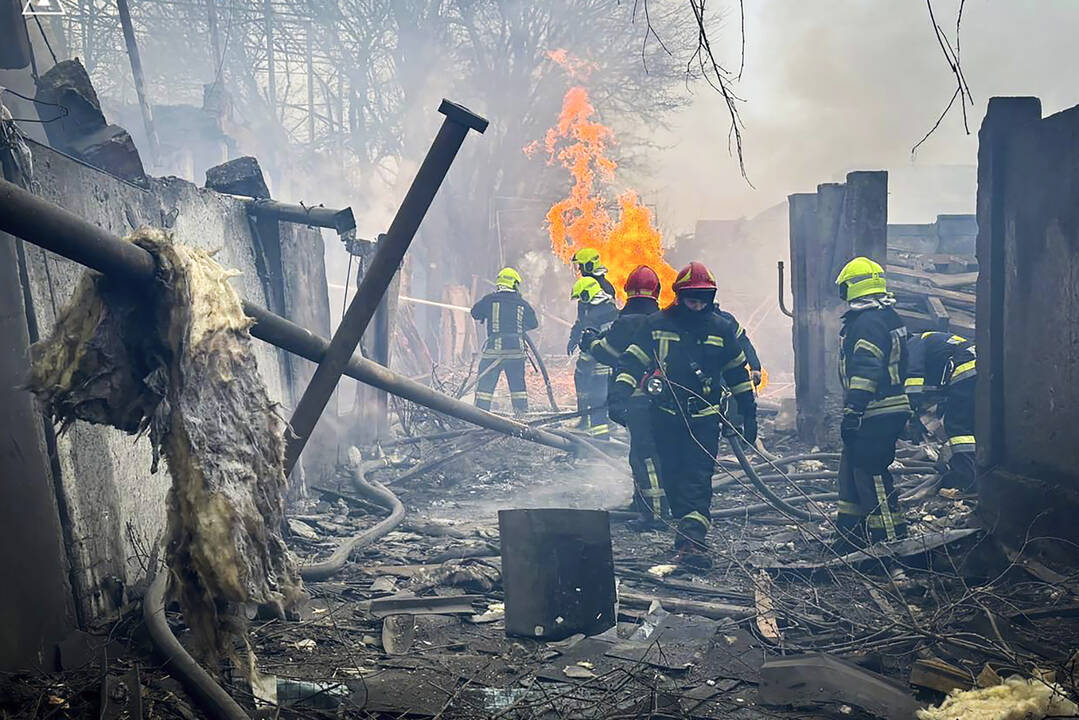
Russia’s repression extends far beyond the workplace. Research by Yale University has identified facilities, including a military base, where Ukrainian children abducted from occupied areas have been allegedly held and forced to assemble drones used to bomb their own families. Rescue workers have been deliberately targeted with so-called “double-tap” missile strikes. In 2023, in Pokrovsk, two Iskander missiles hit residential buildings 40 minutes apart, killing civilians, rescue workers and soldiers.
Some workers have been personally targeted for their role. Journalist Viktoriia Roshchyna went missing in 2023, and her dead body was returned by Moscow a little over a year later with clear signs of torture, while Ihor Murashov, the Zaporizhzhia nuclear power plant’s director, and his employees were interrogated and beaten for months as they were held hostage at the facility. These cases show that abuses are not only structural but also deeply personal.
These crimes and their scale reveal an intent to destroy Ukrainian society – all with the acquiescence of a complacent UN system. The Federation of Independent Trade Unions of Russia (FNPR) – a Kremlin proxy that holds a seat on the ILO’s Governing Board – has itself actively participated in seizing Ukrainian union premises and installing itself as their “replacement”. Its continued presence on the board is an affront to the institution’s credibility.
Responsibility lies not only with the Kremlin and its bureaucratic enablers but also with states that have abstained or voted against resolutions on Ukraine’s protection – including Iran, Venezuela, Belarus and the US under Donald Trump, as well as BRICS members that pride themselves in being democracies, as they most recently did at the International Labour Conference in 2025. Their inaction enables Putin’s attack on workers’ rights and makes them complicit.
Read more: US abstains from ILO vote on Ukraine war, breaking ranks with allies
Levers of pressure
The ILO was created precisely to confront this kind of abuse. Its constitution offers concrete steps towards accountability when a member violates its principles.
State and trade union members can both submit complaints to the Committee of Experts on the Application of Conventions and Recommendations and the Committee on Freedom of Association. They can also request a commission of inquiry, the ILO’s highest-level investigative procedure, reserved for the most serious and persistent breaches. If a country refuses to comply with its findings, the ILO may call on fellow member states to take action.
These mechanisms are not theoretical – they have set historic precedents. South Africa was excluded in 1963 from certain trade committees over its apartheid and faced a unanimous condemnation at the International Labour Conference the following year. A 1998 forced labour complaint against Myanmar helped trigger international sanctions, while another case against Belarus in 2004 reaffirmed that repressing unions can lead to institutional censure.
The situation in occupied Ukraine clearly meets – and exceeds – this threshold.
The time for reports has passed
Since 2022, the ILO governing body has heard regular reports on how Russia’s war is affecting Ukrainian workers. While valuable, these updates are insufficient. The ILO has confined itself to little more than statements and observations, citing political complexity and limited jurisdiction over occupied territories. Yet the organisation’s constitution makes no exception for political inconvenience.
Its supervisory system can – and must – address violations from member states in unlawfully occupied zones.
At the very least, the ILO should install a permanent monitoring mechanism on the situation of workers in Russian-occupied Ukraine – just as it did in 1980 for Arab workers in Palestine and other occupied Arab territories.
States committed to the rule of law, democracy, peace and human rights for all have both a moral and legal duty to act. The global trade union movement, including the International Trade Union Federation and the European Trade Union Federation, likewise must also respond to calls by Ukrainian unions.
The destruction of independent unions in occupied Ukraine is not only a labour issue. It’s a threat to freedom of association everywhere and a strategy to annihilate democratic society itself. Every act of forced labour, every confiscated union hall, every imprisoned teacher chips away at the ILO’s founding vision: that peace must be built on social justice.
The time for watered-down reports has passed. The time for action is now.
Vasyl Andreyev is a lawyer, president of the Building Workers’ Union of Ukraine and vice-president of the Federation of Trade Unions of Ukraine. Luca Cirigliano is a lawyer, former judge, former central secretary and former head of international affairs at the Swiss Trade Union Confederation. Both are members of the ILO’s Governing Body. The views expressed here are strictly their own.
Geneva Solutions publishes opinions and columns proposed by or requested from external contributors and experts. These texts reflect the point of view of their authors and do not represent the position of the media.