When the second suicide bomber detonated his explosive vest outside the Stade de France, Paul-Henri Baure was standing less than 10 metres away.
It was Friday, 13 November 2015 and Baure, then aged 64 and a security officer from Marseille, was working as a steward at a friendly match between France and Germany that would become notorious for reasons nobody could have anticipated. The bomber, he was later told, had backed away from the entrance at Gate H after refusing to be patted down by another steward. Baure had not noticed him.
“All of a sudden, there was an explosion,” he tells The Athletic. “I found myself on the ground with a pain in my left ankle, ringing in my ears and a wound like a paper cut near my eye. In the minutes that followed, I felt a lot of pain.
“I felt the force of the blast – everything happened so quickly. I thought there’d been a gas leak beneath the pavement but, at the hospital afterwards, the police told me: ‘No, no, it wasn’t a gas explosion.’ You never imagine someone is going to want to blow themselves up.”
Fortunately for Baure, there was a Red Cross station right next to his security post meaning he received immediate medical attention. After being taken to the stadium infirmary, he was transported to a nearby hospital for treatment.
The damage sustained to his left leg would prevent him from returning to work for two and a half years. As a former soldier in the French army’s medical corps, he is quick to play down the extent of his injuries, but he knows too that things could have turned out very differently.
“Everything was OK,” he says. “But I could very easily not be here.”
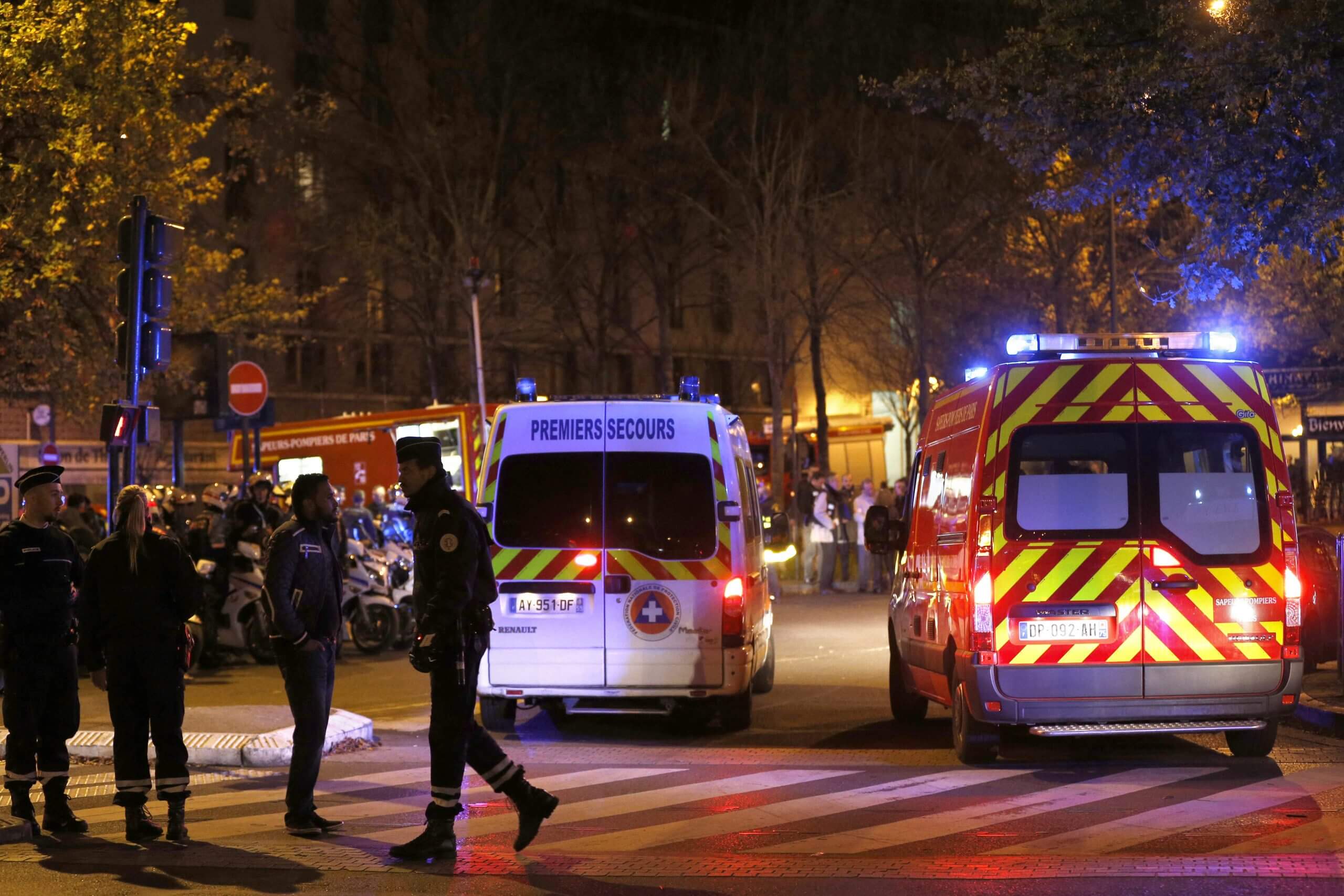
Rescuers and police gather outside the Stade de France (Francois Guillot/AFP via Getty Images)
At the exact same moment, a few yards further away, 39-year-old grassroots football coordinator Denis Carrel and a friend were hurrying past Gate H. They had travelled to the game from the town of Chateauroux in central France on a work outing, but their bus had been caught up in traffic, causing them to miss kick-off.
Knowing the layout of the stadium from previous visits, Carrel let the 50 or so other people in the group go into the ground while he made a note of where the bus ended up parking. He and his friend were trying to find the right entrance gate when the second bomber struck.
“Suddenly, there was a huge boom,” Carrel says. “The whoosh ruffled my trousers and my body shook. I didn’t look, but I remember a woman saying: ‘There’s a man there!’ People were screaming and shouting. I said to my colleague: ‘This is serious.’ Then I started running.
“I positioned myself behind a line of police officers and the first thing that came to mind was: ‘What have I done with my son? I’ve let go of my son’s hand.’ But then I remembered I’d bought a shirt for him and it was in my bag. I thought: ‘No, he’s not with me, because otherwise he’d be wearing this shirt.’ I don’t know what had happened in my head.”
After walking along the northern side of the stadium to Gate N, where they had previously been told to enter, Carrel and his friend were informed by a steward that the stadium had been locked down so they would not be able to pass through the security gates.
“I told him: ‘Listen, something serious has happened. We just want to come in so we can be safe,’” Carrel says. “He said: ‘For the time being, I’ve been told not to open the gates.’ Me and my colleague put our backs to the security barrier and we studied everyone who walked past us. We just thought: ‘Let’s hope there’s not another bomber.’ We’d realised that it was a bomb, given the boom it had made.”
After several anxious minutes, the pair were told that the stadium would not be re-opening before the end of the game so they began to walk back towards their bus.
“There were police officers everywhere with guns raised,” Carrel says. “They told us to go past with our hands in the air. We walked like that for about 500 metres. We still didn’t really know what had happened.
“We only found out when we got to the bus, because there were two police officers there holding mirrors underneath it (to check for explosive devices). We asked the police officers and one of them said: ‘Something serious is happening in Paris.’”
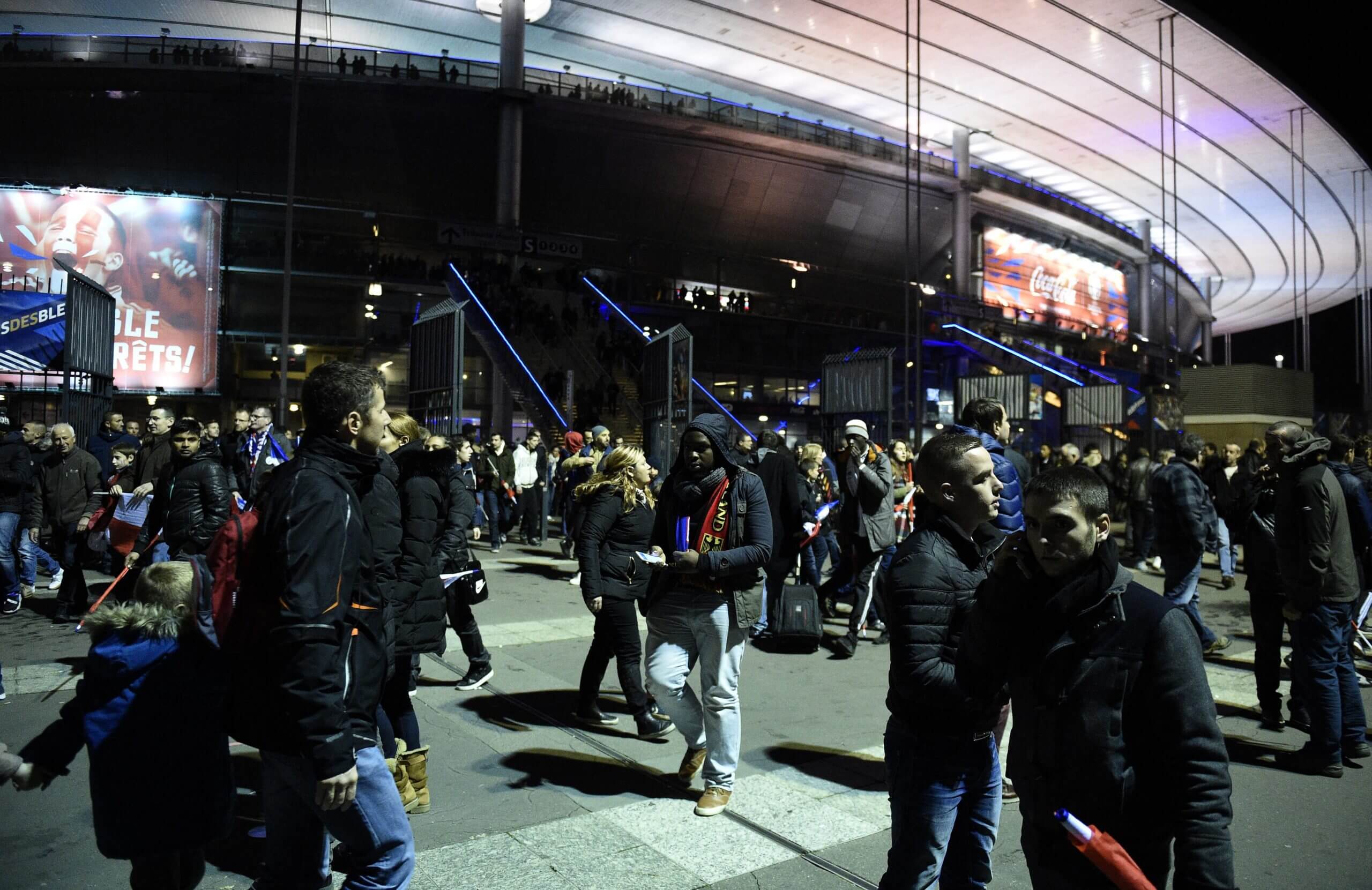
Spectators outside the Stade de France leave the scene after the stadium had been locked by authorities (Franck Fife/AFP via Getty Images)
The suicide bombings at the Stade de France marked the beginning of a murderous four-hour assault on Paris by a 10-man Islamist terror cell that would leave 130 people dead and over 400 injured. It was the deadliest attack on the French capital since World War II.
Three suicide bombers (known in French as kamikazes) targeted France’s national stadium in Saint-Denis, five miles north of central Paris, during the national side’s game against Germany. The first bomber detonated his device near Gate D on the stadium’s eastern flank after being refused entry to the ground, killing a 63-year-old Portuguese chauffeur called Manuel Colaco Dias.
Other than the bombers themselves, there were no other fatalities after the second and third blasts, although the latter, which occurred outside a McDonald’s restaurant a little distance away from the ground, left 50 people injured — seven of them seriously.
In addition to the physical injuries, many of those caught up in what happened were left with psychological trauma to process.
As France marks the 10th anniversary of the attacks, it remains a night that nobody who was there will ever forget.
The sound of the first suicide bombing — a deep, heavy boom — thundered across the stadium 16 minutes into the game.
Assuming that it was simply a smoke bomb, which are often noisily detonated by supporters during league matches in France, fans reacted with ironic cheers.
“I remember, I was on the bench and I was next to (No 2 goalkeeper) Steve Mandanda,” former France midfielder Morgan Schneiderlin tells The Athletic. “We heard the first explosion and Steve turned around and said something like: ‘Oh la la, they’re not messing around!’ We took it as a joke.
“We’d heard firecrackers at games before — not so much at the Stade de France, it’s true — but we obviously had no idea what was going on.”
The second explosion, three minutes later — just as loud, but with an even more resonant echo — prompted a similar reaction inside the ground. But on TF1’s live television broadcast, Patrice Evra could be seen looking towards the source of the noise with a concerned expression on his face as he played the ball back to a team-mate on France’s left flank.
Some of the 79,000 spectators, meanwhile, were beginning to feel uneasy.
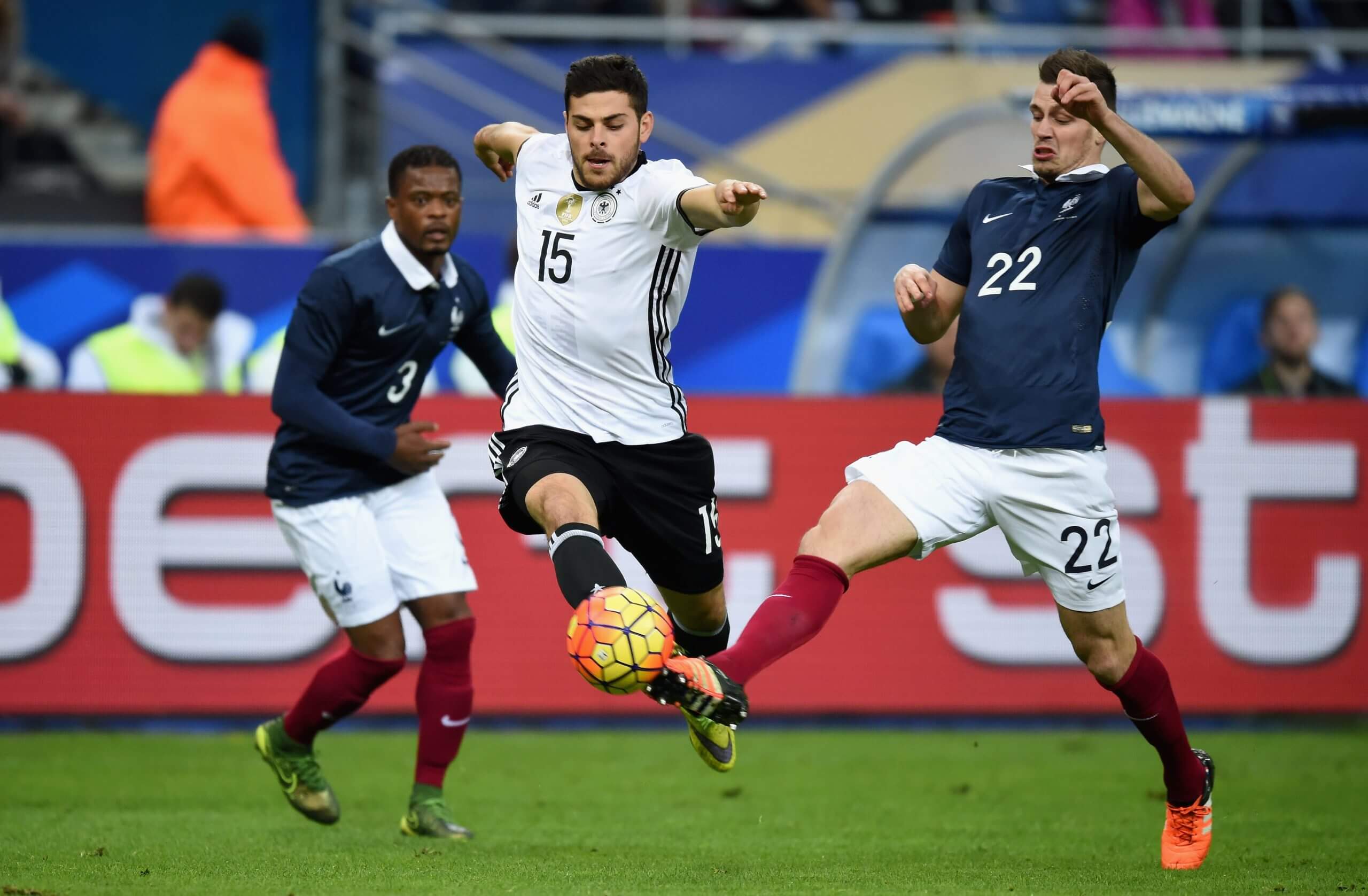
Patrice Evra, left, Morgan Schneiderlin, right, playing for France against Germany the night of the attack (Photo by Matthias Hangst/Bongarts/Getty Images)
“When the first bomb exploded outside, it was pretty loud,” recalls Till Bajohr, a German fan who attended the game while studying for a master’s degree in Paris. “People were applauding and laughing, but it didn’t feel right because it didn’t sound like one of those firecrackers people let off in stadiums.
“When the second one happened, it already felt that this might be something else.”
The game continued until half-time, Olivier Giroud giving France a 1-0 lead in stoppage time. By this point, 39 people had been fatally wounded in the attacks on cafes and restaurants in Paris’ 10th and 11th arrondissements, while the bloody siege of the Bataclan concert hall, which would claim the lives of 90 people, had begun.
French President Francois Hollande was discreetly ushered out of the ground by his security detail. A helicopter appeared above the stadium and the streets outside became thronged with emergency vehicles.
With phone networks jammed, as they inevitably are whenever thousands of people attend a live sporting event or concert, news of what had happened outside and what was unfolding in Paris slowly filtered into the stadium. But up in the press box, where journalists covering the game had access both to wi-fi and live TV feeds, the carnage in the French capital was playing out with harrowing clarity.
“By half-time, I realised that something was going on,” says Scottish journalist Andy Scott, who was reporting on the game for Agence France-Presse (AFP). “We saw updates coming in on Twitter of shootings taking place around Paris. We went into the press room at half-time and saw the updates on the rolling news channels.
“It was very clear that there were attacks going on in the city and probably in a coordinated fashion. But it took a while for people in the stands to realise.”
Fearful of allowing spectators to leave before the area around the stadium had been secured and anxious not to create panic, Hollande authorised the game to be played to its conclusion, but a decision was taken not to inform the two sets of players about what was happening. Former French Football Federation (FFF) press officer Philippe Tournon says that he did not find out until shortly before the end of the game.
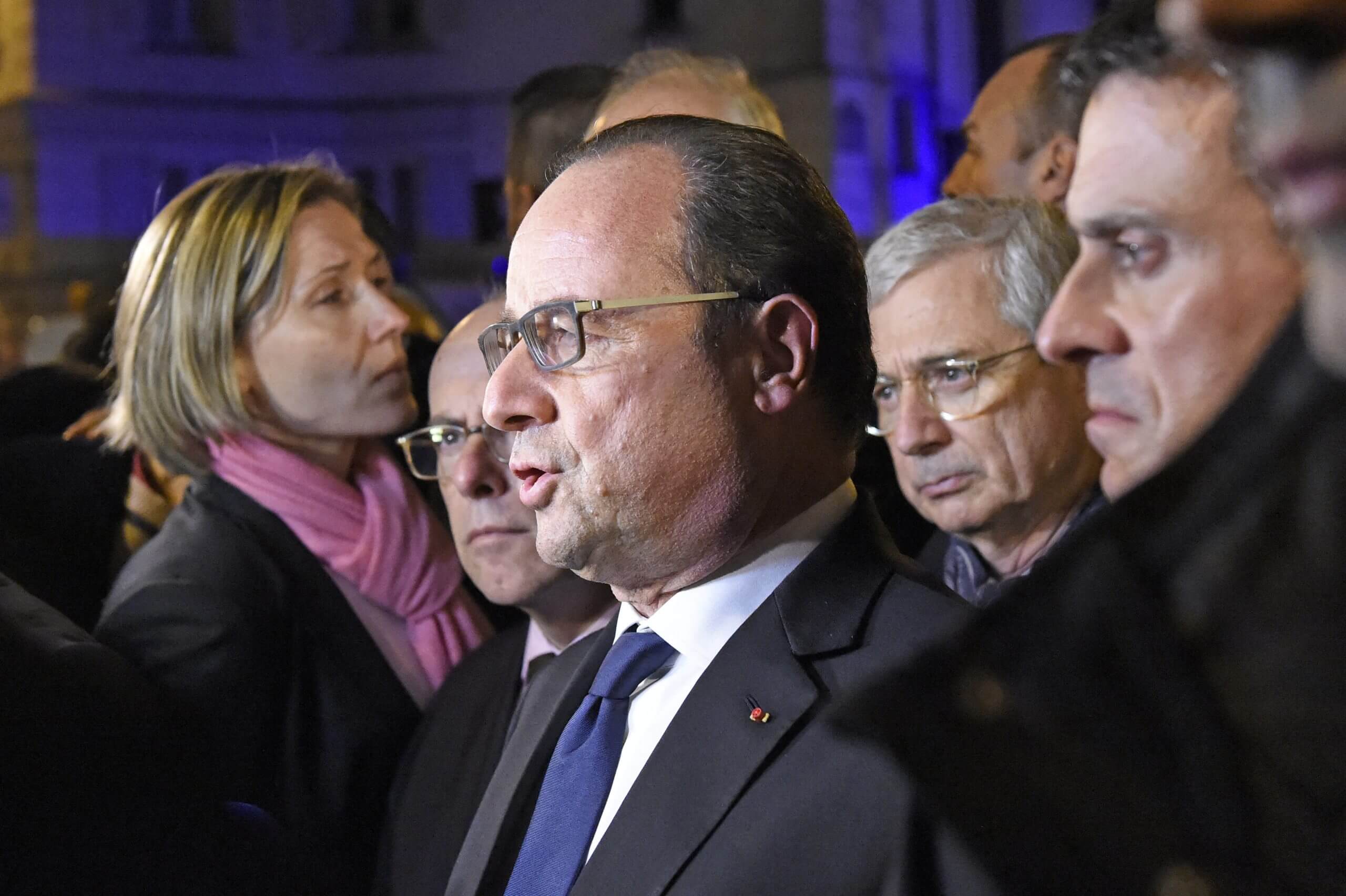
French President Francois Hollande addresses reporters near the Bataclan concert hall in the early hours of November 14 (Miguel Medina/AFP via Getty Images)
“The atmosphere on the bench was completely normal (in the second half),” he says. “We weren’t talking about a terrorist attack or anything like that.
“Three minutes from the end of the match, I went to see TF1’s touchline reporter to ask him which players they wanted for the post-match interview. He had a very grave expression and he said: ‘No, no, we’re not doing any interviews. We’re going off air straight away. Something very serious has happened and there are people dead in Paris.’”
Many of the players did not learn of the night’s horrors until they passed by a TV stationed in the tunnel at the end of a 2-0 France win that had long become an irrelevance.
“What was crazy was that we didn’t know anything during the match,” says Schneiderlin, who came on as an 81st-minute substitute. “It was only at the end of the match, when we saw on the TV screens: ‘Attack ongoing.’ I remember pointing at the TV with another player and saying: ‘What is going on?’
“Then we go into the changing room and we get a real smack in the head. Everyone’s face is downcast and the head of security tells us that, at the request of the government, we’re going to have to stay put.”
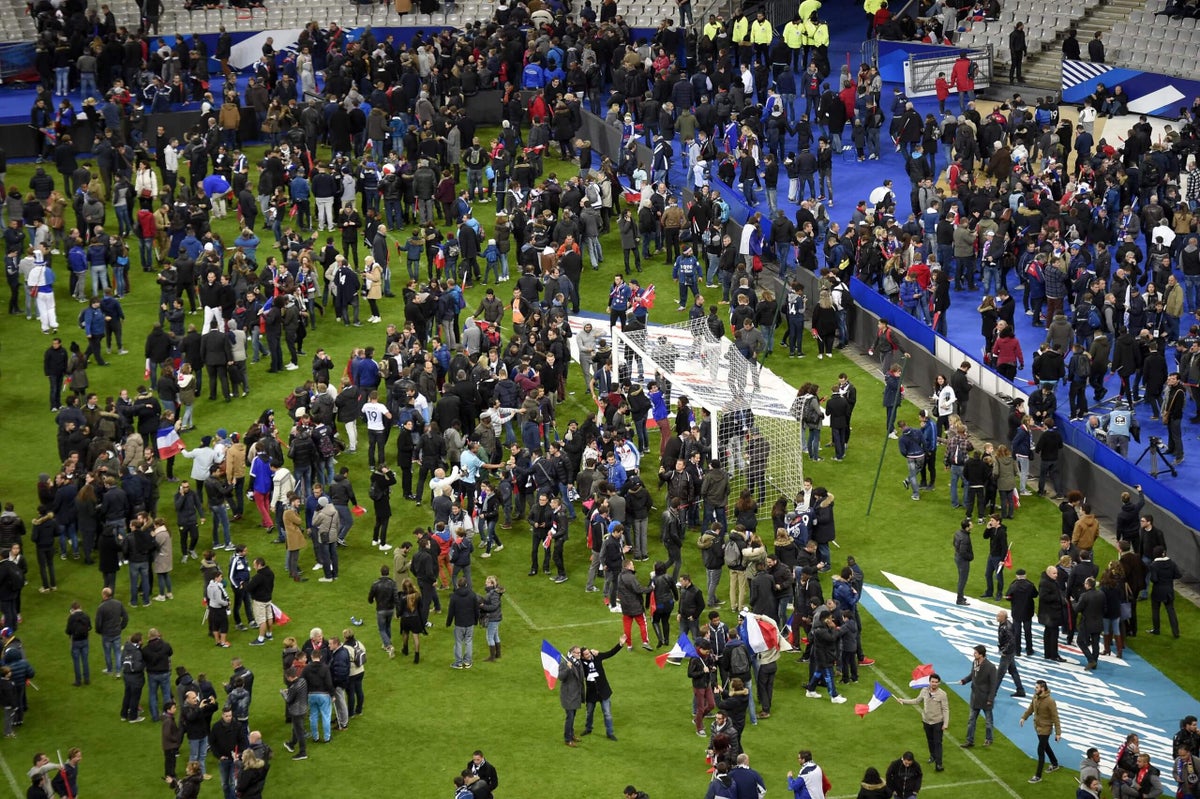
Amid the confusion that took hold at the end of the match, some of the players’ families found themselves running down onto the pitch in panic, along with thousands of other supporters, after a false rumour spread that terrorists had entered the stadium.
“People were shouting: ‘They’re in the stadium, they’re in the stadium!’” remembers Camille Schneiderlin, Morgan’s wife. “People started panicking and running everywhere. And when you see people running, you start running as well.
“Your heart starts beating at 100 miles an hour. And your first reflex is to find somewhere to hide. Some of the unused seats were covered by tarpaulins and we decided that we’d hide under there if they came in. We really thought they were there.
“We all found ourselves running onto the pitch to take refuge and we were all looking at each other, not knowing what to do. But then a security agent for the France team came and found us and led us back into a lounge. Then we started to feel a bit safer.”
In the sombre quiet of the changing room, the players’ focus quickly switched to France forward Antoine Griezmann, who had a gut feeling that his sister, Maud, was attending the concert by American rock group Eagles of Death Metal that was taking place at the Bataclan.
After several agonising hours of unanswered phone calls to her and anguished conversations with his parents, who had attended the game, Griezmann learned that although Maud had indeed been at the Bataclan when the terrorists burst through the doors, she had escaped unhurt. “Thanks to God, my sister was able to get out of the Bataclan,” he wrote in a 3.30am Twitter post. “All my prayers go to the victims and their families.”
Hours later, France midfielder Lassana Diarra discovered that his cousin, Asta Diakite, had been killed in her car after gunmen opened fire on Rue Bichat near the Canal Saint-Martin in eastern Paris.
In a statement, Diarra wrote that he had lost “a big sister” and added: “In this climate of terror, it’s important for all of us who are representatives of our country and its diversity to speak out and remain united against a horror that has neither colour nor religion.”
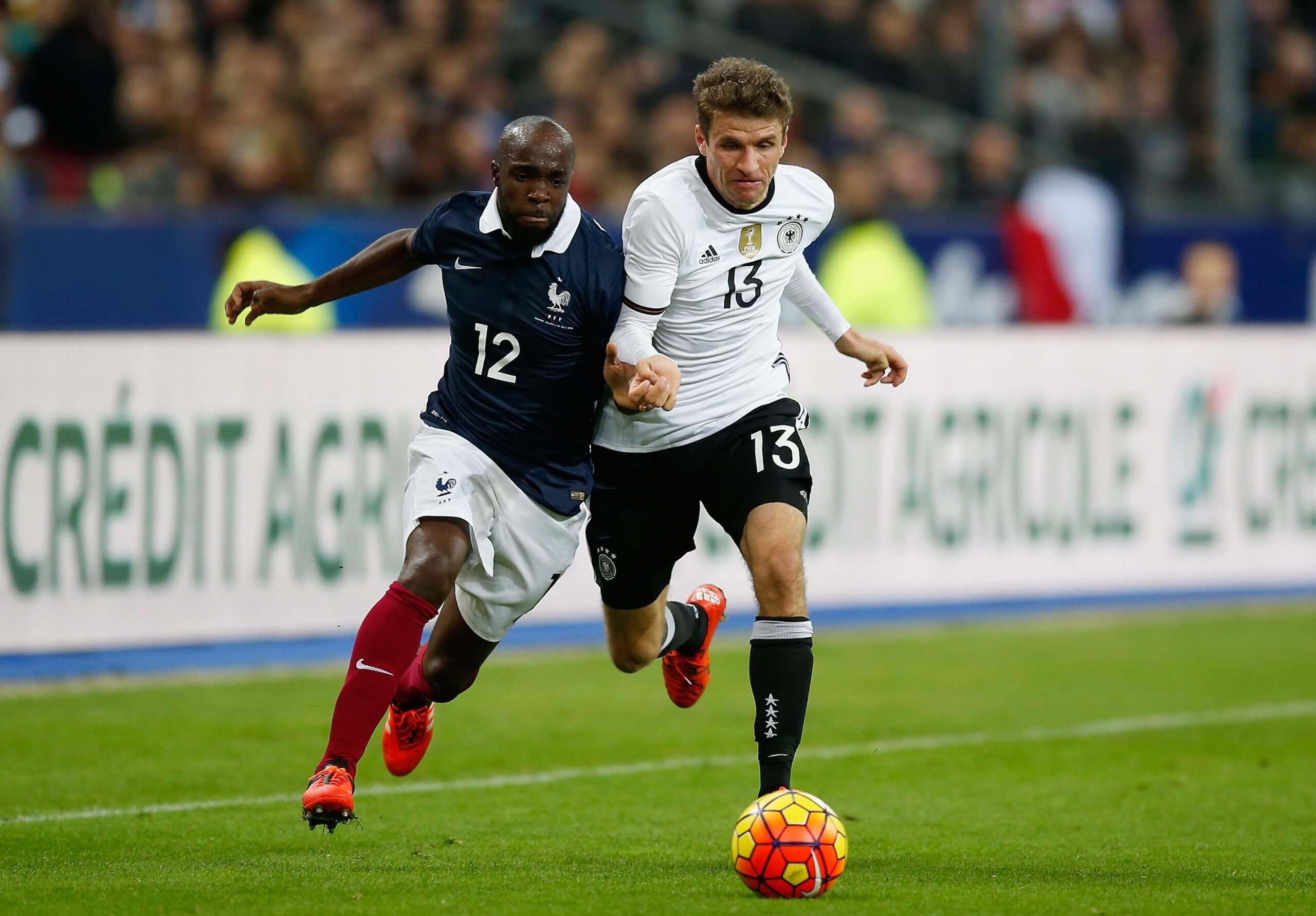
The cousin of France midfielder Lassana Diarra, left, was killed in the attacks (Photo by Boris Streubel/Getty Images)
The German team’s hotel in western Paris had been the subject of a bomb threat earlier that morning and they were advised not to return to it.
After France coach Didier Deschamps’ offer for Germany’s players and officials to spend the night at Clairefontaine — French football’s national headquarters — was politely declined on account of there being insufficient space to accommodate their 150-strong delegation, he decided that he and his players would remain at the stadium until their visitors had found a plane to take them home.
German Football Association president Reinhard Rauball called it “an outstanding gesture of camaraderie”.
Mattresses were brought out for the players to sleep on and they sat around talking and eating sandwiches together until the Germans were able to leave to catch a flight back to Frankfurt in the early hours of Saturday morning.
Once the panic and confusion that had descended at the final whistle had dissipated, fans were evacuated from the stadium calmly. One video posted on social media showed supporters defiantly singing La Marseillaise, the French national anthem, on their way out. Those who returned to central Paris on public transport found the city’s transport network eerily quiet.
“I remember everything being very calm when we were being led out of the stadium,” says German fan Bajohr. “There was no panic or anything. It was quite a scene when we came out because there were helicopters everywhere and policemen in tactical gear. We rode the train back into the city and everything was just deserted.”
At around midnight, AFP reporter Scott hitched a lift back into the city centre with two colleagues.
“It was the eeriest experience of my life,” he says. “You think of that scene in the film 28 Days Later where the guy is walking through the empty streets of London — this is what that was like. There was nobody around.
“We crossed the River Seine and you come to the Assemblee Nationale, the lower house of parliament in France. And it was surrounded by the army. Soldiers standing there, ready to fire, ready for a showdown. I’ve never seen anything like it. It actually makes me quite emotional, thinking about it now. It was terrifying. It was like: ‘This place is at war.’”
Having said goodbye to their German counterparts, France’s players eventually boarded their team bus shortly before 3am and arrived back at Clairefontaine — nestled in a forest near the town of Rambouillet, 30 miles south west of Paris — around an hour later.
“The atmosphere on the bus was heavy,” recalls Schneiderlin. “When we got to Clairefontaine, they always put something on for us to eat. But we didn’t hang around for long at the table. We all went up to our rooms.
“We were scheduled to train the following afternoon and we were due to meet for lunch at midday. But I spent the whole night watching the rolling news on BFM and I didn’t get any sleep at all. I think it was the same for lots of the others.”
Although the players were unanimously reluctant to play in France’s friendly against England three days later, FFF president Noel Le Graet decreed that the game would go ahead. The fixture at Wembley provided the scene for a touching moment of solidarity.
“In London, we were welcomed with human warmth and sympathy everywhere we went,” says Tournon. “The Wembley arch was lit up red, white and blue, the words to La Marseillaise were displayed on the big screens and Prince William laid a wreath before the game. We weren’t really in the right state of mind for the match, but the welcome we got from the English was remarkable.”
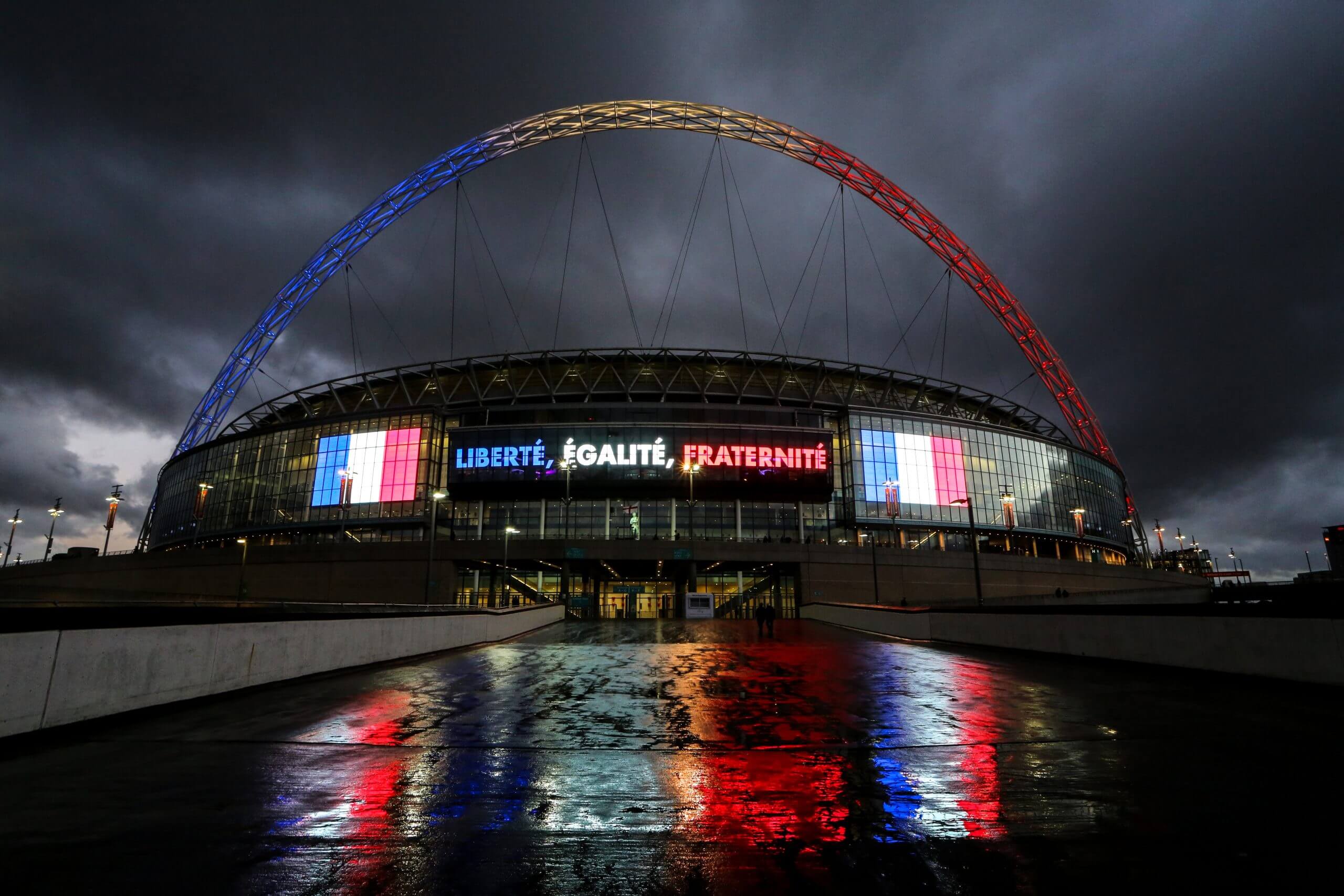
Wembley’s arch was lit up like the French tricolour before the match between England and France days after the Paris attacks (Catherine Ivill – AMA/Getty Images)
France had already been in a state of high alert following the Charlie Hebdo shootings in January 2015, but security arrangements around Les Bleus were reinforced after the Stade de France attacks. The number of security personnel accompanying the team was bolstered and plain-clothes police officers were stationed at Clairefontaine whenever the players were present.
Although the following year’s European Championship in France passed off without incident, the country was plunged into mourning again just four days after the hosts’ loss to Portugal in the final when a Tunisia-born terrorist drove a 19-tonne cargo truck into crowds celebrating Bastille Day on the Promenade des Anglais in Nice, leaving 86 people dead and 458 injured.
No sooner had France’s tears dried than the nation found itself weeping again.
Baure, the Stade de France steward, came face to face with some of the people behind the November 2015 attacks when he testified during their trial at the Palais de Justice in Paris, which began in September 2021 and lasted for 10 months.
All 20 defendants were convicted, including Salah Abdeslam, the only surviving member of the 10-man attack unit, who dropped the three suicide bombers off outside the stadium but later ditched his own explosive vest in a rubbish bin in the southern Paris suburb of Montrouge. His older brother, Brahim, blew himself up inside the Comptoir Voltaire cafe, injuring 15 people.
Abdeslam proved a volatile presence during the trial, angrily castigating the judges over his treatment, initially refusing to answer questions and at one point claiming he had decided not to detonate his suicide vest out of humanitarian empathy.
He was sentenced to life in prison without parole.
What did Baure make of him? “C’est un pauvre gars,” he replies dismissively. A poor guy. “But it was very important (to testify). Because we had to be recognised as victims.”
Carrel saw a psychologist after the attacks to help him come to terms with what he had witnessed having found the days immediately after his return from the Stade de France “very difficult”. Although he shudders at the thought of how close he came to serious harm, he has never forgotten that others paid a far heavier price.
“I could have died,” he says gravely. “If I’d been 30 metres closer, I would have been right next to him (the suicide bomber)… But when you consider all the terrible incidents that took place in Paris, with families gunned down, people wounded and people left handicapped to this day, it helps you put things in perspective.”
Ten years to the day since the attacks, commemorations to mark the anniversary will take place prior to France’s World Cup qualifying match against Ukraine in Paris on Thursday.
A moment of silence will be observed ahead of kick-off and several people who were present at the Stade de France that night will attend the match as guests of the FFF. They include security guard Salim Toorabally, who was hailed as a hero after preventing one of the bombers from forcing his way into the stadium at Gate L, along with representatives of the police and fire services.
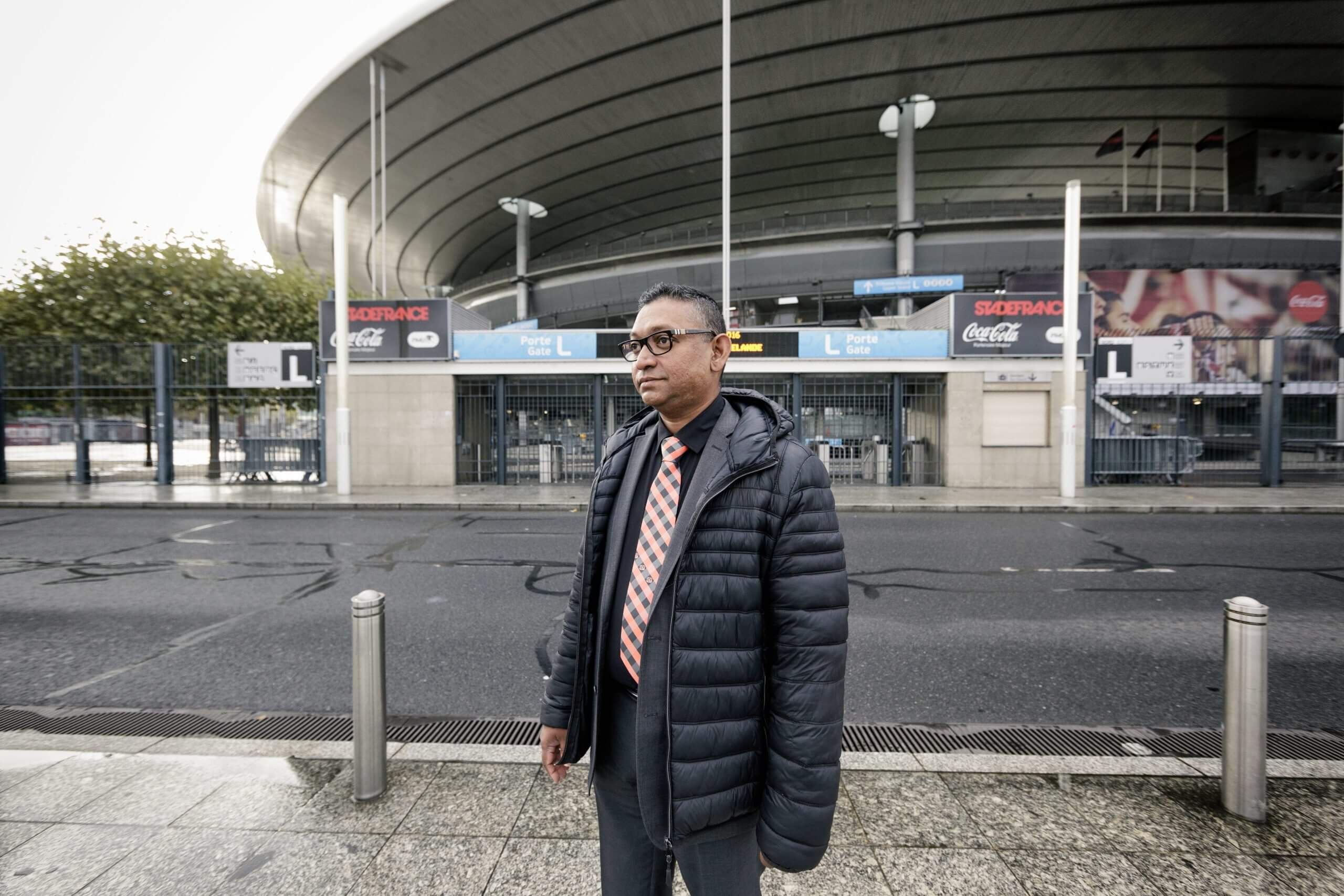
Salim Toorabally, pictured in 2016 outside the Stade de France where he hindered a terrorist from entering the stadium during the attacks (Leo Novel/picture alliance via Getty Images)
Ukraine being no stranger to bloodshed either, a “Football for Peace” banner will also be displayed in the centre circle before kick-off in acknowledgement of the country’s ongoing conflict with Russia.
An impasse in negotiations between GL Events, the new operator of the Stade de France, and the FFF means that the game will take place at the Parc des Princes in Boulogne-Billancourt, west of central Paris, rather than at the scene of the 2015 attacks. Although the echoes of that November night will consequently ring a little less loudly, Deschamps has confessed he would prefer not to be playing on the exact date of the anniversary.
“For me, deep down, if we could have avoided playing on November 13, it would have been good,” he told reporters after announcing his squad for France’s games against Ukraine and Azerbaijan.
Lucas Digne is the only current member of the France squad who was involved in the fateful game against Germany 10 years ago, but captain Kylian Mbappe said that the events of that night carried deep resonance for all of his team-mates.
“I was at Monaco. I watched the match and I followed the news like everyone else did,” the Real Madrid striker, who was 16 and three weeks shy of his professional debut when the attacks took place, told a press conference this week.
“There was fear as well, because it was near where I live — my parents still lived in Bondy. You don’t know what’s happening, you call your loved ones, then you see the atrocities that are taking place and you’re just hoping it stops. It was a terrible moment.
“Playing on the day of the 10th anniversary is special, but not in a good sense. We’ll try to pay homage throughout the day to all the people who lost their lives, all the people who were injured and all the people who were traumatised by this tragic event.”
If France win, they will secure qualification for next summer’s World Cup in the United States, Canada and Mexico, four years on from their penalty shootout defeat by Lionel Messi’s Argentina in the 2022 final in Doha. But as much as everyone associated with Les Bleus will be eager to look forward, it will also, inescapably, be an occasion for many in France to look back.