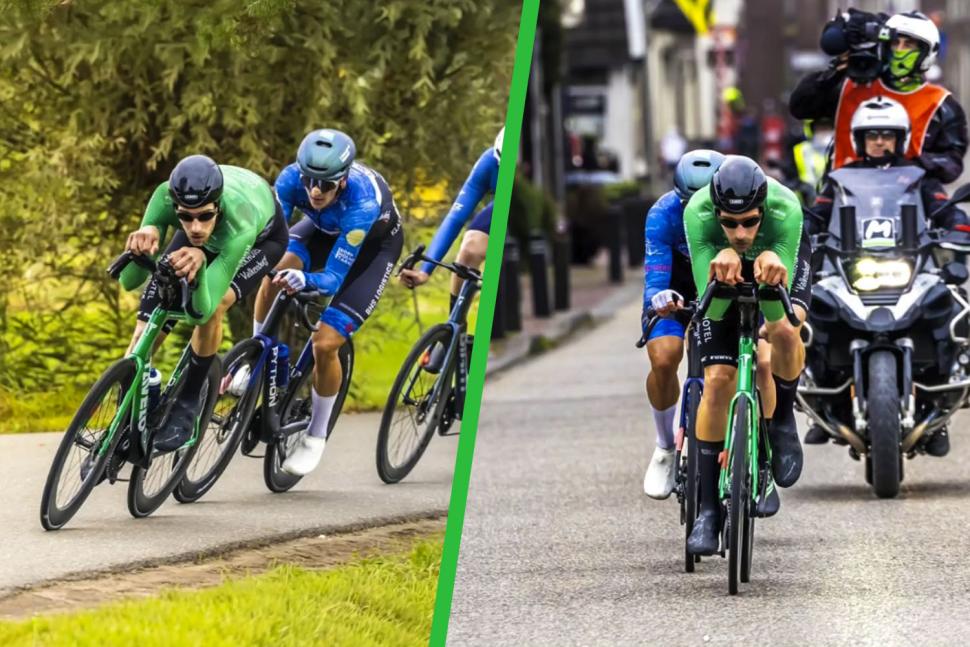
It wouldn’t be a racing season without everybody’s favourite aero experimentalist Jan-Willem van Schip getting a slap on the wrist from the UCI for pushing the boundaries of what a bike looks (and rides) like.
Nobody was surprised when the governing body party-pooped Van Schip’s viral breakaway attempt at the Tour of Holland, disqualifying him over his rather eye-catching ride. Nobody except his team perhaps, who noted the Dutch rider had been allowed to race by the on-the-ground commissaires and had completed other events on the build without problems.
It was the super skinny bars and telescopic stem tilted upwards that got most tongues wagging online, although it is believed it was an unapproved seatpost that ultimately landed the DQ. Once the suits from Switzerland did spot it, it was game over.
Now, clearly, creating a bike that gets you disqualified from races isn’t the most optimal approach to getting results as a pro racer, so the literal answer to our headline question is a hard ‘no’.
However, Toot Engineering, the brand behind those bars, came out fighting and pointed out the position and build was the work of 12 months of data-driven testing to optimise Van Schip’s set-up.
“People say it seems ugly, unnatural or too extreme, but that’s exactly what innovation looks like before it’s understood,” Toot Engineering claimed in a post shared on social media.
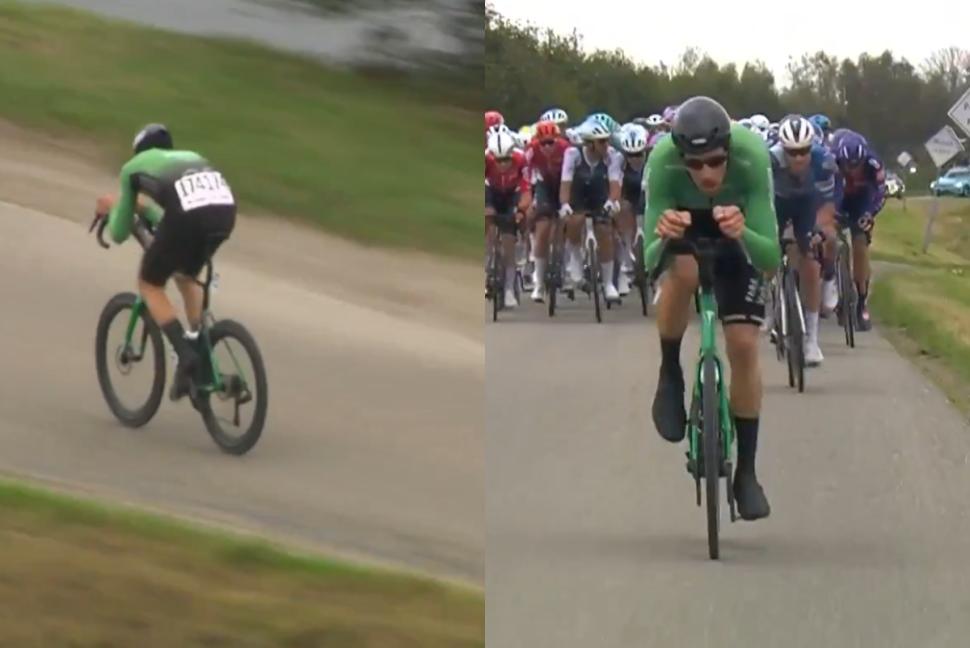 Jan-Willem van Schip wild aero bike set-up at Tour of Holland (credit: TNT Sports)
“What they say is strange is in fact the most precisely controlled position ever validated on his bike. Not by feeling, by data, by AI, by a year of adaptive simulation and testing. This position wasn’t born in front of a camera, but it was born inside a scientific process.
“[It’s] the position where his biomechanics, his power delivery and his neuromuscular patterns could merge. Over one full year, Jan-Willem tested 12 physical prototypes on his road bike. While in our lab, 16 additional configurations were virtually analysed using software like AirCloud for the aerodynamics, simulations, and proprietary AI-optimisation algorithms.
“He didn’t adapt to the bike. We designed the bike and the components to adapt to him. That’s where the Marasa cockpit came alive. A handlebar designed around his body, his position, his reach, his breathing. Long, great geometry in 3D rise and tuned angles, giving him control, not constraints. We didn’t chase aesthetics or beauty.”
But what does a trained bike fitter and physio think? Was there merit in Van Schip’s creation from a purely mechanical, aerodynamic and bike fit perspective? To answer that we’ve called upon the expertise of Bryan McCullough from physio and bike fit specialists ‘The Bike The Body’ to run the rule over the set-up.
So, what was the point of Van Schip’s position and how does it make him faster? “Ultimately, he’s doing what he can within his interpretation of the rules to get as close to a stable time trial mimic position,” Bryan explained. “This set-up allows him to dramatically shrink his frontal area. The forward positioning allows a powerful position over the pedal which would normally be extremely difficult to maintain as there is more weight transferred onto the front end.
“However, again with the bars used from Toot Engineering (Ashaa RR Aero bars) he is using the wide top as an arm rest. This is one of the areas that the UCI had questions as it likely contravenes the ‘puppy paws’ rule that does not allow weight to be supported by the forearm — though many riders do this in practice as we know, this is a more extreme version.
“The 180 +7 stem creates both the length and height to allow adopting this tucked TT style forearm position. So, if we park the rules and the aesthetics, then what he has done here is certainly challenging convention and looks mechanically efficient in the legs, and torso position.”
Bryan went on to explain that Van Schip handled his machine “remarkably well through some of the technical sections”, considering the extreme tech choices, although his sprint looked “pretty challenging on his body”.
Down the outside, off the grass, and onto the attack! 🚀
Jan-Willem van Schip launches a breakaway attempt at the Tour of Holland! pic.twitter.com/a3y8ntn5zc
— Cycling on TNT Sports (@cyclingontnt) October 15, 2025
“That’s maybe harsh given it was the end of the race,” bike fitter Bryan admitted. “Also, we should consider that this position was not designed to deliver all-out sprints, it was designed to optimise seated power and aerodynamics for a successful solo breakaway.”
So if there are positives, what can the rest of us learn from it? Van Schip said he’d been approached by other taller riders who said they wished they could copy his set-up, and there are probably learning points for the rest of us too (even if we don’t race or want to ride around with a metre-ruler for a stem).
First up, Bryan suggested, was that despite what everyone has thought for years, it’s the latest evidence that slamming your stem might not be the best first step for getting faster on your bike.
“Higher front ends can yield more aerodynamically efficient positions — too many riders still try to ‘slam stems’ in a bid to go faster, but often compromise posture on the bike, making the position less sustainable, less comfortable and ultimately less efficient and with an increased potential of injury or pain,” he explained.
“Having a narrower front end can help in shrinking that frontal area which can prove faster if you are able to maintain stability and good breathing mechanics. However, this can be compromised if a slightly larger or broader riders runs bars too narrow for them.
“Finally, there is the iceberg effect — people see the position and think he is a whacky or far out or extreme racer, but the team behind him worked extensively on developing and testing this position so the take-home there for other riders is that if they can work with a skilled or knowledgeable bike fitter they can start to navigate ways to evolve their position depending on their goals — performance, comfort, longer-distance stability etc.”
While Van Schip’s creation is very much designed for his long build, it’s not just taller riders that can need to make significant changes to optimise their riding position. Looking more widely at the bikes brands offer and what the industry could do better, Bryan elaborated on one of his most common fitting conundrums.
“Riders at either end of the height spectrum often pose a challenge as they don’t necessarily shorten or elongate, in terms of limbs or torso, in a linear fashion, as bike brands often scale their sizes,” Bryan continued. “So this can often leave smaller riders with ridiculous front-end drop as the head tube gets so small and then on the other end of the scale often the largest XL or XXL bikes struggle to provide enough drop for some bigger riders.
“The same problem comes in the form of bar width which is scaled up with larger bike sizes — I think you and I both know that human shoulders don’t just get wider as you get taller, particularly not in the case of cyclists. So you have a rider like Van Schip who would get a bike with a 44cm or even 46cm bar if he was a regular rider buying an off the peg bike.
“If you take a random look at some bike geometry charts and consider the stack to reach ratio across the size range, some of them are bonkers while some scale more nicely. As an example, check out the Van Rysel RCR across the size range and the bike at the ends of the size range are like totally different bikes — one a crazy race bike, the other a relaxed endurance bike.”
Bryan McCullough is a bike fitter and physio who runs The Bike The Body in Wiltshire. You can check out their services and work on their website or over on Instagram.