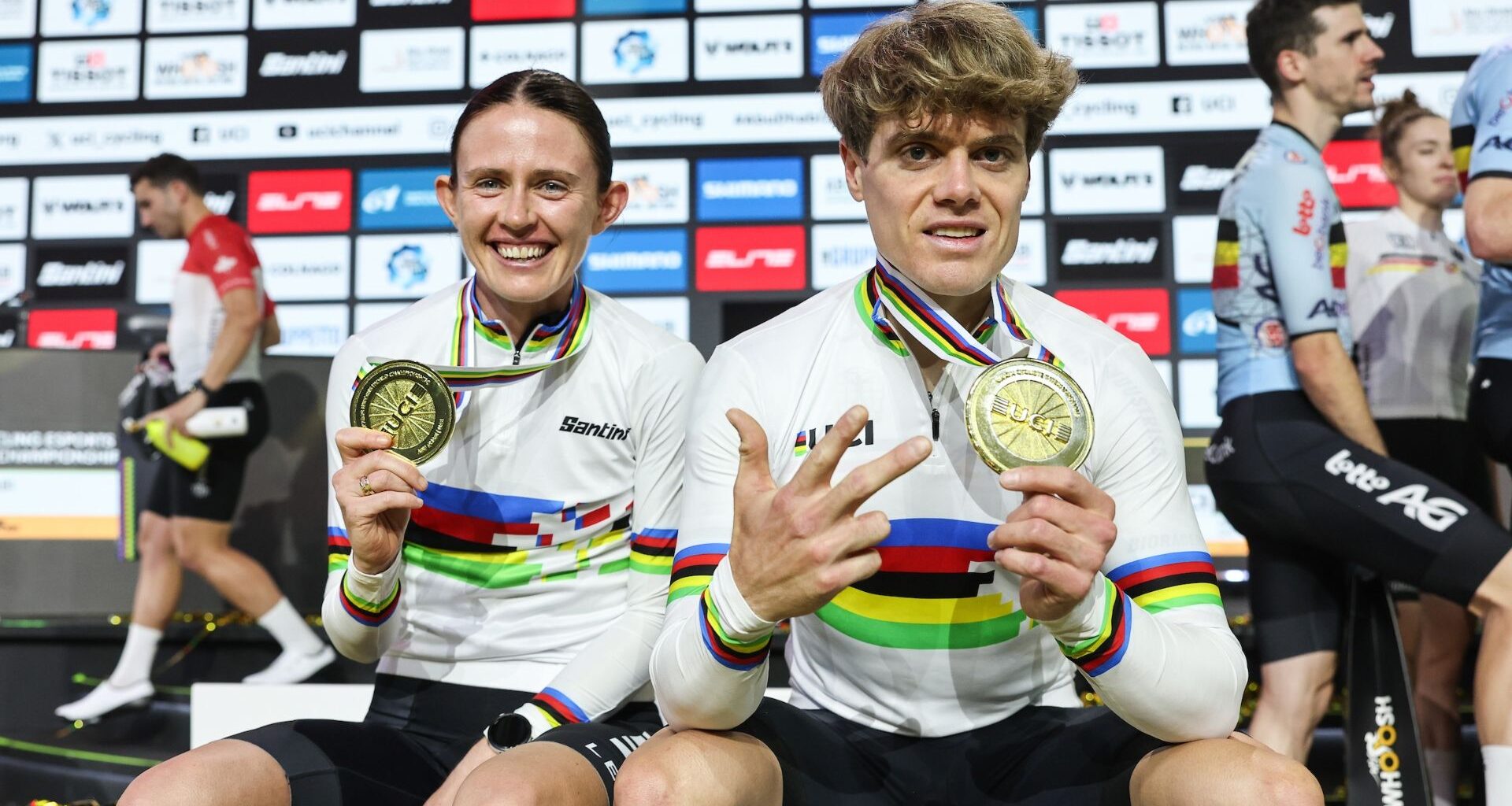
Jason Osborne (Germany) and Mary Kate McCarthy (New Zealand) successfully defended their world titles in Abu Dhabi on Saturday, 15 November, reaffirming their status as the top competitors in virtual cycling.
Their repeat victories headlined the 2025 UCI Cycling Esports World Championships, held once again in front of a live audience in Abu Dhabi. In 2024, virtual cycling platform MyWhoosh won the bid to host the official UCI championships, taking it away from Zwift and adding the first-ever in-person event. The live format proved a breakthrough, and 2025 built on that momentum with a bigger venue, a more polished production, and a growing roster of star spectators.
From walkout songs to a towering Jumbotron-style screen and real-time rider data displayed throughout the Space42 Arena, the Championships showcased not only elite competition but also the maturing spectacle of the sport itself.
To qualify for the final, Pucker and the other finalists competed in a global qualification system of events hosted both by national cycling federations and public races. Only 20 men have been selected for the final this weekend, where they’ll compete in a three-stage, points-based showdown in a custom MyWhoosh virtual world.
You may like
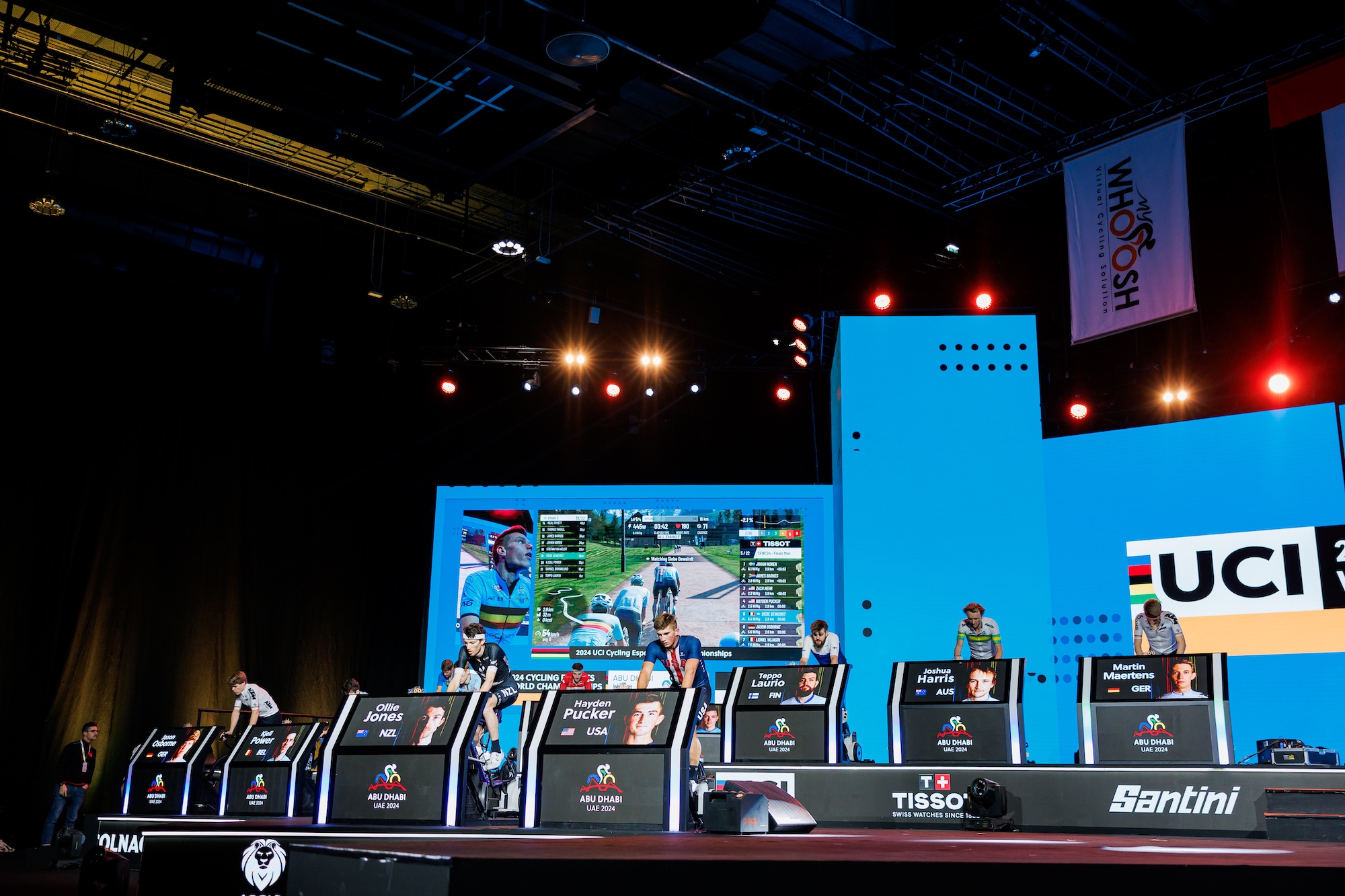
Both the women’s and men’s fields faced the same trio of races that would ultimately determine the 2025 UCI Cycling Esports World Champions. Before diving into the action, it’s worth explaining the unique race format.
2025 UCI eSport World Championships Race Format
(Image credit: SWpix.com)
Stage 1 – The Mountain’s Verdict
The first stage was basically a mass start hill climb elimination. Riders started from the pens on a 0% gradient, and the road gradually got steeper all the way up to 20%. However, no one would make it to the finish line because there was a virtual chaser that would eliminate riders as it caught them.
Only the strongest riders survived, and each rider earned points based on how long they stayed ahead of the chaser.
Stage 2 – The Puncher’s Playground
The second stage was a points race on a 12km course that included two flat sprints and two uphill sprints. There were also points given at the finish line based on the rider’s position. While the first half of the course included some flat sections and rollers, the second half included a steep 2-3 minute climb that would surely break up the field.
Stage 3 – The Sprinter’s Paradise
In the final stage of the UCI eSport World Championships, riders took on eight laps of a 1.5km circuit that included two medium-size rollers. At the end of each lap was a sprint point, plus, there were double points available at the finish line. With so many points up for grabs in Stage 3, the overall standings could be turned on their head.
The UCI eSport World Champions would be the riders with the most accumulated points across all three stages. Osborne and McCarthy had won the rainbow jerseys in 2024, but could they repeat on completely different courses against the fiercest competition?
Here’s how the racing played out.
Kate McCarthy Dominates the Women’s Race
(Image credit: SW Pix)
In Stage 1, McCarthy broke away from the rest of the field and rode away to victory. The New Zealander finished the stage with an average of 5.7w/kg for 19 minutes and 35 seconds, a world-class output that put her 28 points clear of second-place Gabriela Guerra (Brazil). Camilla Ahlberg (Sweden) finished third with 202 points, while Merle Brunnee (Germany) and Francesca Tommasi (Italy) rounded out the top five.
McCarthy already had a comfortable lead, but the fight for the podium was tight. Only 30 points separated third place from 17th, a margin that could be completely undone with a single sprint in Stages 2 and 3.
McCarthy continued racking up the points in Stage 2, finishing with nearly a perfect score after winning every prime except for the first sprint (where she finished second). Guerra solidified her spot in second, while Tommasi jumped into third, and Ahlberg fell to sixth.
Coming into the final stage, we weren’t sure what to expect between McCarthy and Guerra. The defending champion had a significant lead, but it was one that wasn’t impossible to overcome. If Guerra could break away from the pack, she could mop up the prime points on offer and maybe even earn double points at the finish. But those attacks never came, and it was McCarthy sprinting against Guerra each of the eight laps.
The rest of the pack followed suit, but that was until Ahlberg attacked with one-and-a-half laps to go. The Swede won the sprint, moving into third place overall, seven points ahead of Tommasi. McCarthy had sewn up the win with Guerra in second, but now, all eyes were on the fight for the podium.
With 500 metres to go, Tommasi attacked and gained a two-second gap. As the riders flew toward the finish, Ahlberg was sitting in fifth place on the virtual road – she needed to finish fourth or better to finish on the overall podium.
Tommasi came across the finish line in first, earning double points and putting all the pressure on Ahlberg. The Swede was pushing 400w in the final few metres, but she crossed the line in fifth, losing the bronze medal to Tommasi by a single point.
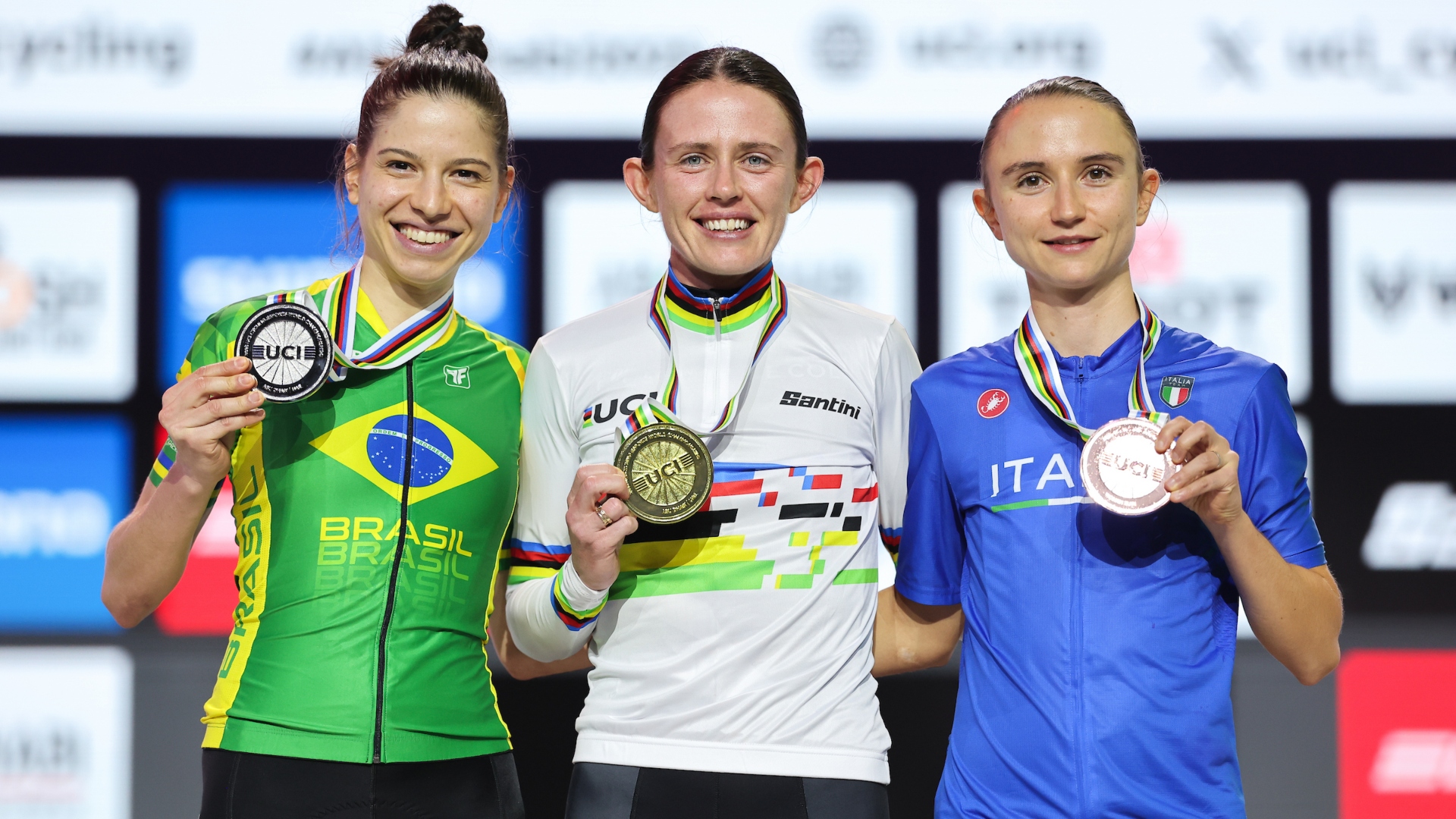
McCarthy won her second consecutive UCI Cycling Esports World Championship with a total of 597 points, while Guerra repeated in second place with a total of 525 points. Tommasi earned the final spot on the podium with 478 points, while Ahlberg came up the tiniest bit short, finishing fourth with a total of 477 points.
In between the women’s and men’s races, the broadcast had cycling icons Tadej Pogačar and Peter Sagan in the booth to talk about everything they had seen. Pogačar noted the unique riding styles of esport cyclists, with most of them riding out of the saddle at a low cadence (60-70 rpm) for the majority of the race. When asked if he would ever compete in the Esport World Championships, Pogačar joked that he might struggle to even qualify.
Virtual cycling has turned into a unique discipline, one that is nearly incomparable to professional road cycling. There are numerous differences between the two, including, but not limited to, the impact of aerodynamics, riding positions, different cadences, drafting and physics, and the importance of raw power versus watts per kilogram (w/kg). Listening to Pogačar and Sagan speak about the race served as a reminder that one cannot easily compare the different types of racing.
Jason Osborne Delivers as Pre-Race Favourite
(Image credit: SW Pix)
There was already drama before the men’s race even started. Two pre-race favourites failed to show up in Abu Dhabi, with Michael Vink (New Zealand) citing illness and Marshall Wu out due to an injury sustained in a training ride.
Both rides have displayed off-the-charts power numbers in MyWhoosh’s Sunday Race Club (e.g. over 7w/kg for 20 minutes), but we have yet to see them compete at a live event.
The 2024 silver medalist, Lionel Vujasin, was present but in less-than-perfect shape. The Belgian had crashed the day before the race in Abu Dhabi. His arm was heavily bandaged, but he was determined to show up and give it his all at the World Championships.
With all of that drama behind them, the men’s field took to the stage with Osborne now the resounding favourite. The German delivered the goods in Stage 1, pushing 454w (6.6w/kg) for 18 minutes and 28 seconds. That put him at the top of the leaderboard with 221 points, ahead of Pawel Scierski (Poland), who earned 206 points and Lennert Teugels (Belgium) with 199 points.
Osborne and Teugels both have decorated backgrounds as professional road cyclists, whereas many of their rivals were complete unknowns. Scierski is a Polish medical student who was racing in Category 2 of the Sunday Race Club only a few months ago. His teammate, Michal Kaminski, hardly races outdoors, but he finished fourth in Stage 1.
Other pre-race podium favourites were struggling: former World Champion Bjoern Andreassen was in seventh, Ollie Jones (New Zealand) was eighth, young American Hayden Pucker was 13th, and last year’s bronze medalist Kasper Borremans (Finland) was in 12th.
In Stage 2, attacks flew from the very start, and that aggressive nature played into the hands of Osborne and Scierski. The defending champion broke away on the steep climb and soloed to victory, while Kaminski and Scierski gobbled up points at multiple prime points. The Poles were looking good heading into Stage 3, sitting in second and fourth with Teugels sandwiched in third.
Osborne was only 13 points ahead of Scierski at the start of the final stage, and with double points at the finish line, anything could happen.
The defending champion is one of, if not the, strongest riders in esport cycling history. Osborne is a powerful engine capable of 8w/kg for 5 minutes and over 7w/kg for 20 minutes. We never really see him sprint because he typically wins solo. Thus, at the beginning of Stage 3, it was a surprise to see the German riders take the second, first, and first places in the first three field sprints.
Clearly, his legs were good, and it wasn’t long until Osborne went on the attack with Vujasin. Riding with a severely bruised and bandaged arm, Vujasin was turning himself inside out to stay with Osborne. Lap after lap, the pair took first and second while slowly extending their gap over the peloton. Kaminski was getting stronger and stronger as the race went on, while his countryman was doing the opposite. Perhaps in a bid to go for the win, Scierski had completely blown up on Lap 3, dropping from the pack and dropping out of podium contention.
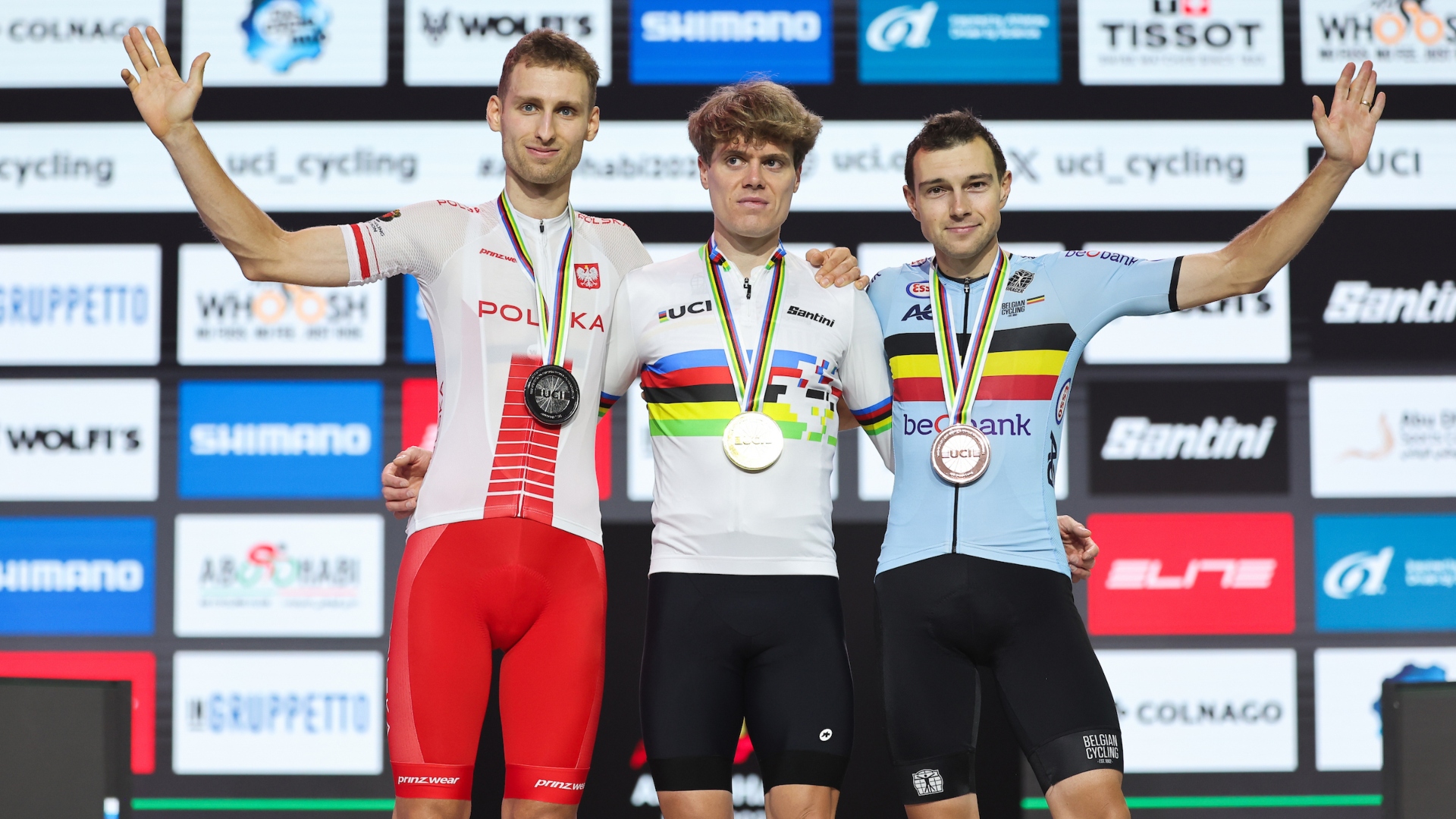
With Scierski out of the picture, the final podium was yet to be decided. Osborne was dominating the race, while Kaminski had moved into second and Teugels was in third. The point gaps had widened during Stage 3, so the final podium was set as they crossed the line for the final time. Osborne was World Champion once again, Kaminski earned an impressive silver medal, and Teugels took home the bronze.
As it was in 2024, the UCI Esport World Championship live final was quite the spectacle. MyWhoosh went all-in to make the event as professional as possible, investing hundreds of hours and millions of dollars to bring it to life. It is mostly what you expect from a World Championships event live in Abu Dhabi. It is colourful, spectacular, and a bit eccentric.
It is simultaneously beautiful and weird. Riders were flown in from around the world to ride an indoor trainer on stage. They were weighed in a few hours before the race, and given a WWE-like entrance in front of a few hundred people. Does half the audience know what’s happening in the race? I’m not sure. But I also don’t think it matters that much.
MyWhoosh is pushing the boundaries of esport cycling, and these live events appear to be here to stay. There is nothing better than getting these athletes together for the biggest race of the year. It casts away so much doubt, and allows these riders to display their true abilities in front of a live audience.