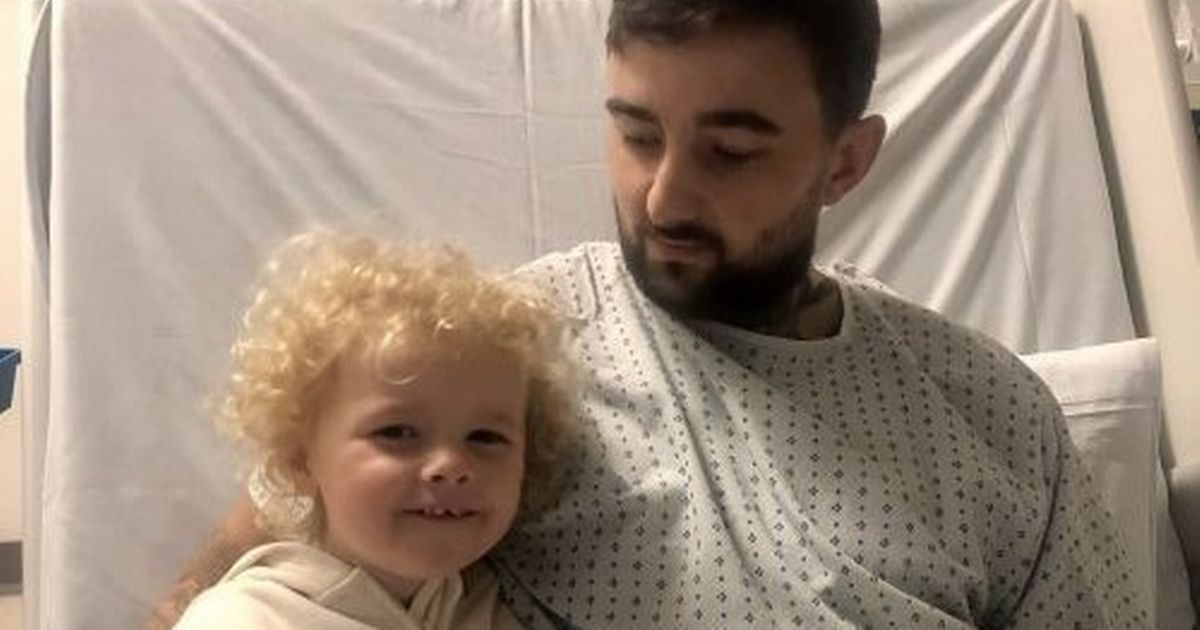
Dad-of-two Jerry Peachey struggled to pick up his children’s toys from the floor and often felt faint and out of breath Jerry Peachey has a heart condition called Tetralogy of Fallot(Image: NHS Organ Donation)
A dad was so unwell with a heart condition that he was unable to play with his children. Jerry Peachey, 34, from Bridgend, struggled to pick up their toys from the floor and was often left feeling faint or out of breath.
This was because he had a critically narrowed and potentially infected heart valve caused by a congenital heart defect. However, everything changed for Jerry when he had a heart valve replacement.
Jerry has shared his story after concerning figures were released revealing that the NHS could not supply around one in five heart valve requests for life-saving surgeries last year amid a drop in donations.
One expert said: “The reality is we are just not getting enough donations to meet demand.”
Before his health issues, the dad-of-two was going to the gym and working in a physically demanding job as a manager in a busy warehouse. But as his condition got worse, he started to struggle to even pick up his children’s toys from the floor.
“I would often feel faint and out of breath,” said the dad-of-two. “I couldn’t play with the kids or take them out.”
Jerry has a heart condition called Tetralogy of Fallot, a congenital heart defect that affects how the hearts works. If left untreated, the condition causes eventual heart failure.
Jerry has had four life-saving heart valve producers since birth. His last heart valve was supplied by the NHS Blood and Transplant service and was replaced during around nine hours of open heart surgery at University Hospitals Bristol and Weston NHS Foundation Trust in July 2025.
The new heart valve means that blood can now flow more easily to his lungs and reduce the strain on his heart.
“It has made a massive difference,” said Jerry. “I’m already showing positive signs of recovery. I look forward to picking up my newborn and my three-year old-again.
“If I could speak to the donor’s family, I would like for them to know how this has made such a difference to me and my family. Without the transplant, I would have gone downhill quickly. I’d like to thank the family of the donor for making this possible.”
The NHS is urgently appealing for more donors after a drop in heart valve donation which is affecting care for adults and children. More than half of the heart valves issued by the NHS are sent to children’s hospitals.
The NHS could not supply around 20% of heart valve requests from hospitals last year. The shortage is continuing this year due to a drop in heart valve donations over recent years.
In 2021, around 600 hearts were donated to three heart valve banks in England. In 2024, only 368 were donated. Stay informed on the latest health news by signing up to our newsletter here
NHSBT, one of the three banks, targets nine donations a week but last year received only four a week.
Jackie Brander, head of operations for tissue donation at NHS Blood and Transplant, said: “Heart valves can be especially important for babies born with genetic heart defects. But the reality is we are just not getting enough donations to meet demand.
“We think there are several reasons why heart valve donation has decreased. Organ and tissue donation as a whole has fallen – last year, for example there were 100 fewer organ donors.
“Also, since the pandemic, more people are dying at home or in the community, where heart valve donation is not possible.
“We’re investigating whether there might be other reasons. But what we really need is for more people to support donation – you will change and save lives.”