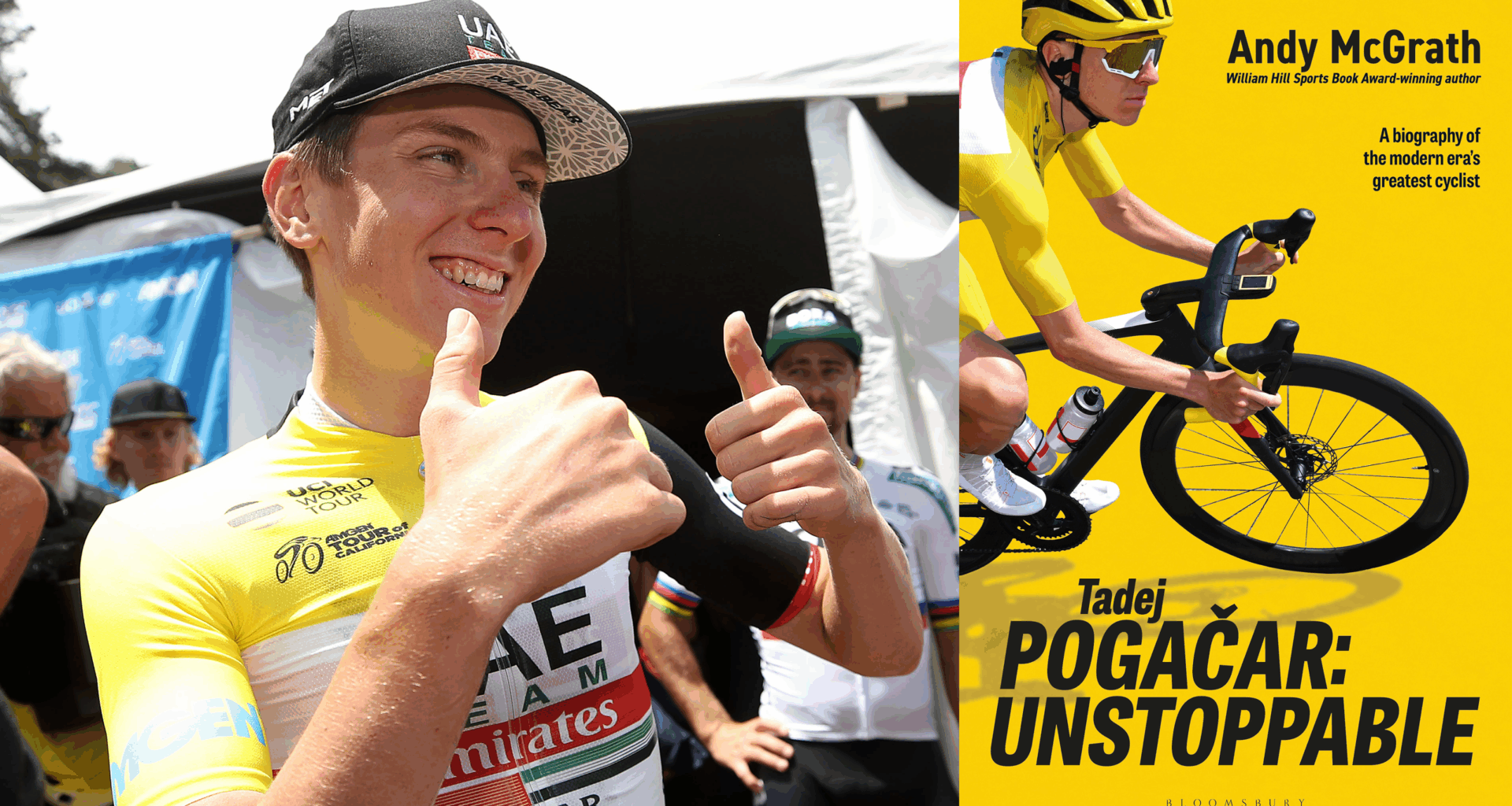
This is an extract from the new book Tadej Pogačar: Unstoppable by Andy McGrath (Bloomsbury Sport). Available to buy now.
In Chapter 5: Breakaway, McGrath revisits the important early years of Pogačar’s career, here the summer of 2018, which concluded with him winning the Tour de l’Avenir.
Ushering in a summer he would never forget, Pogačar took his first win of 2018 in spectacular fashion at June’s under-23 Peace Race. Part of the Nations Cup, the foremost UCI season-long series for that age group, he won with an audacious, last-day attack over two climbs and 35 km, through the pouring rain into the Czech town of Jesenik, jumping from sixth to first on GC in the process. The rival Swiss and Great Britain teams chased hard, but made few inroads into his advantage. Even a couple of years later, after winning his first Tour de France, Pogačar talked about that day as his best memory of racing on the offensive.
You may like
The subsequent Tour of Slovenia was a big success for Pogačar and his team. Ben Hill took enough intermediate bonus seconds from breakaways on the opening two stages to slip into the green jersey of race leader.
‘I’m leading the tour and there are fellas still not giving me the wheel,’ Hill says of the lack of respect afforded to him. ‘Whereas Pogačar didn’t care, he was sat back in 50th by himself, moving up when he needs to move up. As soon as it started going uphill, he just rode around everyone.’ Pogačar finished fourth, helped by a strong time trial, though Primož Roglič was the comfortable race winner.
The young team captain’s happy-go-lucky side also shone through. ‘I was tucked up in bed one night and Pogačar bust in at 10:30, handing out pizza sticks,’ Hill says. ‘He was like, “This town is a great pizza stick stop, you have to have these pizza sticks.” I was like, “Mate, we’ve got a race tomorrow, what are you doing?” He was so relaxed about it … life seemed to come pretty easy to him. Win races, have fun, no problems.’
Despite his consistent top 10 finishes throughout the year, Pogačar never slacked off working for teammates. ‘I remember stage 1 of Friuli [the 2018 Giro della Regione Friuli-Venezia Giulia], there were 20 of us or so coming into the finish, and he was chasing down every move for me for the last 20 km because he was like “Ben, you’re a sprinter, you can win this.” He was all-in helping me, leading me out, even though he was the one that was going to win the tour, it had a big hilltop stage. He was really happy to ride for someone else if they had a chance.’ Pogačar dropped him off at the front for the finish; unfortunately, Hill’s back wheel slipped out of his frame, and he crashed.
After Pogačar duly won the race overall days later, they dropped equipment off at the team’s headquarters and then went into Ljubljana, to the local pizzeria. ‘I think they were drinking Long Island iced teas that night,’ Hill says, laughing. ‘He did [too]. I’m not sure if it was a common occurrence for him, it was a kind of end-of-season party.’
Pogačar did not miss out on teenage kicks completely for sport. He went to a few parties, and after training, he and his friends would occasionally stop off at Bar Julija in Domžale for a beer or two. But largely, he stuck to his goal of becoming a WorldTour cyclist without distractions. ‘I sometimes thought that cycling was making me miss out on all the fun,’ Pogačar told Siol in 2019. ‘But in the end, it’s worth putting so much effort into what you love to do. Cycling has given me a very special life. Without a bike and fellow cyclists, I would probably be bored.’
While the Slovenian riders and foreigners on Ljubljana Gusto Xaurum were inevitably a little divided, Hill and his compatriot Tim Guy found Pogačar to be one of the most welcoming riders. ‘Off the bike, you didn’t get the idea of this unbelievably dogged, selfish, directed person,’ Guy says. ‘That’s not the vibe he gave. I remember doing some interviews with him [for the team], and you’re just laughing around.’ When the team went go-karting for Guy’s 29th birthday, Pogačar was one of the best, showing his ability at taking risks and following the racing line.
Guy regards Pogačar’s finished superstar form as partly down to KD Rog’s successful ‘gamification’ of development and training, rather than making him conform to a strict structure. ‘Because you can try to force someone into [being] a robot, and you probably don’t want him as a robot. You want him doing stupid moves with 80 km to go. You could easily beat that out of someone … you could see that personality, and it seems like that stayed.’
Tadej Pogačar: Unstoppable by Andy McGrath (Bloomsbury Sport) is available to buy now.