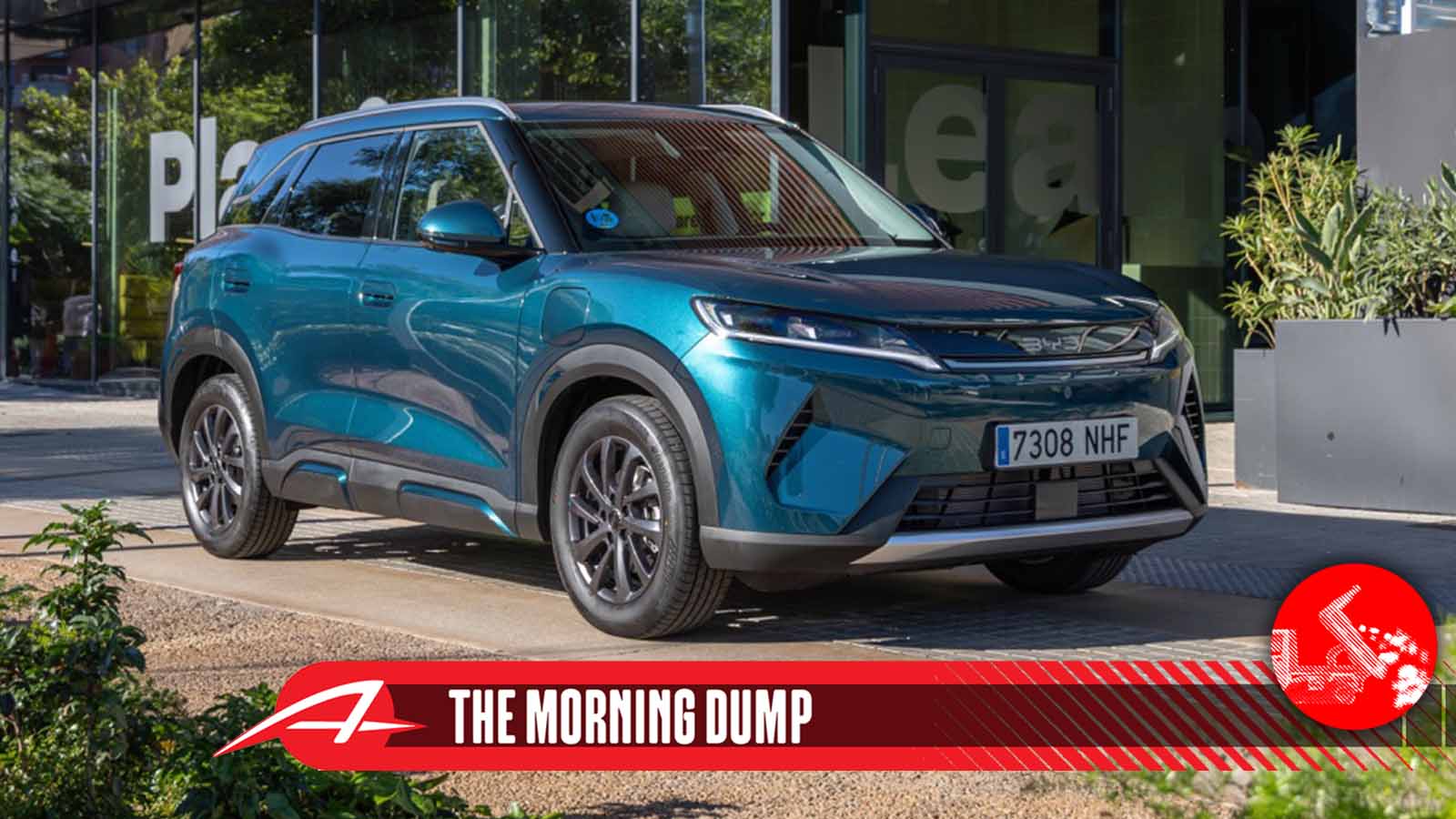
It’s always fraught when I talk about Chinese vehicles here at The Morning Dump or, really, anywhere. There’s an impossibility to divorcing all that comes with where the product is built from what the product is, and I’m generally ok with not divorcing it. However, today, I want to talk about a product I think would do well here and, yet, a product no one can sell me.
Just this week, Chinese automaker BYD launched its Super Hybrid ATTO 2 DM-i in Europe with a flashy drive in Barcelona, Spain. The reviews of it seem generally positive, but what I am missing is the fact that this is a PHEV with actual range, which is something that few companies seem interested in building.


Ford is very interested in continuing to build its F-150 because that’s how it makes money, but the plant that helps process aluminium for its trucks caught fire. Again. No one was hurt, which is a blessing. The same can’t be said for pedestrians, who are being killed at an alarming rate. At least the Department of Transportation is starting to roll out female test dummies, which is as overdue as my copy of Northinger Abbey.
Check Out The BYD Super Hybrid ATTO 2 DM-i

I think we’re fairly clear on our belief that plug-in hybrids are a good thing, as are EREVs (the difference being that a PHEV can power the vehicle with the engine and, in an EREV, the engine only acts as a generator). The shift in interest toward EREVs seems to come from the fact that most of America’s PHEVs kinda suck.
The reason is the battery. There’s just not enough range for most PHEVs, with the new RAV4 finally sneaking above 50 miles of range to provide enough distance for day-to-day commuting. Most are like the Outlander, with under 40 miles from a small battery. That’s not enough!
Again, the new RAV4 PHEV and Prius PHEV are a step in the right direction, but the RAV4 is a bit on the pricier side as it’s a larger vehicle. What I’d love to see is something more Corolla Cross/Honda HR-V-sized with a PHEV option and a larger battery.
Europe is about to get this in the form of the Atto 2 DM-i, which is a boring name for a crossover with a boring derivative design, from not-so-boring Chinese automaker BYD. The company is quickly supplanting Tesla in European markets as an automaker by offering cheaper EVs and cars with engines, which Tesla is unlikely to ever do.
The specs (WLTP) on the Atto 2 are great, with the vehicle offering 56 miles of EV-only range from an 18.3kWH blade battery. [Update: Just to address the WLTP of it all, it’s not possible to know the EPA range of this product exactly, but if you look at the Outlander PHEV in Europe, it gets around 80 km/50 miles WLTP range compared to 38 miles EPA. By comparison, the Atto gets 89 km/56 miles of range. At the same exchange, that’s 43 miles for the BYD. The Outlander PHEV seems to perform worse than the average, so my guess is the BYD would be closer to 44-45 miles. -MH]
Total weighted fuel economy, if you keep it plugged in, is 156 miles. This means a total range of about 620 miles under ideal conditions. Like the Honda system, the motor is mostly acting in series, providing power to the batteries. As necessary, the 1.5-liter gas engine can power the wheels in parallel.
What’s it like? Here’s what Autocar had to say:
Take these numbers with a pinch of salt, considering my test conditions weren’t totally representative of day-to-day suburban drudgery, but over the course of a demanding 90-minute loop comprising busy motorways, tight mountain passes and stop-start inner-city arteries in Spain, I drained around half the battery (circa 9kWh of energy) and took no more than a few sips out of the fuel tank.
That equated to electricity consumption of 9.12mpkWh and fuel economy of 157mpg, which the car told me represented combined consumption in traditional terms of 76.3mpg. But that’s contingent on having a full battery to start with. We will need a few days on UK roads to really crunch the numbers.
Pricing is also competitive, with the larger-batteries Boost model coming in around £28,000 in the UK, compared to a starting price of £32,250 for an HR-V Hybrid.
For many obvious reasons, it’s unlikely a BYD Atto or any other Chinese brand will come to the United States in the near future. Instead of PHEVs with big batteries, we’re probably just going to get hybrids.
Ford Really Needs To Find More Aluminum Suppliers
 Source: Ford
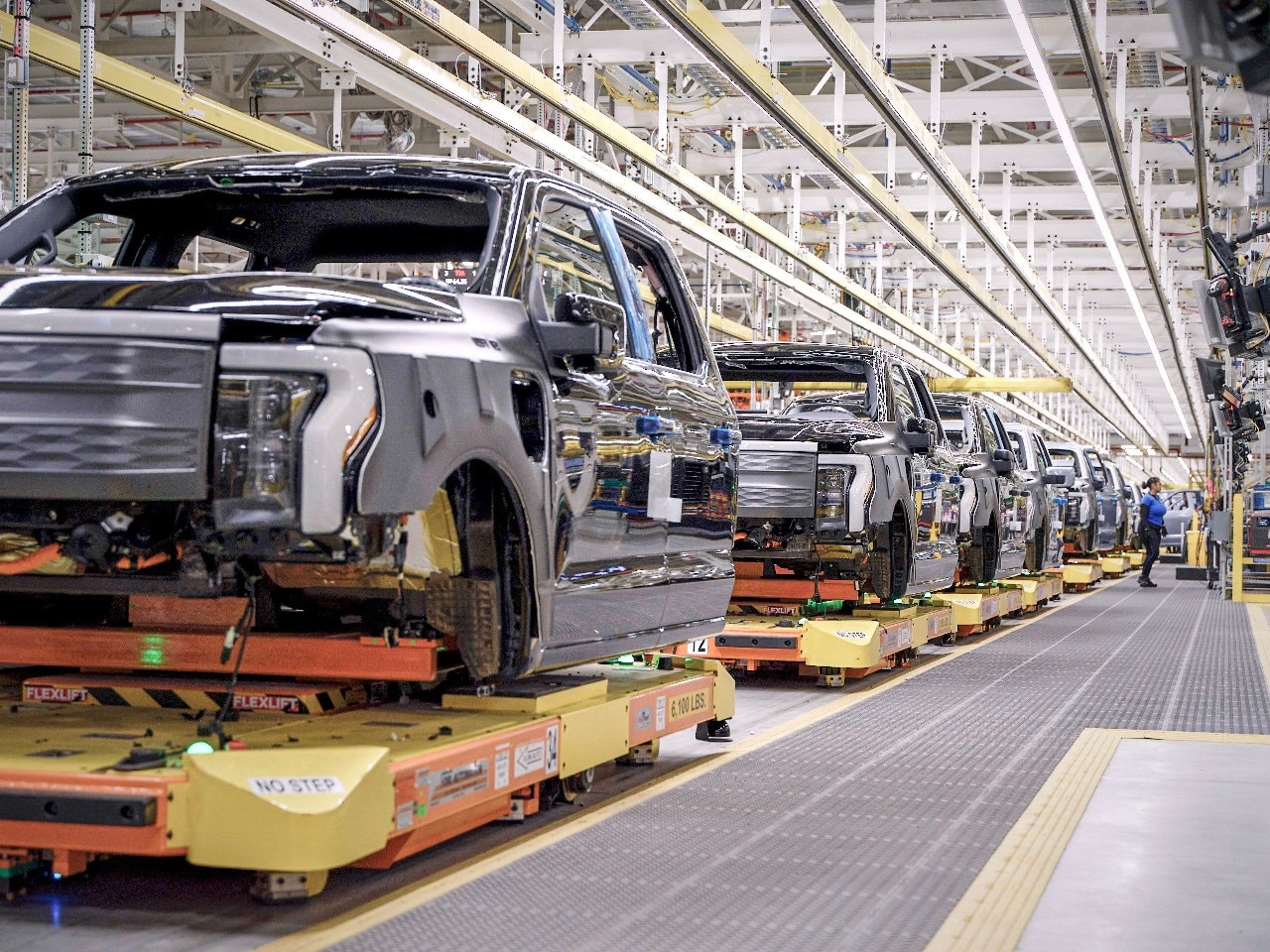
If you were curious, yes, we did just write about how a big fire at the Novelis plant in lovely Oswego, New York, was so bad that it might have prematurely killed the F-150 Lightning, and was otherwise making life hard for an automaker that is seriously reliant on F-150 sales.
It happened again, according to CNBC:
Novelis in October said it planned to restart operations at the affected part of the plant by the end of December, an acceleration from its previous projection of resuming by the first quarter of 2026. A Novelis spokesperson said it was too soon to say if Thursday’s fire would delay that timeline.
“A fire started at Novelis’ Oswego, New York, plant this morning. Everyone working at the plant was safely evacuated. Multiple local fire departments responded, and the fire is now under control. Crews are still on site to ensure it is fully extinguished,” the spokesperson said.
Maybe, uh, look into making sure that part of the plant isn’t catching on fire all the time? Just a thought. With huge tariffs on imported aluminum, it’s not exactly a fun time to be trying to source automotive-grade aluminum from anywhere else.
The Most Dangerous Roads In America Feel Very Familiar To Me
There’s a kind of terrifying article in The Washington Post this week that calls out the deadliest roads in America for pedestrians, and I used to live by two of them.
This is always a much-debated position, and there’s always a lot of fingers pointed at big SUVs with low standards for pedestrians. That’s a real thing, as is distracted driving, but as a person who studied some of this in college a million years ago, my belief is that road design and transit accessibility are way bigger factors. And it’s personal to me, because Houston sure comes off as one of the worst places for this.
The Instagram post above has a graphic, and it shows Houston’s Westheimer Road as the road with the most deaths in America between 2021 and 2023. Not far off is Houston’s FM 1960, which is a road I spent a lot of my youth along. Both are terrible places to be pedestrians.
From the WaPo:
Wide roads and fast-moving vehicles — especially when combined with signs of poverty, homelessness, drug and alcohol abuse, and a lack of pedestrian-focused roadway improvements — produced a pattern of death-by-vehicle that is uniquely American, according to the investigation.
The national data shows how the design of such roads is closely linked to the fatality rate: Those with three lanes or more are by far the most dangerous, because they enable higher speeds. Above 30 mph, fatality risk increases sharply. At 50 mph, someone’s chance of survival when struck is less than 1 in 5.
More people in these areas lack cars and are forced to walk, while many of those killed tended to be impaired and were taking risks trying to cross, the review found.
Most of that conforms to my memories of both Westheimer and FM 1960. While making cars more pedestrian-friendly in accidents and lowering speeds are obvious solutions, the road design of both corridors has always been terrible.
NHTSA Endorses A Female Test Dummy
 Image: DOT
Here’s some good old bipartisan government action, which is missing these days. Both Republicans and Democrats have come out in support of female test dummies. Why? Women are 73% more likely to be injured in a head-on collision and have higher fatality rates, yet not all dummies reflect that.
U.S. Sens. Deb Fischer, a Republican from Nebraska, and Tammy Duckworth, a Democrat from Illinois, both released statements welcoming the female crash test dummy announcement.
“Any progress here is good because there’s simply no good reason why women are more likely to be injured or die in car crashes,” Duckworth said.
Fischer introduced legislation, the She Drives Act, that would require the most advanced testing devices available, including a female crash test dummy. Duckworth is a co-sponsor.
“It’s far past time to make these testing standards permanent, which will help save thousands of lives and make America’s roads safer for all drivers,” Fischer said.
The goal here is to get automakers to start using these dummies, which conform more to how actual human beings are built (versus the existing “Hybrid III,” a smaller dummy based on the male). I’m sure former Real World: Boston co-star and current Secretary of Transportation Sean Duffy will embrace this moment of bipartisanship in a professional way in the DOT’s press release on the subject:
“The Left doesn’t want to hear it, but the science is clear: there are only two sexes – male and female. That biological fact isn’t just a talking point – it’s an important safety consideration when designing cars,” said U.S. Transportation Secretary Sean P. Duffy.
This is a strange statement from the DOT, which serves all Americans — even weirder than Duffy’s recent statement that the way to make travel better this Thanksgiving is to dress nicer at the airport. (I’m not averse to the idea of people dressing up at the airport if they like, as it does add some romance to traveling, but if you look at the math, planes have gotten safer as flyers have gotten more casual…).
What I’m Listening To While Writing TMD
Here’s Willie Nelson, in the best t-shirt you’ve ever seen in your whole life, doing “To All The Girls I’ve Loved Before” featuring Julio Iglesias, performing at the CMAs in 1983.
[Ed Note: Last month, a celebration of the 40th Anniversary of Back To The Future happened at a mall that was featured in the movie, located in the city of Industry. Friend-of-the-site Tiziano Niero went out and shot this, which I figured I’d share:
Man I lave a DeLorean DMC-12! -DT]
The Big Question
Are we wrong about PHEVs?
Top photo: BYD