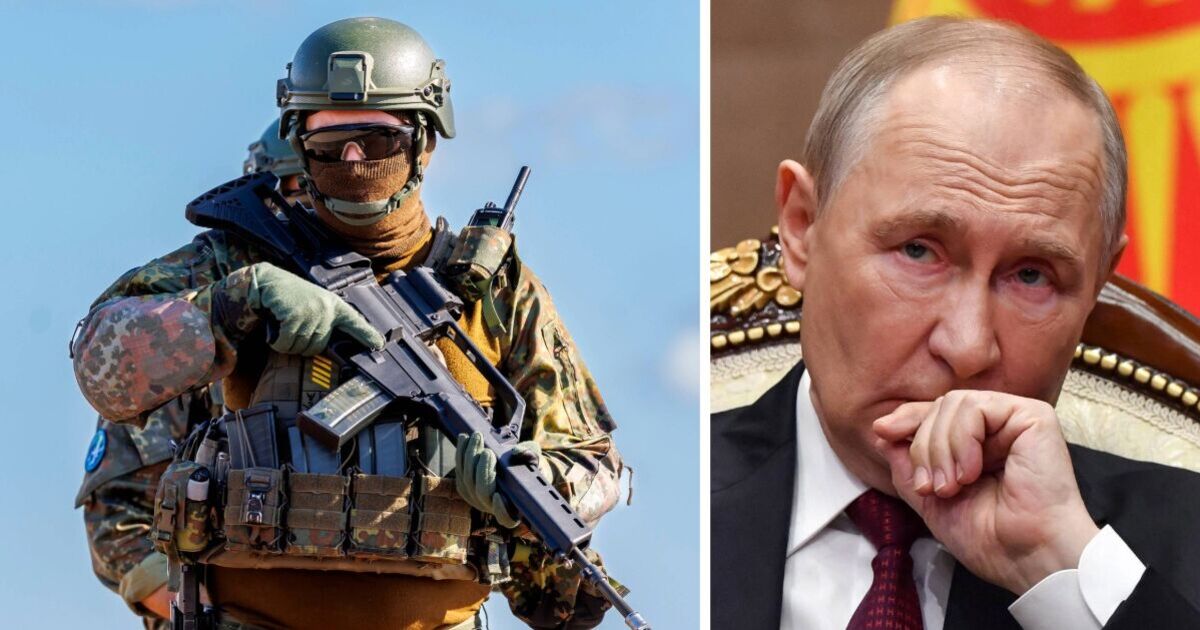
Germany is racing to implement a plan in the event of a war with Russia, it has been reported. Operation Plan Germany – referred to by those in the know as OPLAN DEU – is a 1,200 page classified strategy put together at Julius Leber Barracks, located south east of the former Berlin-Tegel Airport. The plan would see as many as 800,000 German, United States and other NATO troops transported east toward the front line in the event of a full-on armed confrontation with Moscow.
Commanders have mapped the ports, rivers, railways and roads that would be utilised, as well as how soldiers would be supplied and protected during the journey. Officials in the country believe that Russia will be ready and willing to attack NATO in 2029. However, a number of alleged incidences of Kremlin-orchestrated spying and sabotage attacks, as well as and airspace intrusion into European countries, suggest Putin could be preparing to strike before then.
“The goal is to prevent war by making it clear to our enemies that if they attack us, they won’t be successful,” a senior military officer and one of the earliest authors of the plan told The Wall Street Journal.
It comes as Kremlin officials “continue setting conditions to reject any [Ukraine] peace deal that does not concede to all of Russia’s maximalist demands”, the Institute for the Study of War (ISW) reports.
Russian Deputy Foreign Minister Sergei Ryabkov said on November 26 that “there can be no talk of any concessions or any surrender” of the “key aspects” of Russia’s challenges with Ukraine in response to Donald Trump‘s peace plan.
Ryabkov also stated that Russia “is prepared to achieve its stated goals” in negotiations, which experts say was referring to Russia’s “long-held and oft-repeated demands”.
Moreover, the official noted that Russia will continue its war in Ukraine if there are “any setbacks” in negotiations.
The ISW wrote that Ryabkov “reiterated that Russia’s position has not changed and invoked the alleged ‘understanding’ that the United States and Russia reached at the August 2025 Alaska summit, despite the fact that there are no public-facing agreements resulting from the summit.”
It added: “ISW continues to assess that the Kremlin is attempting to exploit the lack of clarity about the Alaska summit to conceal the Kremlin’s continued unwillingness to compromise and its commitment to achieving nothing short of a full victory in Ukraine.”
Kremlin Spokesperson Dmitry Peskov said on November 26 that ”it is too early to say” whether Ukraine and Russia had never been so close to concluding a peace deal.
This is “a further indication that the Kremlin is distancing itself from the peace proposal, likely because Russia intends to reject it”, the ISW wrote.