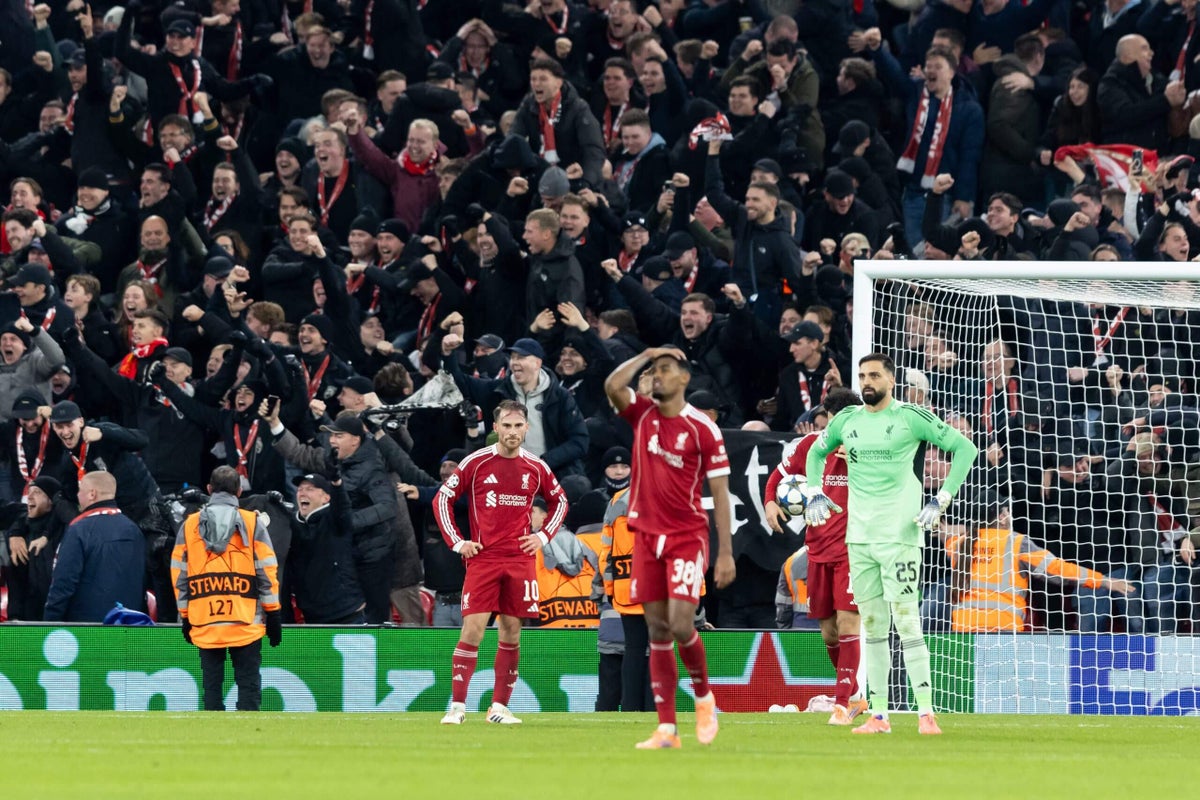
When you are called out by your head coach for the “ridiculous” number of goals the team has conceded so far this season, the ideal response is not to let in another four in the next game.
Arne Slot did not mince his words when talking about his Liverpool side’s defensive record this season ahead of the Champions League tie against Dutch visitors PSV on Wednesday.
“The amount of goals we concede is, of course, the big difference between this and last season,” Slot told reporters. “It is not a thing over 90 minutes that we are not ready or we are not defending well enough. In the moment we have to defend, we are not as switched on as we should be.
“It is not a general thing because you can’t control or dominate the game, (which) we do, if you don’t win enough duels. In moments, we have to defend better. The few times (Manchester City) did, we were lacking intensity in our duels.”
Yet, the intensity did not return. PSV won 4-1 at Anfield.
Liverpool have kept just four clean sheets in 20 matches in all competitions this season, conceding 34 goals. It wasn’t until the Merseyside derby on February 12 last season that their goals-against total reached the same number.
Their title success in Slot’s 2024-25 debut campaign was built on a defensive foundation and compact structure that allowed the attackers to flourish from a position of strength.
The Athletic has watched back the goals Liverpool have conceded this season, focusing on the current run of nine defeats in 12 matches, to try to work out why their solidity of a year ago has deserted them.
Open play
There have been plenty of questions about Liverpool’s fight after recent defeats, and their lack of aggression in key duels has exposed them.
The latest example was Mohamed Salah being easily dribbled past by Mauro Junior in this passage of play from Wednesday night. Instantly, the PSV midfielder was able to advance unopposed towards Liverpool’s box.

The ensuing pass was excellent, but Milos Kerkez was also on the wrong side of goalscorer Guus Til and did not recognise that he could have played the winger offside.
It was a similar situation for Nottingham Forest’s second goal, during the 3-0 defeat at Anfield a week ago, when Alexis Mac Allister lost a crucial challenge with Neco Williams inside his own penalty area.

It summed up the lack of intensity in Liverpool’s defending at the start of the second half that day, and was also another example of a player losing their marker as goalscorer Nicolo Savona’s run was not tracked by Cody Gakpo.
The second big issue from PSV’s second goal in midweek is the position of Liverpool’s No 6 Ryan Gravenberch. PSV had played around the home side’s initial press and the Netherlands international was left exposed despite being deployed as the deepest midfielder.
Following the 2-1 win against Everton in September, Gravenberch revealed in an interview with TNT Sports that he had been given licence to get forward more frequently. “It’s the coach that gives me the confidence,” he said. “This season, we have more freedom in the midfield. Last season, I was only on the six, like deep, deep. Now I can go more forward.”
This issue is more related to Liverpool when they are in possession, but appears to be having a knock-on effect. The high positioning of Gakpo played a key role in Chelsea’s first goal at Stamford Bridge on October 4, when the 23-year-old aggressively tracked Enzo Fernandez, vacating the middle of the pitch and leaving Mac Allister alone against Malo Gusto and Moises Caicedo.

Liverpool’s press has not looked cohesive all season. It is not for a lack of trying or work ethic, but there is a lack of impact, and they are struggling to be proactive.
The initial build-up to Manchester City’s first goal on November 9 demonstrated that. While Liverpool had plenty of time to defend the situation, they allowed the home side to escape from their own corner flag after repeatedly being close to winning the ball back but ultimately failing.

Ibrahima Konate’s form has been a concern since the beginning of the campaign. He has looked a shadow of the player who formed an excellent centre-back partnership with Virgil van Dijk last season.
It began with his defending for Antoine Semenyo’s second goal for Bournemouth in the opening game of the top-flight season, where he failed to engage with the forward, and his latest error against PSV was another low moment.
The France international failed to connect with the ball when attempting to clear, and it resulted in Couhaib Driouech scoring off the rebound after Ricardo Pepi’s initial shot hit the post.

Konate’s performances are generally good until he makes a mistake, and then his level plummets. The calls to replace him with Joe Gomez are getting louder.
He is not being helped by the lack of consistency at right-back and to continue the theme of not tracking runners, Curtis Jones — somewhat understandably because he isn’t a right-back but a midfielder — does not track the run of goalscorer Driouech, as highlighted in the clip above.
Ultimately, Liverpool are repeatedly masters of their own downfall.
For Brentford’s second goal in October, during the champions’ 3-2 away defeat, there appears to be no danger from the first image in the sequence, yet 20 seconds later, the ball is in Liverpool’s net.
Hugo Ekitike misplaced a simple five-yard return pass to Florian Wirtz, and then the latter and Jones were both too passive when Igor Thiago passed the ball to Mikkel Damsgaard. It allowed him to pick out Kevin Schade.

Again, the key themes: a lack of intensity and aggression.
Set pieces
Aaron Briggs was appointed as Liverpool’s set-piece coach over the summer, but it has been a difficult few months for him as he has stood in the corner of the technical area and watched the team repeatedly concede.
At this stage of last season, Liverpool had conceded twice from set pieces — a Jarell Quansah own goal against West Ham in the Carabao Cup and a Mikel Merino header against Arsenal in the league. The number for 2025-26 is already at 10, and eight of them have occurred during this run of bad results. They have also conceded four penalties, bringing the total number of opposition goals from set-piece situations to 14.
What’s quite bizarre about Liverpool’s set-piece concessions is that none have been a simple cross-and-header combination. The majority have been scored from the second ball or second phase.
Manchester United’s winner at Anfield on October 19, scored by Harry Maguire, was the prime example of Liverpool’s players not being in ‘defend mode’. They weren’t alert to the initial corner and when the ball came back out to Bruno Fernandes, both Gakpo and Jones had moved away from their markers, ready to join a counter-attack. They could then only watch as three United players at the back post attacked the Fernandes cross unmarked.

There are parallels to both the late goal conceded against Crystal Palace, when Jeremie Frimpong vacated his position, and Nico Gonzalez’s goal for City, when Liverpool were not prepared for the short corner.

Outside of Konate and Van Dijk, Liverpool have few other aerially dominant players, but there is also a lack of aggression and concentration in these situations.
Liverpool’s defensive problems this season run deep.
From individual errors to structural issues to not getting the rub of the green, nothing is going right for Slot’s side. With both first-team right-backs injured and uncertainty surrounding Gomez’s fitness, there are not many options for the head coach to instigate change.
The back four are failing, but they are getting little help from those in front of them.
To try to turn their situation around, Liverpool need to get back to basics, and a key part of that has to be rekindling the defensive desire they displayed in winning the title last season.