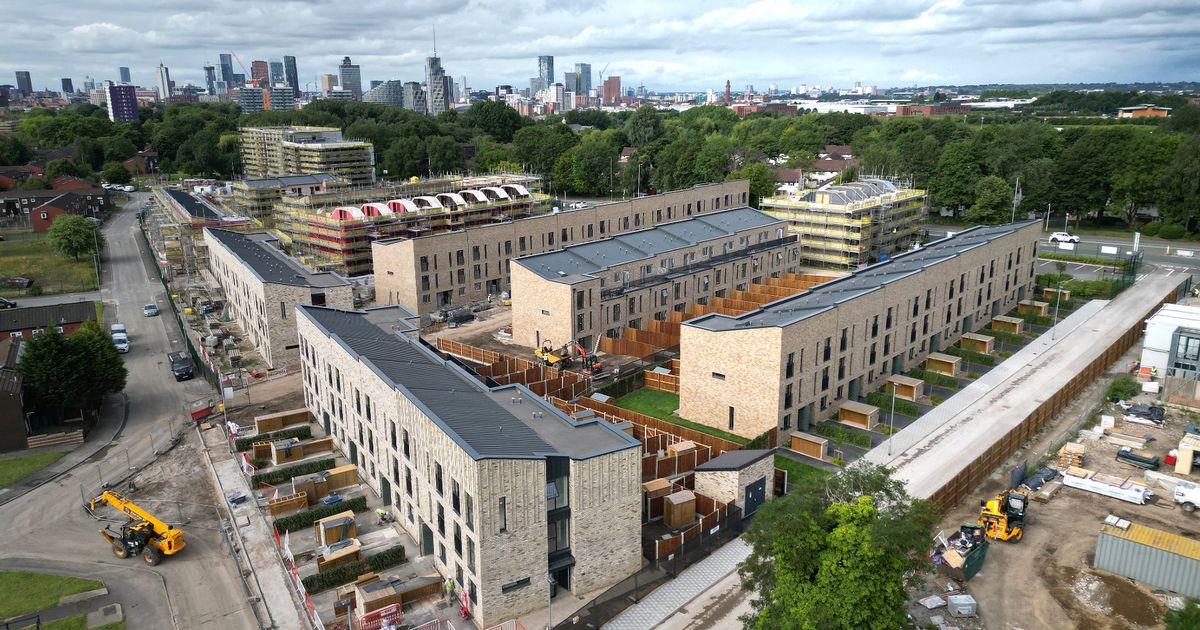
A long-neglected corner of the city is being completely transformed in one of the biggest regeneration projects in the country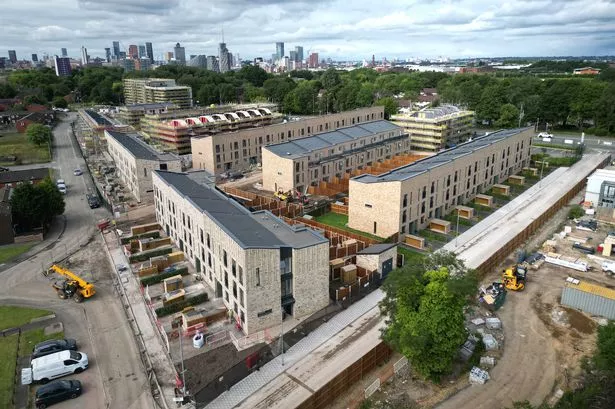 The Victoria North development is well under way(Image: Sean Hansford | Manchester Evening News)
“It’s dirty contaminated stuff,” Bev Craig says, looking out towards the city centre. “There’s a reason it’s sat empty for 50 years.”
The Manchester council leader is walking over a former quarry in Collyhurst as the city’s skyline appears above the horizon. Others who take the tour can’t believe how barren this land is, she says, given its proximity to Manchester’s ever-expanding metropolis.
But there’s a good reason for it. Building on the old industrial land north of Victoria station is costly because it needs to be cleaned up.
“Christ knows what’s under here,” Coun Craig says as she braves Barney’s Steps – an old Victorian relic immortalised by L.S. Lowry.
But change is afoot in this forgotten corner of the city which stretches from Angel Meadow in town to Queen’s Park in Collyhurst. It’s one of the biggest regeneration projects in Manchester’s history – and now it’s officially been backed as one of Labour’s new towns.
Victoria North, which will see 15,000 homes built across 390-acres of land, is now well underway with plans having first emerged seven years ago. But last month, it reached a major milestone as the first tenants finally moved into their brand new council homes.
It’s been a long time coming. Collyhurst was promised a £250m regeneration two decades ago, but the plans were later pulled.
Manchester council has since teamed up with the Hong Kong-based Far East Consortium (FEC) on an even bigger project with seven new neighbourhoods spanning from the New Cross quarter near Ancoats, all the way up Rochdale Road to Smedley Dip in Collyhurst.
The plans include building a new tram stop at Sandhills, a 46-hectare park along the River Irk and plenty of ‘affordable’ homes. The project includes a revamp of Red Bank with thousands of new homes as well as new businesses moving in under the railway arches.
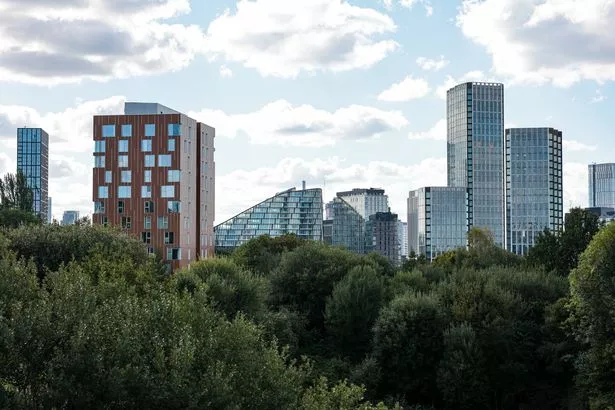 The new tram stop is planned at Sandhills(Image: Kenny Brown | Manchester Evening News)
Alongside this, the council is working on proposals for a new secondary school in the area as well as a new neighbourhood health centre. And now that it has been named as one of the first 12 ‘new towns’ in England, the council says it can all happen ‘much quicker’.
The local authority also hopes the first fruits of the £4bn project to be seen in Collyhurst will help sell the wider vision for the area which would effectively expand the city centre on mostly unused land and grow the local population by 40,000 over a 20-year period. But while the first residents to be rehoused on the new estate are ‘relieved’ to move in after years of delays, some are still sceptical.
Collyhurst Village, which is still a construction site, will feature 244 homes, of which 100 will be council homes, when it’s completed. The first two rows of terraces on the estate are now almost full with a mix of private buyers and council tenants having moved in.
Ashif Aba, 51, was among the first to buy a property on the estate. Like many of his neighbours, he reserved his home three years ago. Looking to upsize from his two-bedroom property nearby in Queens Road, Ashif’s family finally moved into their home this summer.
“I’ve been living in Manchester for 30 years,” he told the Manchester Evening News. “30 years ago, this area was run down. In the next 10 years, this will be like Ancoats.”
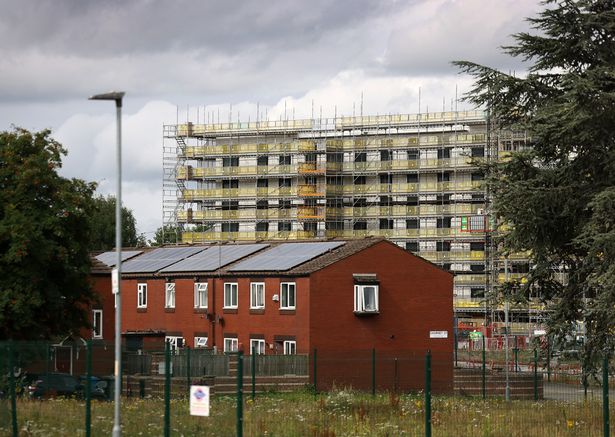 Some of the old council homes are set to be demolished to make way for the development(Image: Sean Hansford | Manchester Evening News)
Other ‘pioneer’ buyers, many of whom have moved to Manchester more recently, share Ashif’s optimism about the regeneration plans. But some of the rehoused residents who have lived in Collyhurst for decades are not pleased about having been ‘forced’ to relocate.
In total, 29 properties will be demolished as part of the first phase plans with all those affected offered new homes on the estate. The local authority and its developer partner are proud of their efforts to build bespoke properties for the residents they are rehousing, including a five-bedroom home built specifically for one big family and an adapted property for a council tenant who has a disability.
Rehoused residents have also received thousands of pounds in compensation. But despite all this, some were still reluctant to move.
“I really didn’t mind my house,” Catherine, 43, says, stood in the doorway of her brand new property. “I lived there for 22 years.”
“It is an upgrade,” she says of her new home. “It does feel nice and warm. And I do appreciate I’ve got grass in my garden now.”
However, another woman, who asked not to be named, was more scathing when reviewing her new home which she calls a ‘rabbit hutch’. And like Catherine, she complains about her monthly costs increasing as both rent and council tax are higher in the new builds.
“It’s like a tin of sardines,” the woman who has lived in Collyhurst for around 30 years says. “They’ve built them as narrow as possible. I suppose we’ve got to adapt.”
 The first homes in Collyhurst Village were completed in the summer(Image: Manchester City Council)
Manchester council says the new homes in Collyhurst have ‘generous space standards’, describing the new-builds – which are the same size as the £300,000-plus open market properties that were sold next door – as ‘some of the best social housing available’ in the city. But there’s no denying that the layout of the new estate is denser. That’s exactly what the project team is trying to achieve.
Ian Slater, who is the council’s assistant director of major regeneration, has worked on housing projects in the city for 30 years. He describes Victoria North as the ‘most ambitious’ projects he has worked on, likening it to the regeneration of Hulme in the 1990s.
As with Hulme, he says, what the council is dealing with in Collyhurst is ‘the wrong type of product in that place at that moment in time’. The current estate in Collyhurst was rebuilt in the 1980s when Manchester’s population was haemorrhaging – and ‘car was king’.
This led to a ‘strange’ layout which Ian describes as ‘inefficient’ with ‘too few houses occupying too much space’. “The city can’t make more land,” he says, strolling through the construction site. “It has to better use the land that it’s got to house a growing population.
“We think here is the opportunity to build new homes across a whole mix of tenures but more affordable homes as well. That’s the opportunity and the prize – we can accommodate Manchester residents better in the future.”
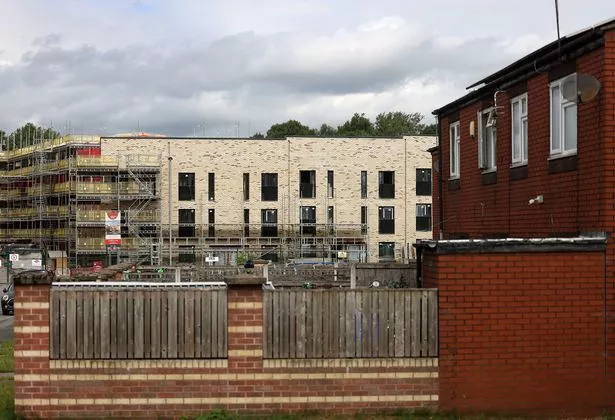 Residents complain of crime and anti-social behaviour in the area(Image: Sean Hansford | Manchester Evening News)
The new layout isn’t just denser. It has also been designed to reduce crime – something residents in Collyhurst hope will work. The M.EN. spoke to several residents in Collyhurst Village who raised concerns about crime and anti-social behaviour in the area – pointing to teenagers riding around on bikes with balaclavas on – and some of them ask to stay anonymous, fearing reprisals for speaking out.
One new homeowner told the M.E.N. that he had his bike stolen within a month of moving in, while others say they do not feel safe. Manchester council says anti-social behaviour ‘isn’t localised to Collyhurst’ and pointed to recent investment in citywide policing.
However, according to those behind the project, moving from the old Radburn design to a denser layout will help tackle the issue too. “I think the Radburn style, not just here but in other parts of the city, has not been great for things like crime,” says Manchester’s executive member for housing Gavin White. “We can’t turn the clock back but it probably wasn’t the best design at the time.”
One form of ‘densification’ that Manchester is very familiar with is building upwards. But developers want the ‘right mix’ of homes here. The further you go into the city centre though, the argument to built taller apartment blocks becomes ‘more evident’, Ian Slater says.
Several tower blocks have already been built as part of Victoria North, including the recently completed Victoria Riverside scheme. Of the 634 homes built across four blocks there, 128 are only available to households with a combined income of less than £80,000.
This shared ownership model, which offers a lower-cost way to buy, counts as ‘affordable housing’ – and while it won’t help those waiting for social housing, the town hall, which wants to increase the level of home ownership in the city, says it still meets a need. Affordable housing aside, the biggest challenge for Victoria North is ‘what lies beneath’ the land, according to council leader Bev Craig.
Like in Ancoats, tens of millions of pounds of government money is being spent on getting land in the area ready for development. Some of that remediation work has already started, making way for 5,500 homes opposite Victoria Riverside at the Red Bank plateau.
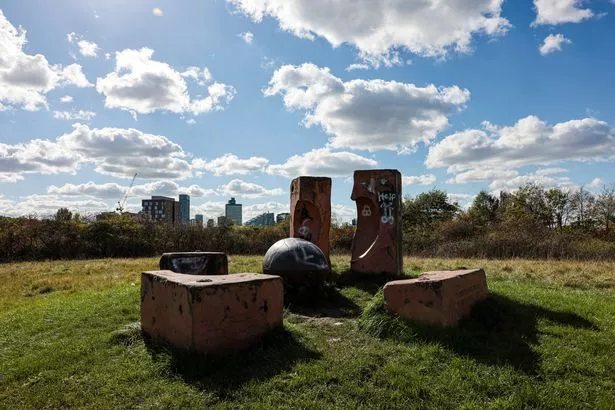 Barney’s Hill sits on a former quarry(Image: Kenny Brown | Manchester Evening News)
It’s a problem that’s common in Northern towns and cities – and it’s why so many other places have taken an interest in the project. “The north and the east of the city has always been the hardest bit because of what it used to be used for,” Coun Craig explains. Whereas the Manchester, Salford, Trafford cusp on that side, the access into the rivers and waterways, that was always the flowing in and out of dirty stuff that was made somewhere else.
“If you think about the journey of the last 30 to 40 years, it’s made sense that you do that bit first. It was always clear, it was always flat and it was always a transport hub. Whereas this is where stuff was made and transported through.”
Like Coun Craig, FEC director Tom Fenton regularly takes visitors to the city on a tour around the 390-acre site, including ministers, officials and advisers from the Treasury, Homes England and various other government departments as well as foreign ambassadors. The government has clearly been impressed, having recently announced that Victoria North will be one of its first 12 new towns.
The precise details of exactly what this will mean in practice hasn’t been agreed, but Tom is expecting an answer by next spring. His pitch to government was to build 10,000 new homes over the next 10 years across four of the seven neighbourhoods – and in return he is hoping to get a pot of money that can be used for infrastructure including the new tram stop and new schools.
Seven years in, the first 1,000 homes at Victoria North are almost complete. So when can investors expect to see a return?
“It’s not about making money quickly at the outset,” Tom says. “It’s about growing the viability over a period of time. The reality is there’s a lot of heavy lifting to be done in the early phases. We’re all sharing the burden of that.”
Last month, the council issued an update on its wider plans for regeneration in Collyhurst as part of Victoria North. This will include building more homes, a neighbourhood square and a new park. But it could also mean more demolitions.
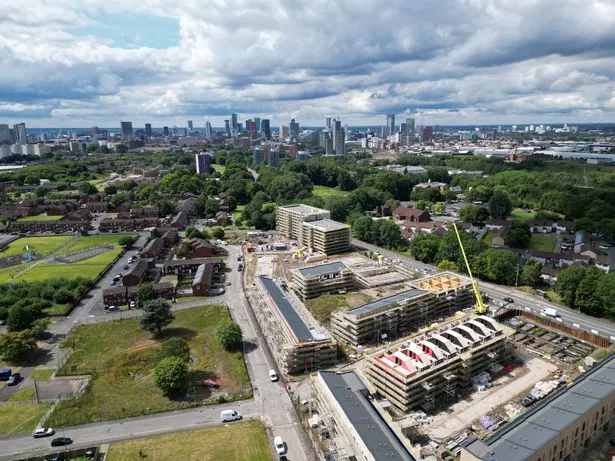 The Victoria North site spans 390 acres(Image: Sean Hansford | Manchester Evening News)
Some residents, backed by campaigners from the Greater Manchester Tenants Union, are calling for ‘an end to demolitions’, arguing that they are being ‘displaced’ with some council tenants saying they have been left ‘in limbo’ as the town hall decides what to do. Unlike their new neighbours who have bought new homes on the estate, some are ‘worried’ about the area turning into Ancoats.
Those behind the project say the regeneration of Collyhurst makes good on an old promise while creating more housing in the city. So who is actually buying these new properties? According to the developer, the latest open market sales data shows that 80 per cent of the new purchasers of properties currently live within Greater Manchester and around half of them are first time buyers.
However, most of the new homeowners the M.E.N. spoke to at Collyhurst Village had only moved to the city within the last few years. In some cases, the ‘pioneer’ buyers purchased their properties before they’d lived here at all, reserving them up to three years ago.
One such new homeowner, a 50-year-old woman who asked not be named, moved up from London in search of a ‘new start’.
“The thing I loved about this location is that it’s still walkable to the city centre but I can access nice parks,” she explains. “People are very friendly. Much more than London. People do look out for each other a lot.”
“I feel very sensitive to the fact that this is a big change for them,” she adds. “These are people who’ve lived here for decades. I lived in east London where there’s a lot of regeneration so I came in with a very respectful mindset.
“I don’t want to be part of the gentrification crowd. You’ve got to integrate as a community.”