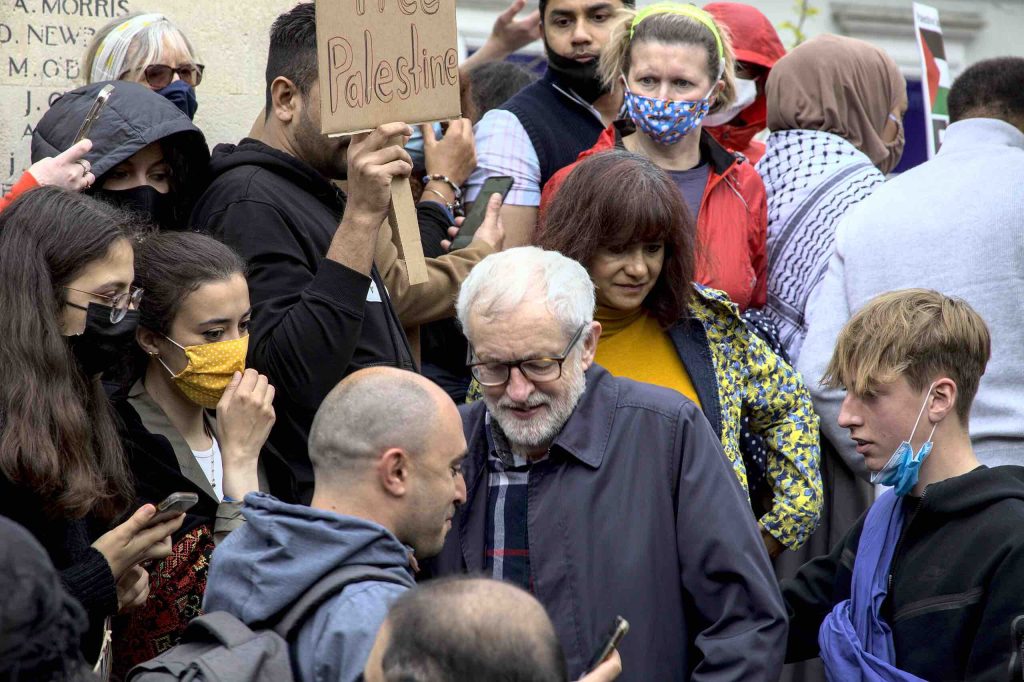
76British politics has always had a weakness for nostalgia, but Jeremy Corbyn’s newly launched political party must rank among the most unexpected retro revivals of recent years.
Corbyn’s latest attempt to return to front-line politics feels rather like a deleted scene from a film we all thought had wrapped. Yet here he is, stepping back into the limelight with a new political project built on the same familiar themes: Britain is the villain, Western alliances are suspect, and the only just wars are those fought by groups violently opposed to London’s foreign policy.
For all the talk of “fresh energy” and “renewed purpose,” Corbyn’s new outfit looks less like a bold leap forward than a museum of his greatest hits — or, depending on one’s viewpoint, his most enduring controversies.
The Ghosts of Politics Past
Corbyn’s political record is a matter of public record, and his detractors have never struggled for material. In the 1980s, his invitations to figures linked to the Provisional IRA earned him a reputation that stuck — not least because he refused to condemn the group’s bombing campaigns outright at the time. His explanation was always the same: he was pursuing peace through dialogue. For his critics, however, it all looked rather too cosy for comfort.
Likewise, his longstanding engagements with representatives of Hamas and Hezbollah — groups he once described, in his now-famous formulation, as “friends” — continue to haunt him. Corbyn later insisted the term was “a collective” one, spoken in the context of fostering diplomatic dialogue. His opponents saw it rather differently: as a troubling willingness to extend political warmth to organisations whose commitment to democracy is, shall we say, less than robust.
___________________________________________________________________________________________________________________________

Image credit: Palestinian Embassy in Tunis, via Facebook.
One of the most damning episodes highlighting Corbyn’s anti-Israel stance was his appearance at a wreath-laying ceremony in Tunisia in 2014, commemorating individuals linked to the 1972 Munich Olympics massacre, in which 11 Israeli athletes were murdered by Palestinian terrorists.
Corbyn’s presence at the ceremony, coupled with his evasive responses when questioned about it, reinforced perceptions that his criticism of Israel was not merely political but perhaps deeply rooted in ideological bias.
___________________________________________________________________________________________________________________________
These episodes are not footnotes. They shaped how the public perceived Corbyn as Labour leader, and they shape how they will perceive this new party. For many voters, Corbyn’s foreign-policy worldview simply sits too far outside the British mainstream: a blend of anti-Western scepticism, reflexive suspicion of American power, and an instinctive sympathy for almost any anti-establishment movement overseas, no matter how illiberal its methods.
The New Party With Old Problems
Corbyn’s new movement — whose official name matters less than its unmistakable ideological DNA — presents itself as the antidote to Starmerism. Where Labour now seeks moderation, Corbyn offers purity. Where Starmer talks about fiscal responsibility, Corbyn talks about “ending austerity” for the fifteenth consecutive year. Where Starmer tries to reassure Britain’s allies, Corbyn offers a foreign policy warmly received in Caracas, Havana and various parts of the Levant.
There is a market for this, of course. A small one. But its size is not necessarily the point. For Corbyn and his allies, the purity of the message matters more than its popular appeal. Electability was always a secondary concern behind the loftier mission of global reorientation — ideally away from NATO and toward a vague internationalist brotherhood that has never successfully existed anywhere except on left-wing academic reading lists.
One suspects Starmer will not be mourning the return of Corbynism to the ballot. If anything, it allows Labour to point at Corbyn’s new project as an external embodiment of everything the party has tried so desperately to exorcise. “That was then,” Labour can say. “And this is now.”
Voters Didn’t Forget — They Remembered All Too Well
Corbyn again insists Britain is ready for his vision. The voters, however, have always said otherwise. Repeatedly, and in increasingly loud tones. The 2019 general election wasn’t judged harshly because the manifesto was misprinted. It was because the public took one look at Corbyn’s worldview — from economics to national security — and politely, then firmly, declined.
Britain is, after all, a country with a long memory. It remembers the IRA bombings. It remembers Islamist attacks on British soil. It remembers the need for strong alliances — particularly at a time when Russia, China and Iran are shaping the international environment with far less regard for niceties.
Against that backdrop, Corbyn’s instinct to distrust Britain’s own institutions, to frame Western democracies as the problem rather than authoritarian regimes he appears to admire, has always strained his credibility. And while his supporters admire his “principled consistency,” much of the country simply sees stubbornness dressed as virtue.
A Party Destined for the Footnotes?
Realistically, Corbyn’s new party is unlikely to break into the mainstream. But it could drain votes from Labour in precisely the wrong constituencies, creating havoc at the margins. The Conservatives will quietly welcome this. Reform will cheer. And Corbyn’s supporters will hail every lost Labour seat as proof that their message is catching fire — even as it burns down no one’s house but their own.
If the new party proves anything, it is that Corbyn remains convinced the public didn’t reject Corbynism — they merely misunderstood it. His movement is built on the belief that ideological conviction matters more than public consent, and that Britain will eventually come round to his worldview through sheer force of repetition.
A Revival No One Requested
And so Corbyn steps back onto the political stage, armed with familiar grievances, familiar allies, and familiar controversies he insists were all part of a noble pursuit of peace. Whether this convinces anyone beyond his devoted base remains doubtful. Britain in 2025 is not yearning for a revival of Cold War posturing or radical anti-NATO adventurism.
But this much is true: Corbyn’s new party offers something clarifying. It shows just how far Labour has travelled. It crystallises the difference between pragmatic governance and performative radicalism. And it reminds the electorate — vividly — of the political experiment it was asked to endorse just a few years ago. If nothing else, that is public service.
Main Image: By plasteredparrot – Leader of the Opposition, CC BY-SA 2.0, https://commons.wikimedia.org/w/index.php?curid=105417278
Jeremy Corbyn: Britain’s Controversial Supporter for Left-Wing Extremism
________________________________________________________________________________________________________________________
Post Views: 979