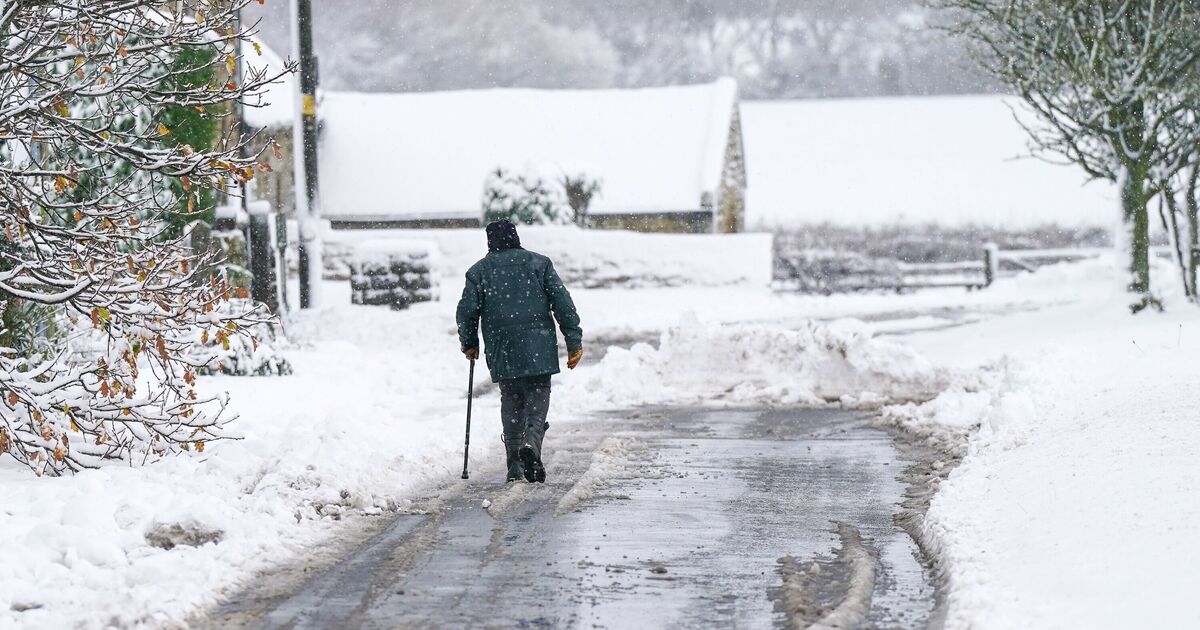
Weather maps have suggested that seven snow bombs are set to hit the UK simultaneously. Wintry weather is in store for multiple areas north of Manchester, WXCharts predicts, as December gets under way. Meteorological winter has begun as of today, with astronomical winter not quite yet upon us, expected to begin on December 21. But festive conditions are in store nonetheless, forecasters believe.
One of the snow patches, expected early on December 6, looks to include Manchester, as well as an area above the city. Maps then show two areas over the Lake District and Pennines, to the west of Newcastle. Above those seem to be three more across the border into Scotland – two larger ones and one smaller purple area. Finally, a larger covering of snow is expected north of Glasgow and to the West of Dundee.
The Met Office says in its long range forecast for Deecember 5 to 14: “Likely a continuation of the unsettled conditions see for much of the week. Initially, a weakening frontal zone will bring cloud and some patchy rain and drizzle, mostly to northern and eastern areas. Following this, winds are likely to fall light, and this could allow some fairly widespread mist and fog to form on Friday morning.
“However, this should readily lift as winds begin to freshen once more ahead of a further band of rain expected to reach western areas later on Friday.”
Experts add: “This could bring a spell of locally heavy rain as it moves east across the country, particularly on hills exposed to the strong southerly winds.
“Thereafter, likely to remain unsettled into the weekend, with further rain or showers for most. Temperatures not far from average throughout.”
Specialists say that water falls as snow when the air temperature is below 2C, and it is a myth that it needs to be below 0C.
The Met Office adds: “In fact, in this country, the heaviest snowfalls tend to occur when the air temperature is between 0C and 2C.
“The falling snow does begin to melt as soon as the temperature rises above freezing, but as the melting process begins, the air around the snowflake is cooled.”