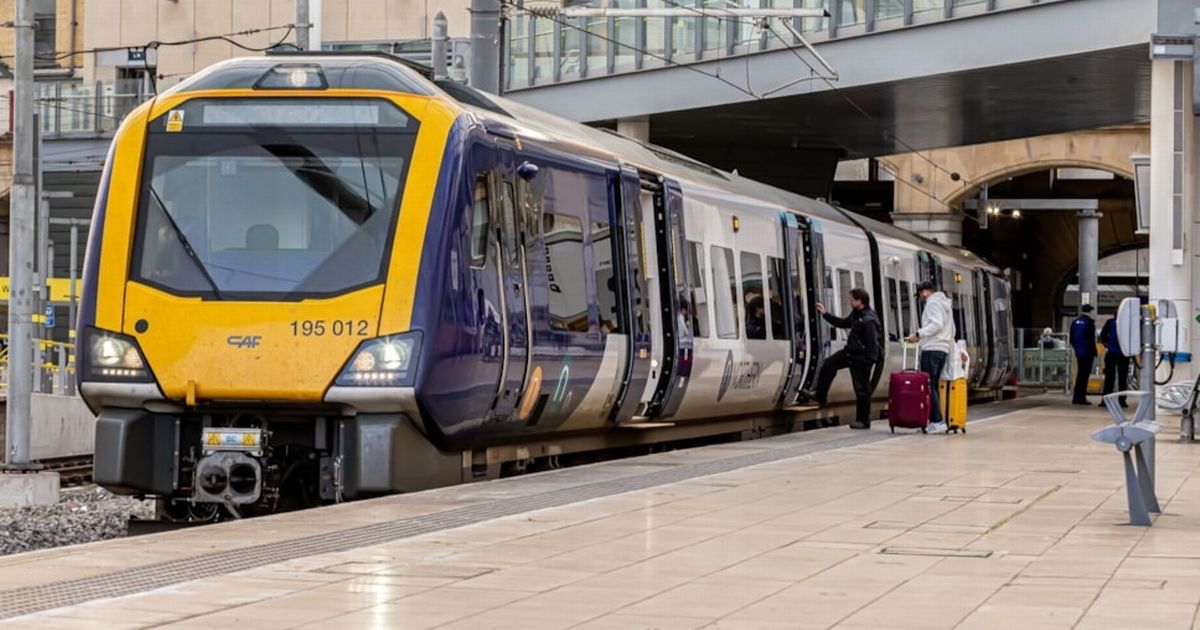
North’s biggest rail operator recently had its busiest month of customer travel since before the pandemic. Rob Parsons reports
Rob Parsons Northern Agenda Editor
09:33, 01 Dec 2025
 Northern Trains has seen a growth in passenger numbers in recent months
This time last year the North of England’s biggest rail operator was not in a good place. Reprimanded by the Government in the summer for its poor performance, Northern Trains even got a public dressing down from Andy Burnham when it emerged it was still using fax machines to communicate with staff.
“People in the North of England should not be expected to put up with a substandard service”, said the Greater Manchester mayor last October. “People here should no longer be treated as second-class citizens when it comes to transport.”
Read more: Andy Burnham aims for ‘quick decision’ on Bee Network rule affecting hundreds of thousands
Twelve months on and, as Mr Burnham chaired a meeting of the Rail North Committee last week, he told Northern boss Tricia Williams the region’s leaders appreciated the firm’s efforts to turn things round. “It was a particularly difficult autumn last year, and [Northern] is clearly not now in that place.”
The state-run operator, which has some 370 trains serving the towns and cities of the North, said last year it was hampered by not having an agreement for staff to work on their days off, meaning performance levels dipped alarmingly on Sundays in the North West as trains were cancelled at short notice.
Since then train drivers (if not conductors) have agreed to work on Sundays, helping the number of cancellations to drop by two-thirds and overall performance to stabilise. And with train travel in the North now more reliable, there’s been a very encouraging growth in passenger numbers.
Northern recently recorded its busiest month of customer travel since before the pandemic, with more than 8.1 million journeys made across its network between September 14 and October 11. This is an 8.3 per cent up on the same period last year and the most journeys in a four-week window since February 2020.
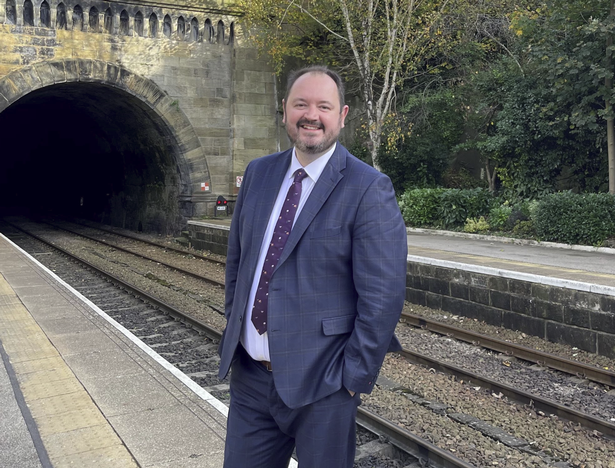 Northern’s commercial and customer director Alex Hornby
“We’re much improved on last year,” Northern’s commercial and customer director Alex Hornby tells me in an interview last week. “And that isn’t just what the performance is telling us, it’s also what the customer numbers are telling us, what revenue is telling us, and what satisfaction is telling us as well.
“So all those metrics are up. So something is clearly going well, and when we look at performance, that tells us we’re running more trains on time as well. But I think we’re seeing better scores around how customers feel they’re being spoken to, the visibility of staff, how they’re treated by our staff. People are feeling better about Northern and the railway.”
The aim is to get to 90 per cent of trains arriving within three minutes of scheduled time, with the most recent rate 77.27%. But train faults were Northern’s main reason for missing the target, an issue that hints at a wider problem holding back its improvement plan.
Putting it bluntly, Northern doesn’t have enough actual trains – and the ones they do have are very old and more likely to break down, despite the best efforts of its engineers.
As an example, Northern recently secured two extra Class 769s (diesel and electric hybrid trains) to run on the line between Stalybridge and Southport to support its official fleet whilst work is carried out to make the existing trains more reliable.
As the Office of Rail and Road graphic below shows, it has the third oldest fleet of trains of any operator in the country, with nearly half its fleet dating back to the 1980s and 1990s. The plan is to replace two thirds of the existing fleet in the next decade, with up to 450 new trains arriving in a huge new procurement that’s in the works.
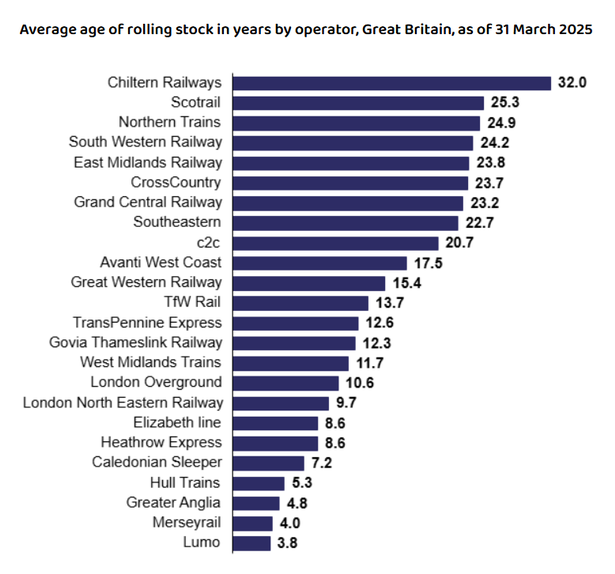 Office of Road and Rail graphic showing the age of the rolling stock at every rail operator
Mr Hornby says the investment will be transformational for customer comfort and net zero, with smaller trains replaced by bigger ones and diesel trains replaced with greener multi-mode vehicles. But the first new trains won’t arrive until 2029, so passengers won’t feel the benefit for another few years.
Mr Hornby concedes the ageing fleet is “not good enough as a message about investment in rail in the North, that isn’t obviously where we want it to be”, though he says the trains have been heavily refurbished so it’s not always obvious how old they are.
“I think it does hold us back”, he says. “If you look at Greater Anglia’s performance, they’ve virtually got a fleet of brand new trains, and guess what? Their performance is better than ours. So obviously it does play a factor.
“It’d be wrong of me to say otherwise, but at the same time the scarcity of rolling stock in the UK, I would say, is more what is holding us back from an ability to deliver the kind of services the customers expect. Because we want to put more carriages on, we know that on certain lines that is preventing further growth.
“If we could get similar age rolling stock, but more of it, I think we would be up for that. We wouldn’t see that as giving us a bigger problem. We’d actually see that as an opportunity.”
Tricia Williams, Northern’s managing director, conceded a similar point at the Rail North Committee (RNC) meeting as she described fleet availability issues impacting particular routes. “There is not a lot of rolling stock available”, she told Northern leaders.
A case in point is in Yorkshire, where a new rail timetable coming in on December 14 will now include an hourly fast train between Leeds and Sheffield. Sheffield council leader Tom Hunt welcomed the move at the RNC but questioned why the new service would only have two carriages rather than three or four – won’t that mean demand for the service will soon outstrip its capacity?
Ms Williams said her team would “be keeping a close eye on that and using data to understand where the pinch points are”. She added: “But there isn’t a lot of available stock then to supplement that going forward. So it may well be a conversation that we come back to in the future.”
Mr Hornby says the December timetable will see a number of improvements to services in Yorkshire and the North East. In the North West, the more limited timetable will remain as the RMT union’s members are yet to sign a rest day working agreement for conductors, making a ‘seven-day railway’ difficult to achieve.
In the longer term, a top priority for Northern is persuading more people to get on the train. The more passenger revenue the company gets, the less subsidy the operator will need from the hard-pressed taxpayer.
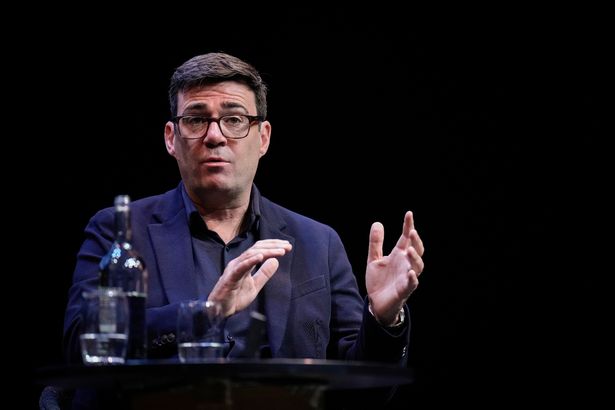 Mayor of Greater Manchester Andy Burnham has previously criticised Northern’s performance(Image: Getty Images)
To make this a reality Northern has unveiled its ’30 by 30′ strategy – based on data from some 4,000 people around the North – to grow annual customer journeys by 30 million by the end of the decade.
The hope is that 10 million of these journeys will come from passenger numbers continuing to grow and a further 10 million by making services more reliable (with 90% of trains arriving on time and less than 2% cancelled).
But the company is also using the data to improve in other areas, like flash sales which saw customers snap up 150,000 advance tickets priced from £2. Pay As You Go ticketing is being trialled in parts of Yorkshire and Greater Manchester is simplifying its fares to just ‘anytime’ and ‘off-peak’, with the Newcastle-Carlisle line soon set to follow suit.
More and more people in the North are returning to offices – a trend Mr Hornby says is more evident here than in the South East – meaning the number of season tickets purchased by commuters has risen by 13% over the last year. At Manchester and Liverpool’s stations, there’s been a growth in passenger numbers in recent months.
“And we’re still seeing growth in leisure”, he says. “So people are still using the train as a choice to go and do shopping and visit relatives as well. So there is still that head of steam.”
Northern still isn’t getting an easy ride from the likes of Andy Burnham, who this week described the “phenomenal” number of people wanting to get about by train in the Northern – to venues like Manchester’s Co-op Live or Everton’s new Hill Dickinson Stadium.
“That demand is absolutely there, but too often it’s having a very poor experience, and then it might turn away,” he said. “And we’ve got to get ourselves into a better position at meeting the demand of people who want to travel and making sure they can do it with a decent service.
“I still feel that we’re not quite there in terms of anticipating some of those major events in our cities, putting in place plans to make the experience as good as possible. I think we’re dropping the ball a little too much in my experience.”
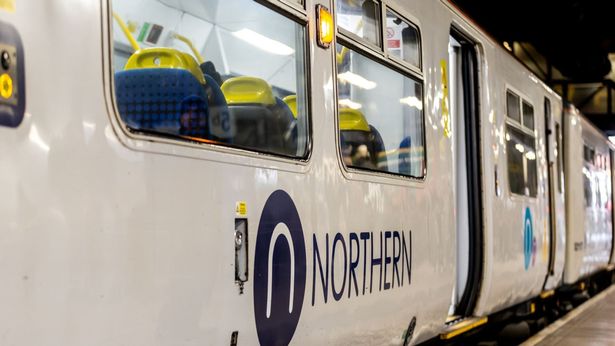 A Northern train at a station. Image: Northern Trains
The mayor has made no secret of his desire to take parts of the rail network around Greater Manchester into his publicly-run Bee Network of trams and buses, a move that could see his mayoral authority take over stations and services currently run by Northern.
Mr Hornby says he respects the mayor’s wishes and is happy to go along with them, though says there’s still work to be done to balance the needs of local services in an area like Greater Manchester with those of the wider rail network.
And he says Northern and transport bosses in Greater Manchester are “completely aligned” on the need to tackle the issues that are putting people off train travel.
“We’ve had those conversations,” he says. “We said, last year, when the Oasis concerts were on at Heaton Park [in Manchester], there should have been later rail services [to get gig-goers home afterwards]. We were in a position where we couldn’t do that. But hopefully, if that was to ever happen again it’s something we could look at and see what we could do to improve.”
And next year, when there are big events on at the likes of Co-op Live, officials will be looking at whether extra services can be provided on top of the existing fixed timetable.
“It is about being really conscious of not just what the railway wants to do and what the railway has always done in the past,” he says. “It’s about being reflective of what customers want us to do, and what the cities want to do, what is going on in local areas that mean that people need a better service or more services.”