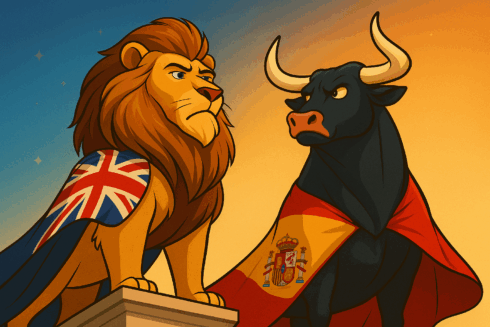
A NEW analysis by The Economist has delivered a surprise that may bruise egos on both sides of the English Channel: the country it says is most similar to Britain is not Denmark, not America, not Germany – but Spain.
The finding comes after the magazine compared OECD nations across ten social, economic and cultural indicators to see which ones genuinely resemble Britain.
And despite centuries of rivalry, a long history of mutual misunderstanding and a modern British habit of looking northwards to Scandinavia for policy inspiration, Spain comes out as the closest match.
According to the analysis, Denmark and Sweden – often treated as role models by British politicians – are nothing like the UK once the numbers are tallied.
Both are smaller, richer, less religious, more highly taxed and significantly happier than Britain. America, meanwhile, is far wealthier, far more religious and socially different in almost every category.
Spain, however, sits almost exactly alongside the UK on a surprising set of measures: population size, GDP per person, alcohol consumption, life satisfaction, the foreign-born share of the population, the percentage of births outside marriage, employment in services and levels of religious belief.
Even tax levels and the health of democracy fall into a remarkably similar range.
The similarities do not end with data.
Historians note that the two countries share strikingly parallel pasts: both built – and lost – vast American empires; both ruled composite monarchies made up of culturally distinct kingdoms; and both now grapple with strong separatist movements.
Spain has Catalunya and the Basque Country; Britain has Scotland and Northern Ireland.
There is also the question of perception. For centuries Britons viewed Spain through the old ‘Black Legend’, painting it as zealous, cruel or simply backward, while Spanish thinkers worried about being ‘peripheral to Europe’.
Yet in the post-Brexit era, those positions have flipped: Spain has become more central to Europe while Britain has drifted to the margins.
British tourists, however, have certainly noticed Spain’s appeal – visiting it twice as often as France, the next most popular destination.
READ MORE: E-scooter users in Spain will need to get insurance from January – after spate of deadly incidents
People who have lived in both countries point to familiar traits that rarely appear in Westminster debates.
Both societies share a streak of self-deprecating humour and a sense that things are always slightly going wrong but can nevertheless be endured.
Workers who move south describe a more relaxed approach to life and a fondness for long lunches, but also a cultural outlook that feels unexpectedly close to home.
Meanwhile, language-learning data shows the relationship tightening: Spanish has overtaken French and German as the most studied foreign language at GCSE level.
Britain may not be embracing Europe politically, but its teenagers are quietly voting with their vocab lists.
The Economist argues that if British policymakers want to learn from countries that truly resemble their own, they should look less to Scandinavia and more to the country they once dismissed.
Spain’s rapidly growing economy and more open stance on immigration offer a counterpoint to Britain’s stagnation and political caution.
Whether this comparison flatters either nation is another matter.
But for The Economist, the numbers point in one direction: if Britain has a twin in Europe, it is not the one its politicians obsess over – it is the one millions of Britons flock to every summer.
Click here to read more International Affairs News from The Olive Press.