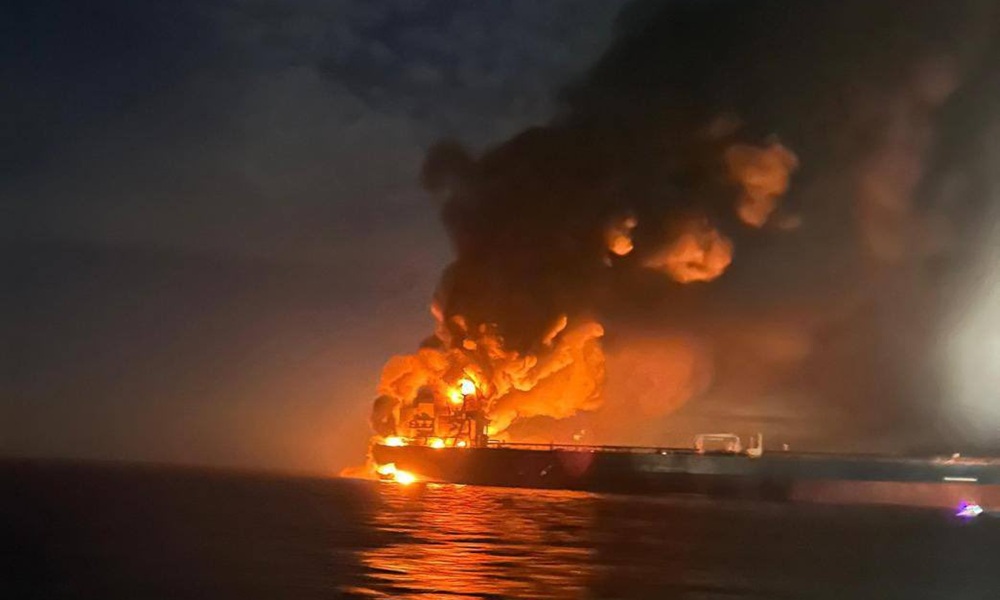
The Panama-flagged tanker Mersin suffered four external explosions while at anchor off the coast of Dakar in Senegal, according to its Turkish manager, Besiktas Shipping.
The attack happened late on November 27, and resulted in the ship’s engine room flooding.
Mersin has long been engaged in transporting refined products from Russia to Africa and South America and has been anchored off Dakar since late September. Its last AIS signal was recorded on November 23. Images shared online show the stern perilously close to the waterline.
The timing of the incident, so soon after high-profile strikes on Russian-linked tonnage, has fuelled conjecture in the market that Ukrainian special forces were behind the attack— even though Mersin is not sanctioned, is G7 price-cap compliant, and has a known beneficial owner.
Five vessels this year — Vilamoura, Grace Ferrum, SeaJewel, Seacharm and Koala — have already been damaged in mysterious blasts, with one common thread: all had previously called at Russian ports.
“The Mersin is more than a sinking ship. It’s a warning that opaque Russian oil flows are not ‘cost‑free’ for the world. If this can happen off Senegal, systemic risk is already sitting off coasts everywhere,” commented Ami Daniel, CEO of maritime analytics firm Windward, in a post on LinkedIn yesterday.
Meanwhile, insurance rates for ships transiting the Black Sea have shot up in the wake of Ukraine’s naval drone strike late on Friday on two Russia-linked shadow fleet tankers – the Kairos suezmax (pictured) and the Virat aframax.
“The incident is regarded as the most significant attack on commercial vessels in the Black Sea since the start of the conflict,” analysts at broker BRS suggested in a new tanker report.
Turkish president Tayyip Erdogan said on Monday that attacks on commercial ships in the Black Sea were unacceptable, issuing a warning to “all related sides”.
“The war between Russia and Ukraine has clearly begun to threaten navigational safety in the Black Sea. The targeting of vessels in our exclusive economic zone on Friday signals a worrying escalation,” Erdogan told reporters.
The double tanker attack follows a separate drone wave earlier last week that hit two bulkers and the CPC Pipeline headquarters on 26 November . In the same wave of attacks that damaged the tankers, a drone hit the CPC offshore terminal at Novorossiysk, which handles over 1% of global oil supply and nearly 80% of Kazakhstan’s exports .
The terminal operates three single-point moorings. SPM2 was disabled in the strike and may be out of operation for up to a year, according to BRS. The backup SPM3 has been offline for maintenance since November 12 and is expected to return only in about two months, while SPM1 remains the sole operational mooring point.
“Export capacity is therefore set to be constrained until early 2026,” BRS stated, with volumes currently at about half their usual level .
“The attacks may elevate regional risk premiums and could temporarily shift Europe’s light crude sourcing towards alternative light, sweet crude suppliers such as the US and North Africa,” BRS suggested.