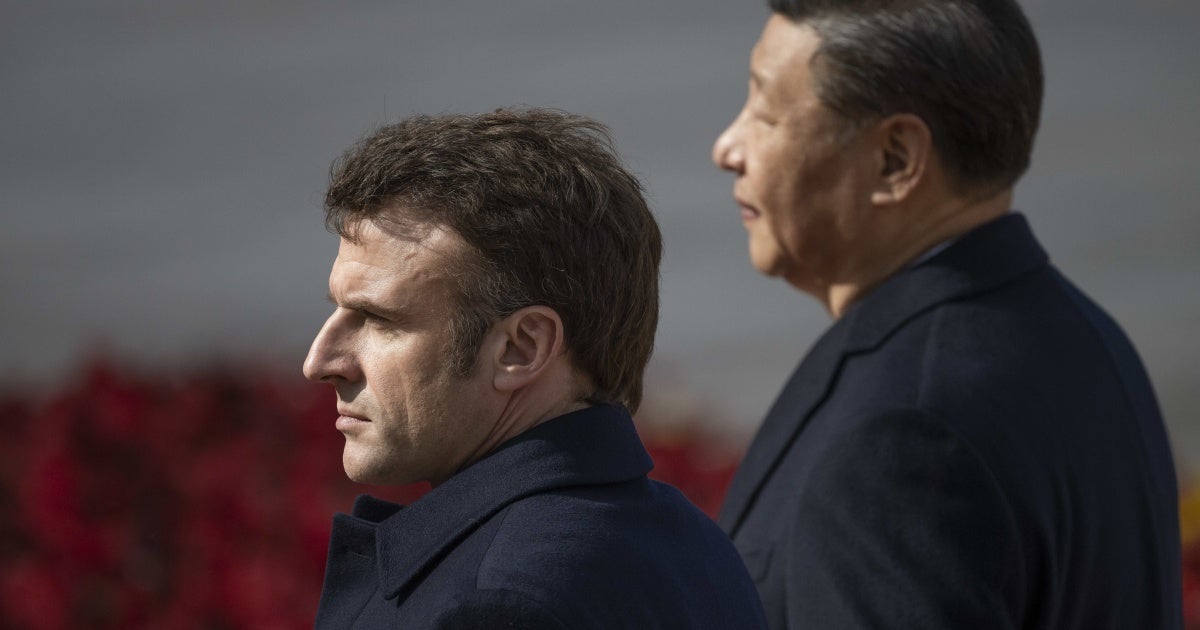
French President Emmanuel Macron should privately and publicly stress the importance of human rights in Sino-French relations during his visit to China from December 3 to 5, 2025, Human Rights Watch said today. Macron’s visit is one of several top-level engagements between European and Chinese leaders amid the complex and shifting geopolitical relationships among Europe, China, and the United States.
President Macron should signal his commitment to taking concrete action in response to deepening repression by China. Key issues include labor rights abuses in China’s supply chains; commercial drones produced by China-based companies being used by Russia to attack civilians in Ukraine; and China’s use of transnational repression to target critics abroad, including in France.
“China’s disregard for human rights has important implications for France, from weapons used in unlawful Russian attacks in Ukraine to abusive supply chains that hinders fair competition for European industries,” said Bénédicte Jeannerod, France director at Human Rights Watch. “Macron should break the silos between human rights and other issues and show leadership by including rights concerns in high-level policy discussions with China.”
Efforts by France and other EU countries to address serious human rights violations in China have been hindered by a willingness to distinguish them from other economic and political aspects of the relationship, Human Rights Watch said. Macron should acknowledge their interconnection and demonstrate leadership by including human rights in its broader policy discussions with China.
The opening of the Chinese company Shein’s first physical store in Paris has raised various concerns, including a company business model that allegedly relies on labor abuses and deceptive commercial practices that include sourcing from state-imposed forced labor in Xinjiang.
Media and nongovernmental organizations have reported that Shein workers in China toil for excessive hours for very little pay. Shein has said it is committed to supporting suppliers to create working conditions that meet international standards for health and safety, labor, and social welfare.
Human rights groups have also documented the use of Chinese state-imposed forced labor involving Uyghurs and other Turkic Muslim communities in China’s cotton, automotive, solar, and critical mineral supply chains. The United Nations, Human Rights Watch, and other organizations have for several years reported on crimes against humanity by Chinese authorities in Xinjiang. a predominantly Muslim Uyghur region.
The European Union’s Forced Labor Regulation, once fully implemented in December 2027, will provide an important tool to block products made with forced labor from the EU market, including those from China. The risk of human rights abuses in supply chains also underscores the need to preserve the EU’s corporate sustainability legislation, which the EU, with the support of the French government, is currently seeking to water down.
Macron has pushed for the EU to use its “trade bazooka” law, the Anti-Coercion Instrument, to address China’s coercive trade practices. But he should reiterate that China’s full compliance with international conventions recently ratified by China-International Labour Organization (ILO) Convention No. 29 on forced labor and ILO Convention No. 105 on state-imposed forced labor-are critical for strengthening ties between the two countries.
Human Rights Watch in June documented Russia’s use of commercial drones produced by China-based companies to attack civilians in Kherson, Ukraine. Macron should press the Chinese government to ensure that these drone companies prevent sales to sanctioned entities and cooperate with investigations into unlawful attacks on civilians in Ukraine.
China has also increasingly carried out cross-border abuses-known as transnational repression-to oppress critics of the government abroad and impose ideological control, including in France.
In a recent case, Chinese authorities in July arrested Tara Zhang Yadi, a Chinese student who had been studying in France, upon her return to China. She faces up to 5 years in prison, or up to 15 if found to be a ringleader, under charges of “inciting others to split the country and undermine national unity,” because she advocated for Tibetan rights while in France. This arrest comes amid broader Chinese government efforts to demand that foreign institutions, including museums in France, refer to Tibet as Xizang, a Mandarin name for the region.
“Millions of people in China, France, and the EU continue to bear the weight of Beijing’s repression and abuses,” Jeannerod said. “Macron should stop trying to justify France’s silence on rights and make clear that the Chinese government’s repression affects many core French and EU interests, and that China needs to reverse course to maintain strong relations.”
/Public Release. This material from the originating organization/author(s) might be of the point-in-time nature, and edited for clarity, style and length. Mirage.News does not take institutional positions or sides, and all views, positions, and conclusions expressed herein are solely those of the author(s).View in full here.