The finalists for the high-profile Project Domani (‘tomorrow’ in Italian) include Japan’s Kengo Kuma, Italy’s Renzo Piano, and New York-based Selldorf Architects, which recently reworked the gallery’s Venturi, Scott Brown-designed Sainsbury Wing.
The shortlist also includes Foster + Partners, a joint bid by Farshid Moussavi Architecture and Piercy & Company, and London-based Studio Seilern Architects.
The competition, organised by Colander Associates, attracted 65 submissions.
The winner will design an entirely new 5,500m²-7,000m² wing for the gallery, which will also provide ‘a vibrant, fresh experience’ for visitors with new public spaces between Leicester Square and Trafalgar Square.
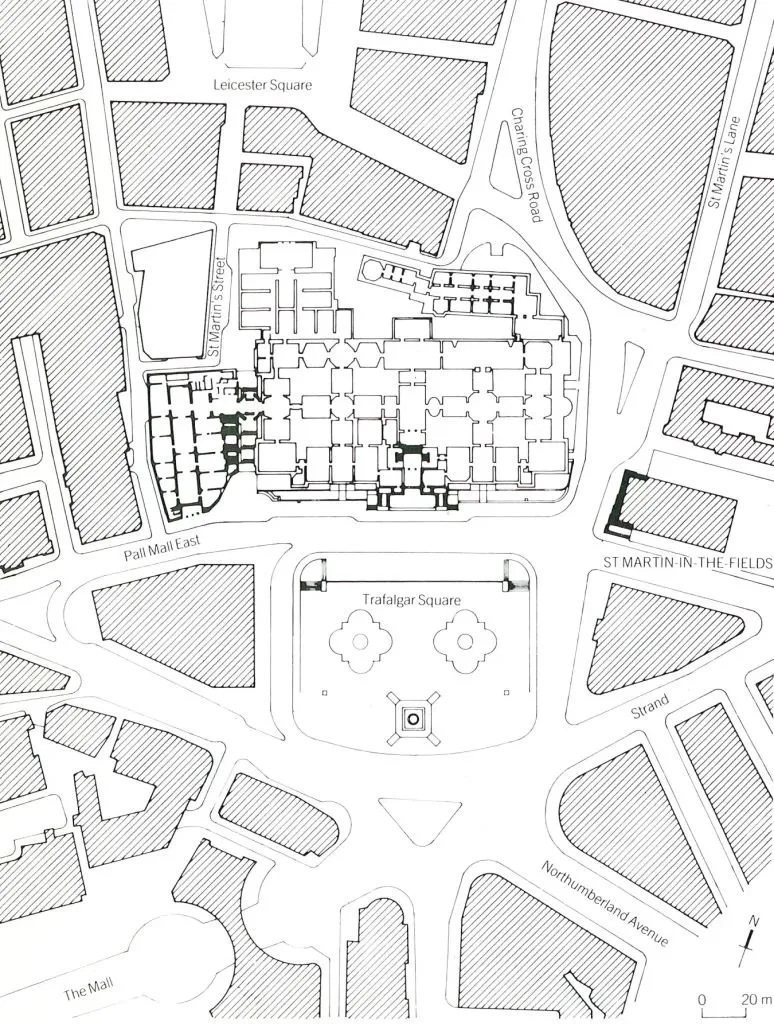
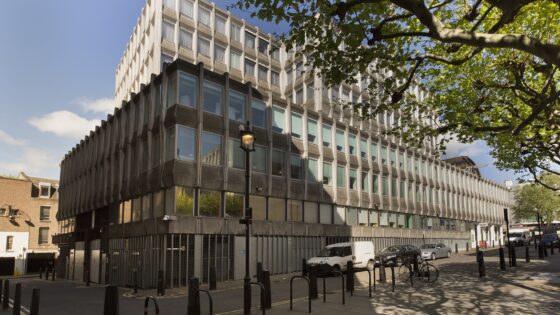
The wing will sit on the site of St Vincent House, a late-1960s block by Charles Pike & Partners, north of the main building. The gallery bought the property nearly 30 years ago for the purpose of expanding gallery space. It currently houses a hotel and office complex.
The shortlist in full
- Farshid Moussavi Architecture + Piercy & Company (both UK)
- Foster + Partners (UK)
- Kengo Kuma and Associates (Japan) + BDP (UK)
- Renzo Piano Building Workshop (Italy) + Adamson Associates (UK)
- Selldorf Architects (USA) + Purcell (UK)
- Studio Seilern Architects (UK)
It will be the third and final stage of a redevelopment masterplan launched by the gallery in 2018 and the gallery’s largest project in its 200-year history.
The National Gallery was designed by William Wilkins and occupies the northern end of Trafalgar Square. The latest project comes two more than decades after Dixon Jones delivered a series of entrance upgrades to the complex.
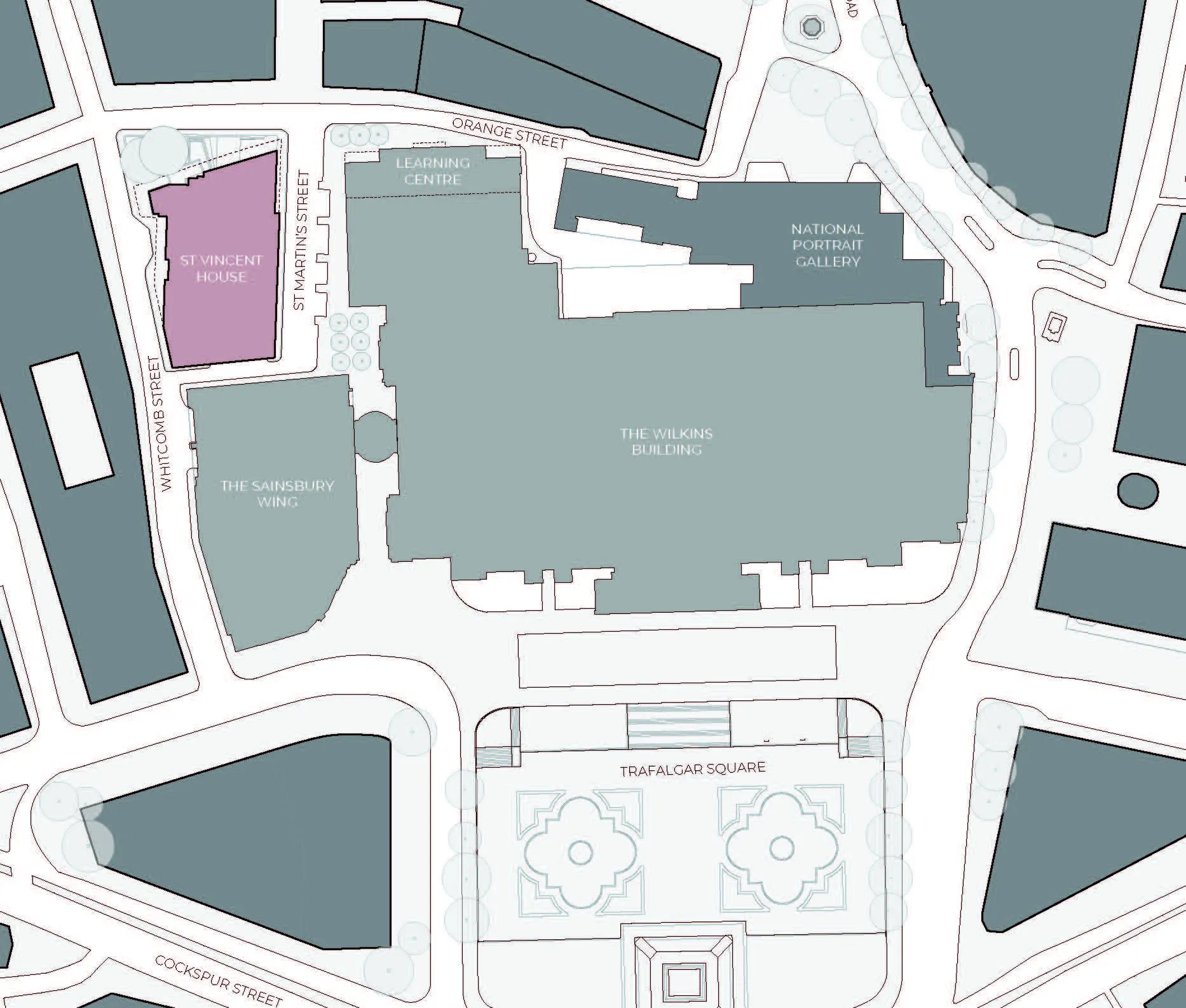
Site plan showing St Vincent House
The competition jury is being led by National Gallery board of trustees chair John Booth, and includes artist Céline Condorelli, former director of The Imperial War Museum Diana Lees and architect Patty Hopkins who was a National Gallery Trustee between 1998 and 2006.
Booth said: ‘The National Gallery’s renowned collection of great paintings and our ambition to develop this further for the benefit of a larger, more diverse public demands a space that not only preserves and displays the collection, but also elevates the visitor experience, enhancing the gallery’s reputation as one of the most visited and stimulating museums in the world.
‘We look forward to finding the right architectural partner to join us on this once-in-a-lifetime journey to create a landmark of local and international significance: creatively ambitious, technologically innovative and environmentally sensitive.’
The six shortlisted teams will each receive a £50,000 honorarium to participate in the second round: a design competition.
The winning architect and wider technical design team will be appointed in April, and the wing is planned to complete in 2030.
View images, drawings and details of the National Gallery in the AJ Buildings Library