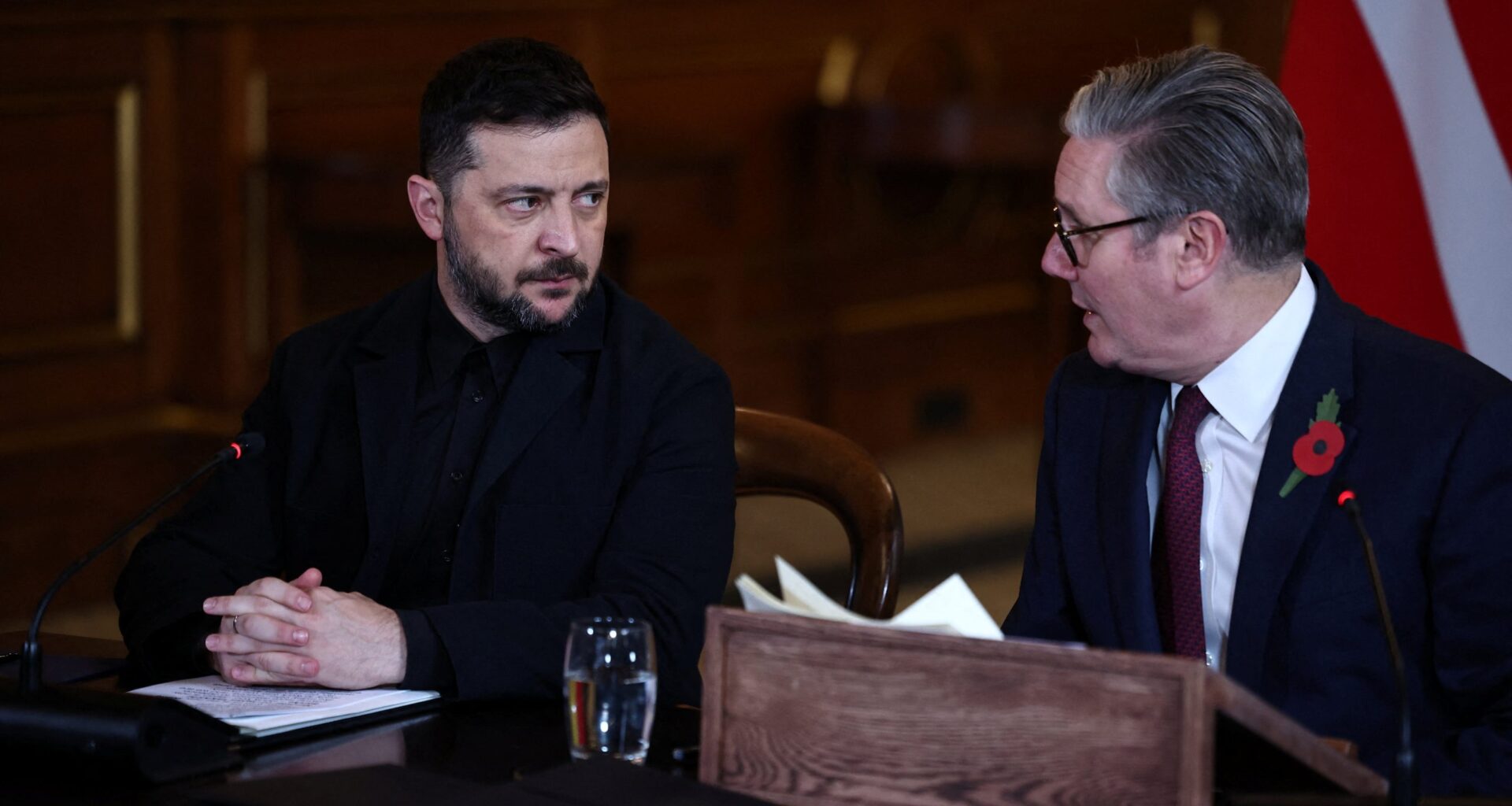
The renewed push for a peace deal to end Russia’s war against Ukraine comes at a time of acute vulnerability for Kyiv, and of unmistakable opportunity for Moscow.
Presented as a pragmatic path to end the fighting, the proposal instead reveals itself as a highly politicized Kremlin effort to cement gains, fracture Ukraine internally, and reconfigure Europe’s security landscape to Russia’s long-term advantage.
For European and UK policymakers, understanding the nature of this proposal and the coercive context in which it is being floated is crucial. Far from guaranteeing stability, accepting such a deal in anything close to its current form would expose the continent to greater risk. That is the case now (when the talks seem to have reached an impasse), and will remain so if some version of the same deal is presented in the future.
The timing of Russia’s move is calculated. Ukraine is simultaneously grappling with two crises: a major corruption scandal and a continuous energy emergency as Russian missiles systematically destroy the country’s electricity infrastructure. While the corruption in fact demonstrates that Ukraine’s anti-graft efforts are stronger than ever, they nonetheless tarnish President Zelenskyy’s reputation since it has exposed individuals from his inner circle.
The deal itself is riddled with odd, even unserious, formulations. Provisions such as a requirement that Ukraine refrain from striking Moscow or St Petersburg raise immediate questions: why those two cities specifically, and what about other Russian targets? Such phraseology exposes a lack of diplomatic sophistication and betrays authors more concerned with political theatre than statecraft.
Perhaps most tellingly, the core terms have barely shifted since Russia’s demands made from December 2021 onwards. Apart from token adjustments, there is little indication of compromise.
Finally, leaks strongly suggest that the document was written in Moscow, adjusted somewhat, and then presented as if it originated from the American side. That amounts to a calculated attempt to increase pressure on Kyiv by creating the perception of US endorsement.
Beyond territorial issues, several provisions reveal a deeper objective: reshaping Ukraine from within to secure a permanent Russian political lever. Clauses relating to language and religious rights are not benign. They revive the Kremlin’s long-standing narrative of defending “Russian speakers” and protecting “traditional spiritual ties.” These arguments have repeatedly served as a pretext for interference and destabilization. Embedding such ideas in a formal settlement would institutionalize Russia’s ability to disrupt Ukrainian politics indefinitely.
Get the Latest
Sign up to receive regular emails and stay informed about CEPA’s work.
And yet, it would be perilous for Ukraine to reject the terms outright, not because the deal has merit, but because the country’s security assistance from the United States hangs in the balance. Kyiv has attempted to work within the framework of the proposal solely to improve its terms, aware that refusal could risk not only weapons but also critical intelligence support.
Ukrainian diplomats nevertheless appear to have had some success in achieving limited modifications. Sergiy Kyslytsya, Ukraine’s ambassador to the UN, told the Financial Times that Washington appeared willing to drop a proposed 600,000-person cap on the Ukrainian armed forces, a restriction that would have severely undermined national defense. In addition, there might have been changes to the proposed prohibition of NATO personnel on Ukrainian territory.
These amendments, however, do not alter Ukraine’s core red lines. Kyiv cannot accept any agreement that recognizes Russia’s annexations or compromises its territorial integrity. Nor will Ukraine agree to provisions that constrain its future defense, predetermine its geopolitical alignment, or set the limits for eventual integration into the EU and NATO. Security guarantees must be credible and binding, not rhetorical gestures that leave Ukraine vulnerable. And any durable settlement must include mechanisms for the prosecution of war crimes.
These principles are fundamentally incompatible with Russia’s demands. The limited changes achieved so far highlight the broader imbalance: Ukraine is fighting for marginal protections while Russia seeks substantial concessions that would its victim weakened and strategically dependent.
For Europe and the UK, the stakes extend far beyond Ukraine’s sovereignty. Accepting such a deal would set a dangerous precedent in international law by effectively legitimizing territorial conquest and political coercion. It would signal that the international community is prepared to welcome Russia back into institutions such as the G7 and potentially tolerate future military interventions under the guise of “protecting Russian speakers.”
Moreover, any truce on these terms would give Russia exactly what it needs: time. Its economy is under strain, with growing indicators of structural failure. A pause would allow Moscow to rebuild stockpiles, shift further into a wartime economy, and prepare for the next phase of confrontation.
Europe does have cards to play, especially the proposed €140bn ($163bn) “reparations loan” funded by frozen Russian central bank assets held largely in Belgium. This plan, legally contested but increasingly urgent, could transform Ukraine’s finances and restore its ability to fight. A decision may be reached at the EU’s December 18-19 meeting. Delay will only strengthen Moscow’s hand.
Europe and the UK must also adopt a more hard-headed outlook and prepare for conflict without US support. It must not only work to avoid a bad and temporary peace deal but also accept that it may not just have to finance Ukraine alone (as it effectively already does) but become the foremost arms supplier. This means accelerating defense-industrial expansion, establishing durable military aid frameworks, deepening UK-EU security cooperation, and reinforcing credible deterrence.
As the EU High Representative for Foreign Affairs and Security Policy, Kaja Kallas, has warned: “We still need to get from a situation where Russia pretends to negotiate to a situation where they need to negotiate.” Only when Russia faces real pressure will meaningful negotiations become possible. Until then, any purported “peace deal” remains an instrument of coercion, not a pathway to genuine stability.
Professor Amelia Hadfield is Head of the Department of Politics, Founding Director of the Centre for Britain and Europe (CBE), and Associate Vice President of External Engagement at the University of Surrey.
Margaryta Khostova is a PhD Candidate in Politics at the Department of Politics and International Relations at the University of Surrey.
A version of this article has also appeared on the Centre for Britain and Europe website at the University of Surrey.
Europe’s Edge is CEPA’s online journal covering critical topics on the foreign policy docket across Europe and North America. All opinions expressed on Europe’s Edge are those of the author alone and may not represent those of the institutions they represent or the Center for European Policy Analysis. CEPA maintains a strict intellectual independence policy across all its projects and publications.
Europe’s Edge
CEPA’s online journal covering critical topics on the foreign policy docket across Europe and North America.