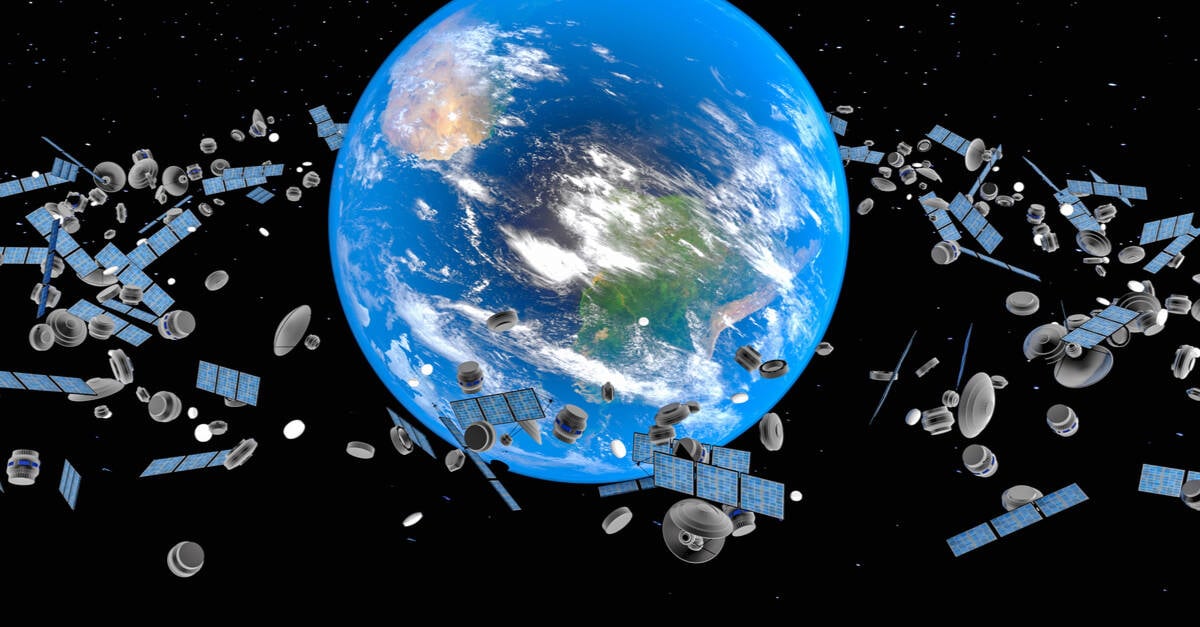
Nearly all images from some space telescopes in low Earth orbit could be affected by light from man-made satellites as the number of communication spacecraft surges, new research led by NASA has found.
The study shows that nearly 40 percent of the Hubble Space Telescope’s images could suffer interference from the proliferation of communication satellites, which are set to explode in number in a few years.
In 2019, the number of satellites orbiting the Earth was around 2,000. Now it is around 15,000, mainly because launch costs have dropped dramatically. The number could balloon to a jaw-dropping 560,000 by the end of the 2030s if currently filed satellite constellation plans are carried out.
NASA research scientist Alejandro Borlaff and his team used a database of planned launches to study the effect of communications satellites on low Earth orbit space telescopes; earlier studies had focused on ground-based astronomy.
Included in the study was NASA’s SPHEREx space telescope, the European Space Agency’s proposed ARRAKIHS system, and China’s planned Xuntian space telescope, as well as Hubble, all of which orbit at altitudes between about 450 and 800 kilometers. The findings suggest about 39.6 percent of Hubble’s images and 96 percent of images from the other three telescopes would be affected by interference from satellites. Meanwhile, the average number of satellites observed per exposure is estimated to be 2.14 for Hubble, 5.64 for SPHEREx, 69 for ARRAKIHS, and 92 for Xuntian, if the planned constellations are completed.
In 2023, scans of historic images taken by the Hubble Space Telescope between 2002 and 2021 found 2.7 ± 0.2 percent of images with a typical exposure time of 11 minutes contained at least one satellite trail.
Writing up the results in a paper published in Nature this week, the researchers said that the problem might be mitigated by deploying satellites at orbits lower than the telescopes operate in. However, emissions from this approach could have implications for Earth’s ozone layer.
“Our results demonstrate that light contamination is a growing threat for space telescope operations. We propose a series of actions to minimize the impact of satellite constellations, allowing researchers to predict, model and correct unwanted satellite light pollution from science observations,” the researchers wrote.
“We are witnessing the beginning of a new era of widespread industrial exploitation of low-Earth orbit, with an expected 20-fold to 100-fold increase in the number of artificial satellites,” they added. “Our results demonstrate that, contrary to popular belief, space telescopes are not immune to light contamination reflected by artificial satellites.”
It’s worth noting that the James Webb Space Telescope does not orbit the Earth. It orbits the Sun at around 1.5 million kilometers from the Earth. ®