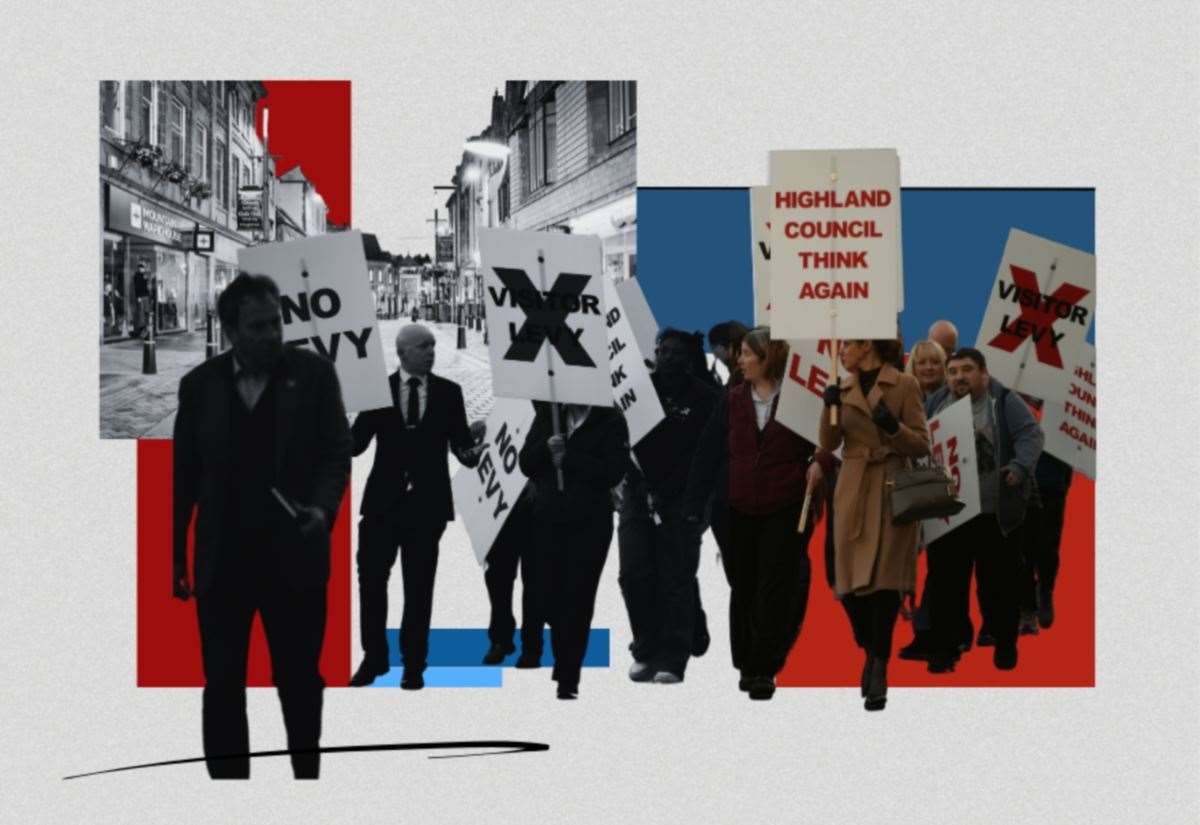
 Tourist Tax Graphic, Photo Components Courtesy of Canva.com
Highland Council is welcoming moves by the Scottish Government that will allow greater flexibility in how it introduces the controversial Visitor Levy Scheme.
The detail of the so-called ‘tourist tax’ measure has drawn fierce opposition from within the industry and many were surprised by public finance minister Ivan McKee’s confirmation that an amending bill to change the legislation would come before the Scottish Parliament next year.
The changes would allow local authorities to raise the levy either as a flat-rate or as a percentage fee.
Highland Council will now await the Scottish Government’s amendments to the bill before discussing the way forward for its own area.
The Visitor Levy (Scotland) Act 2024 currently only provides local authorities with discretionary powers to implement percentage-based levies following statutory consultation.
Highland Council consulted on a potential five per cent levy, which would generate £10 million each year to sustain, support or develop services and facilities heavily used by visitors.
The council received 4,103 responses to its statutory consultation on the proposed scheme as well as feedback from drop-in sessions, online and in-person events.
In response to concerns about a percentage-based levy, shared by accommodation providers, the council’s Visitor Levy Reference Group, and others, the council pressed the Scottish Government to amend legislation to provide councils with discretionary powers to consider adding the option of a flat rate levy.
Locals are worried how the tourist tax would impact them.
The tourism sector, while broadly supportive of the concept of a Visitor Levy Scheme, expressed deep concerns about the complexities inherent in a percentage-based levy. Feedback indicated a preference for a flat rate, or tiered flat rate, which would better meet the needs of the local visitor economy and Highland communities.
Earlier this week the Scottish Government confirmed plans to introduce legislation in early 2026 to give councils discretionary powers to levy a fixed amount, or a range of fixed amounts based on factors such as time of year or types of accommodation.
The Bill would still enable local authorities to implement a percentage-based levy, and would also seek to provide clarity on third party sales and levy returns based on occupancy to simplify the administration for accommodation providers.
The Scottish Government said the decision to introduce the new Bill, which builds on the framework established in the Visitor Levy (Scotland) Act 2024, had been informed by engagement with councils, tourism businesses and industry bodies.
Highland Council Convener, Cllr Bill Lobban, said: “Having listened very carefully to the strength of feedback received from our accommodation providers and others, we pressed the Scottish Government for this change.
“This flexibility means we can consider a Visitor Levy Scheme which could work for Highland – one that could support accommodation providers and local businesses, and potentially provide multi-million pound spend in our region to support, sustain and develop infrastructure and services primarily used by visitors.
There are concerns that the visitor levy will penalise people living in the Highlands who need to stay overnight in Inverness and many other destinations within the region. Picture: Alan Hendry
“I would like to take this opportunity to thank everyone who contributed to our consultation.” A meeting of Highland Council on December 11 will be asked to await the Scottish Government’s amendments and then bring forward a report to a future meeting to decide the way forward for Highland Council.
Latest available data from the Scottish Tourism Economic Activity Monitor in Scotland (STEAM) shows that between 2012 and 2023, visitor numbers to the Highlands increased from 5.16 million to 8.375 million – an increase of 62.5 per cent.
Direct expenditure grew from £1.118 billion to £1.68 billion over the same period.
Visitor levy schemes have been approved in Edinburgh, Glasgow, Aberdeen and West Dunbartonshire to date, with seven other local authorities in active stages of statutory consultation or undertaking early public engagement activities.
In addition, seven other local authorities have decided to pause or are not actively pursuing a Visitor Levy for their areas.
Do you want to respond to this article? If so, click here to submit your thoughts and they may be published in print.