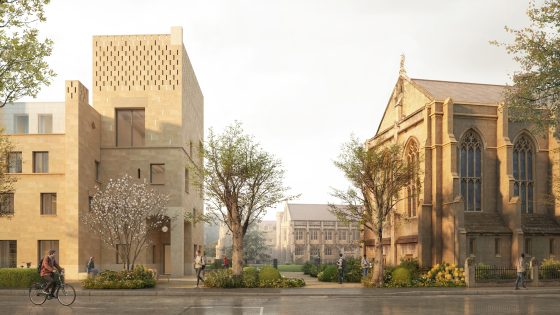
The practice, working with heritage consultant Marcus Beale Architects and engineer Structure Workshop, was chosen for the job in early 2024 ahead of rival bids from Allies and Morrison and Stirling Prize laureates Haworth Tompkins, Mae and Mikhail Riches.
The accommodation is part of the college’s Estate Transformation Project, billed as the most ‘significant investment in Mansfield’s site for decades’. It includes new academic and social spaces, improved accessibility to the site’s historic buildings, a ‘pocket park’, improved landscaping, a new Porters’ Lodge gatehouse, and ‘better permeability throughout the site’.
Mansfield College opened in 1886 as a theological training school for nonconformist ministers. It occupies a series of buildings that include Grade II*-listed Gothic blocks by Basil Champneys.
Feilden Fowles’ scheme involves demolishing the 1960s John Marsh Building, 6-8 Mansfield Road, Staircase E and the Garden Building, and replacing them with a new south range.
The practice said it was planning to reuse building stone from these blocks, together with other sources of recycled limestone, to build the replacement scheme, which will have a hybrid structural system combining a timber frame with load-bearing limestone walls.
Practice director Edmund Fowles said: ‘Working with specialists Material Index, the design team is developing a strategy for a careful programme of deconstruction and reclamation, drawing inspiration from the ancient practice of spolia.
‘Recycled stone is proposed to be reincorporated into the new south range and hard landscaping elements, while selected decorative stone fragments may be embedded within the masonry as a quiet memory of the buildings that once occupied the site.’
The project includes the refurbishment and additions to the Grade II*-listed north range to improve ‘user experience, accessibility and operations’.
Feilden Fowles described its approach to the project as a ‘quietly radical contemporary response’ which was ‘rooted in the material character of Champneys’ architecture and in the wider traditions of Oxford’.
The Mansfield Road and north elevations boast a ‘regular rhythm of projecting stone chimneys’, providing passive ventilation to the ground floor academic and office spaces, which reference the ‘vertical accents found throughout the city’s historic fabric’.
The elevations face the south quad,d looking towards David Kohn’s neighbouring Gradel Quadrangles at New College . They feature a ‘calmer material character [with] timber windows, lime-washed reclaimed stone, fine metalwork and deep eaves’.
College principal Helen Mountfield said: ‘This is a once-in-a-generation opportunity to secure Mansfield’s future for generations to come.
‘We want to ensure we can offer more of our students an inspiring, sustainable and inclusive place to live and learn – while contributing positively to Oxford. By increasing on-site student accommodation, improving our green spaces and honouring the college’s heritage, this development helps both our community and the wider city to thrive.’
A decision on the planning application is expected next spring. Subject to approval, construction is due to begin on site in autumn 2026.
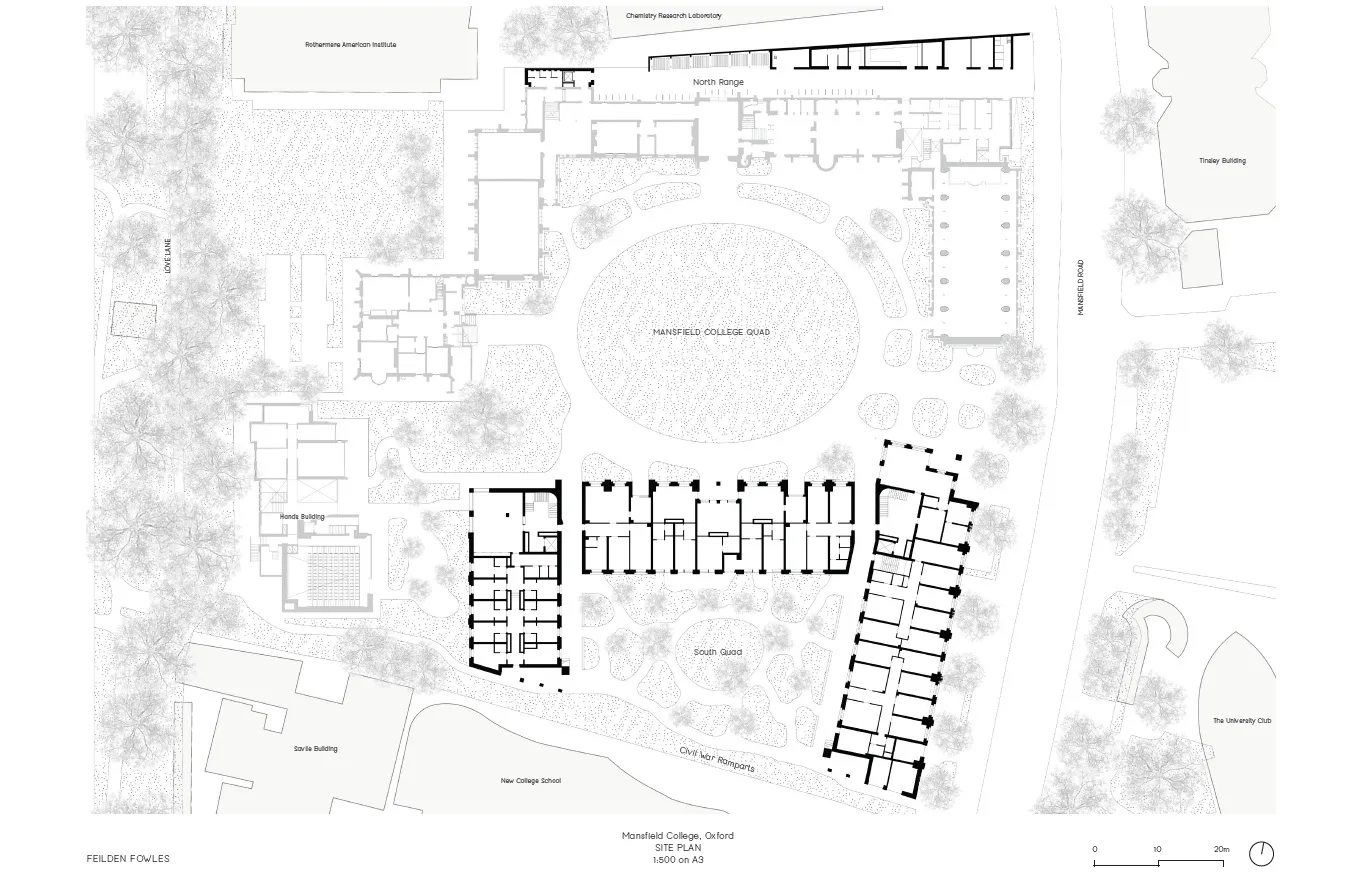
Site plan
Architect’s view
The design approach draws upon an understanding of Mansfield’s architectural and civic character, a close reading of Champneys’ work and the wider collegiate setting of Oxford. Early in the project the design team undertook a series of walks through Oxford, guided on one occasion by a college fellow, studying the city’s unique urban features: spires, quadrangles, gatehouses, cloisters, chimneys and narrow passageways. These observations helped establish a set of core architectural principles that are both attuned to the city and distinct of Mansfield.
A key move is the formation of a generous new entrance garden on Mansfield Road, replacing an existing car park. A new porters’ lodge tower is set back from the street, creating an open threshold that preserves Mansfield’s characteristic sense of civic generosity. The tower engages directly with Champneys’ chapel opposite, establishing a dialogue between old and new while marking the college entrance with greater clarity.
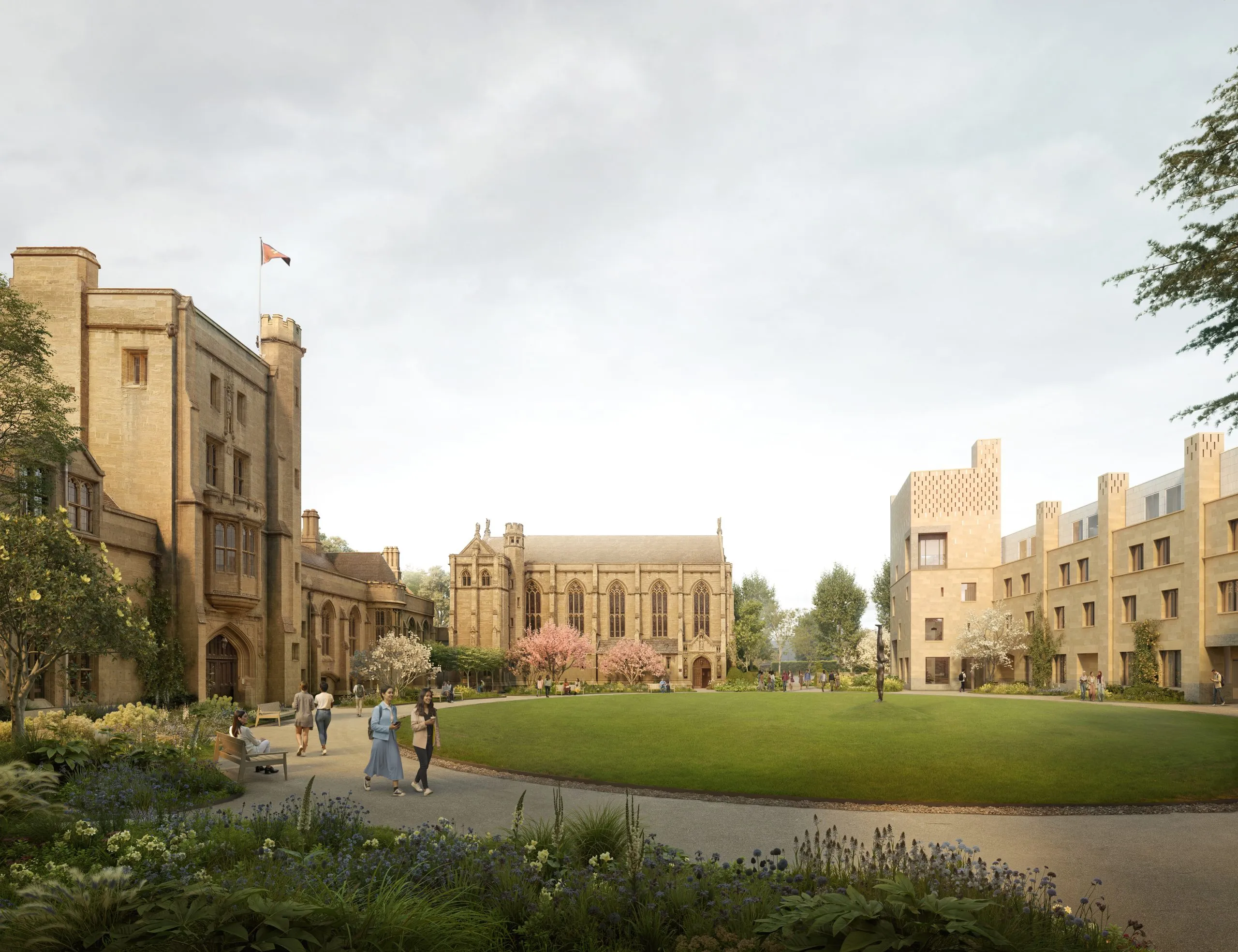
Feilden Fowles’ Mansfield College plans, Oxford, as submitted November 2025 (north quad view)
The south range is conceived as a contemporary counterpart to Champneys’ celebrated buildings and completes the main quad, providing a stronger feeling of definition and enclosure. Its body is composed as part of a family of figures around the main quad, participating in the long Oxford tradition of expressive collegiate elements, such as towers, chimneys, gables and cloisters.
The formation of a new south quad creates a more intimate space, bounded on its southern edge by the preserved Civil War ramparts. The horseshoe plan produces a strong sense of orientation and coherence across the site, with passages from north to south improving the legibility and connectivity of the college as a whole.
The siting of key social and communal spaces has been carefully considered. For example, the new junior common room occupies a prominent position at the north-west corner of the south range, facing the library gable and overlooking the west quad.
This location, at the intersection of important east-west and north-south routes, grounds it at the centre of daily life, encouraging interaction between students living across the college.
Passageways, staircases and covered walkways are designed with equal care, recognising that these threshold moments shape the day-to-day collegiate experience. Together, they establish a sense of porosity and openness that reflects Mansfield’s ethos while enhancing the richness of movement across the site.
Within the south quad, the building’s character becomes softer and more domestic in scale. Covered walkways blur the distinction between inside and outside, deep eaves shelter circulation routes, and a generous, natural planting scheme weaves between the buildings.
These elements establish a calm, intimate garden atmosphere, distinct from the more formal, outward-facing elevations on Mansfield Road. In this way, the scheme creates a set of complementary architectural characters – civic, collegiate and domestic – held together by a coherent material and spatial language.
Edmund Fowles, director, Feilden Fowles
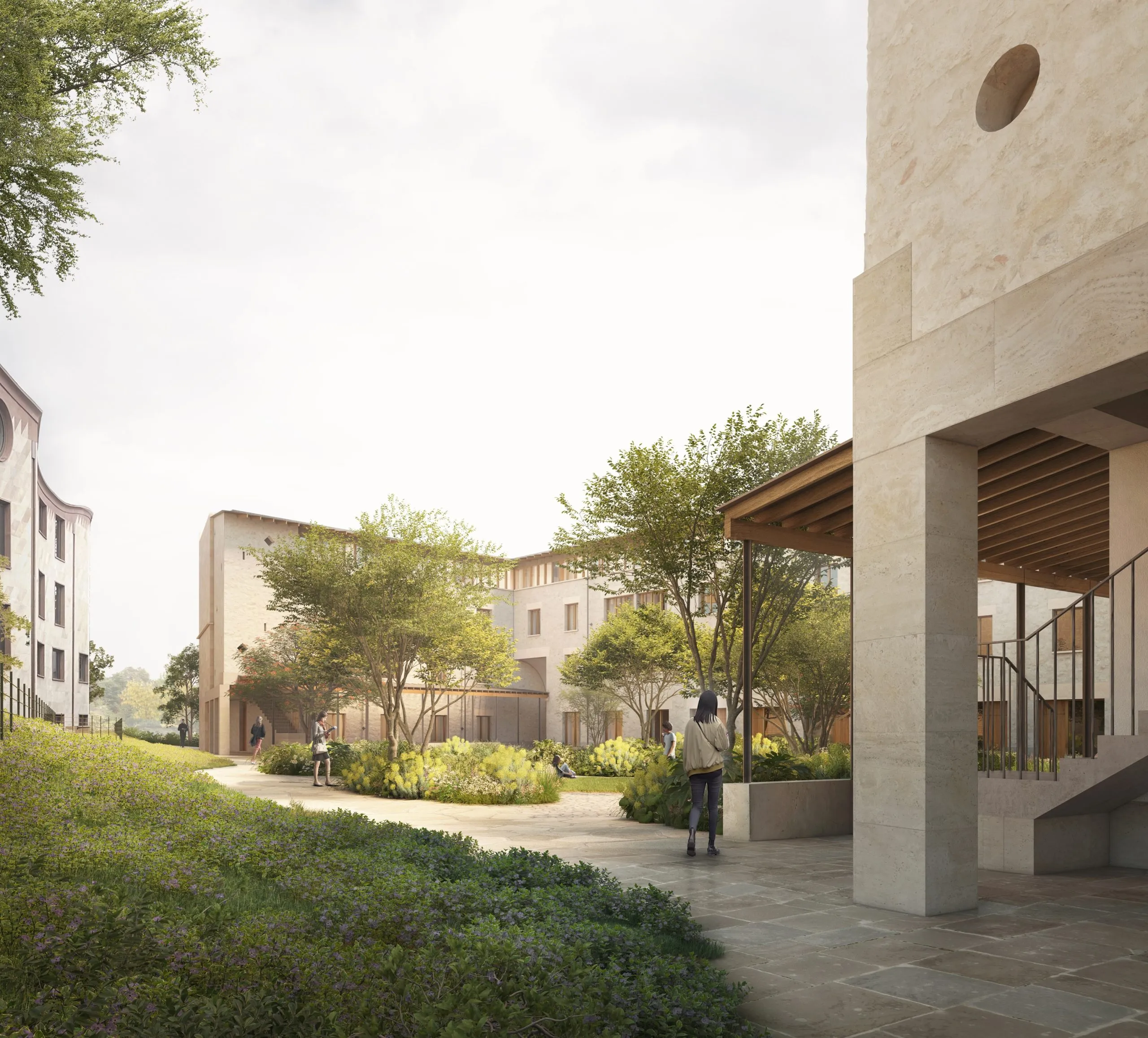
Feilden Fowles’ Mansfield College plans, Oxford as submitted November 2025 (ramparts)
Project data
Address Mansfield Road, Oxford OX1 3TF
Local authority Oxford City Council
Type of project Student accommodation and welfare, academic offices, administrative facilities
Site area 1.1ha
Gross internal floor area of the proposal south range: 7,191m²; north range total new build: 262m²
Client Mansfield College, University of Oxford
Architect Feilden Fowles
Development partner Stories
Landscape designer Tom Stuart-Smith Studio
Heritage consultant Marcus Beale Architects
Planning consultant Savills
Structural engineer Structure Workshop
MEP and sustainability Skelly & Couch
Project management Childerstone
Quantity surveyor Cast
Principal designer Feilden Fowles
External lighting consultant Light Follows Behaviour
Acoustic engineer Sound Matters
Archaeology MOLA
Fire consultant OFR
Arboriculture consultant Heritage Trees
Access consultantDavid Bonnett Associates
Transport consultant Paul Basham Associates
Rights of light surveyor GIA
Material reuse consultant Material Index