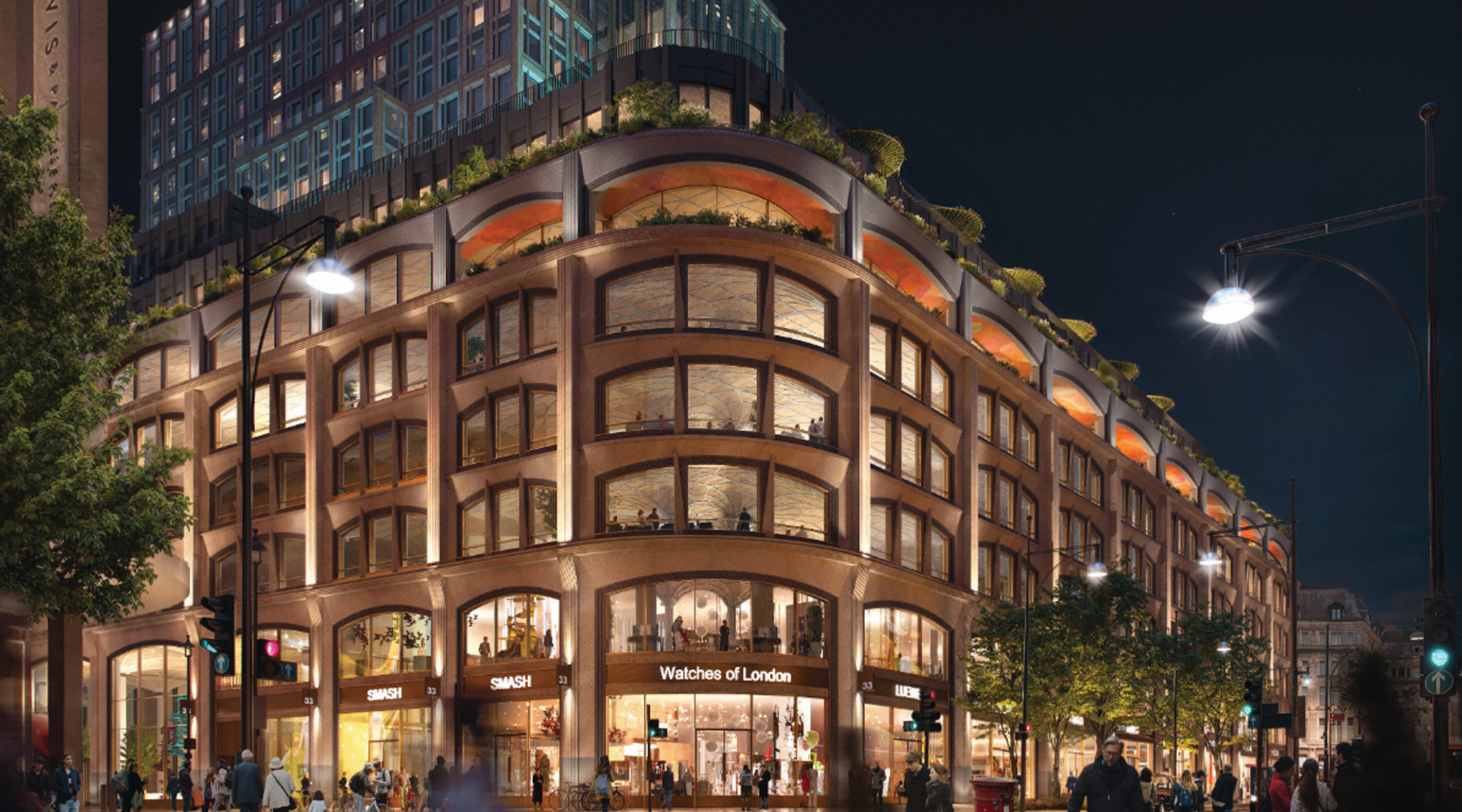
A familiar Oxford Street landmark, once home to the London College of Fashion and British Home Stores, could be in line for a rather unexpected reinvention — a rebuild inspired by medieval cathedral architecture.
 Currently
 Proposed (c) Planning documents / developer
The original complex was completed in 1958 under the plot-ratio rules introduced in 1947, which encouraged taller structures set back behind lower street-frontages. Hence, the classic mid-century “podium with tower” form as seen here. Shortly afterwards, the southern block, known as the “South Bar” and used by the London College of Fashion, was added in response to the London County Council’s push for mixed-use development on the site.
Also, as part of the deal, the college received its share of the building for a nominal rent, but it is now part of the University of the Arts London, and moved to Stratford in 2023.
For decades, British Home Stores occupied the ground floor as its flagship store, until the chain collapsed in 2016. Since then, the retail units have hosted a revolving cast of unremarkable tenants, while the offices above have grown tired, partially empty, and in need of refurbishment.
The site’s owner now proposes retaining and refurbishing the tower, while demolishing most of the podium, including the former college block. That structure was built with lightweight materials so it could perch atop the podium, but it hasn’t aged well. Columns also dominate the retail floor to support the building above, but modern buildings don’t need as many thanks to stronger materials.
So the developer plans to demolish the retail podium and refurbish the tower, which they expect will still allow them to retain about half the existing building fabric.
The medieval inspiration comes in the design of the replacement office and retail floors, which will use a modern funicular floor structure — effectively a contemporary take on the fan-vaulted ceilings of Gothic cathedrals. The technology significantly reduces the amount of concrete needed, while early concept images show the vaulted undersides left exposed.
 (c) Planning documents / developer
As a result, office workers will find themselves tapping away beneath modern cathedral vaults, echoing — however faintly — the scribes and monks who once worked under the real thing.
While that will be internal, depending on how the office floors are used, they may be visible from outside as well, which will be a nicer sight than a conventional office suspended ceiling.
 (c) Planning documents / developer
Another potential improvement is that there could – possibly – be a public access to the 17th-19th floors as part of a cultural offering. That does mean food and drink, so nice views for the paying diners. Whether the public will be able to pop up for free will be argued in the planning process.
Westminster Council is due to discuss the plans at its planning committee meeting on 9th December.
Interestingly, although most of us familiar with the area think of this as an Oxford Street facing building, its official address is actually 33 Cavendish Square.
And I really hope it was a typo in the placemaking section of the planning application, and that they’re not actually planning to call it “33 Cav Square”, because that level of faux-youthful branding would be how-do-you-do-fellow-kids in steel and stone.