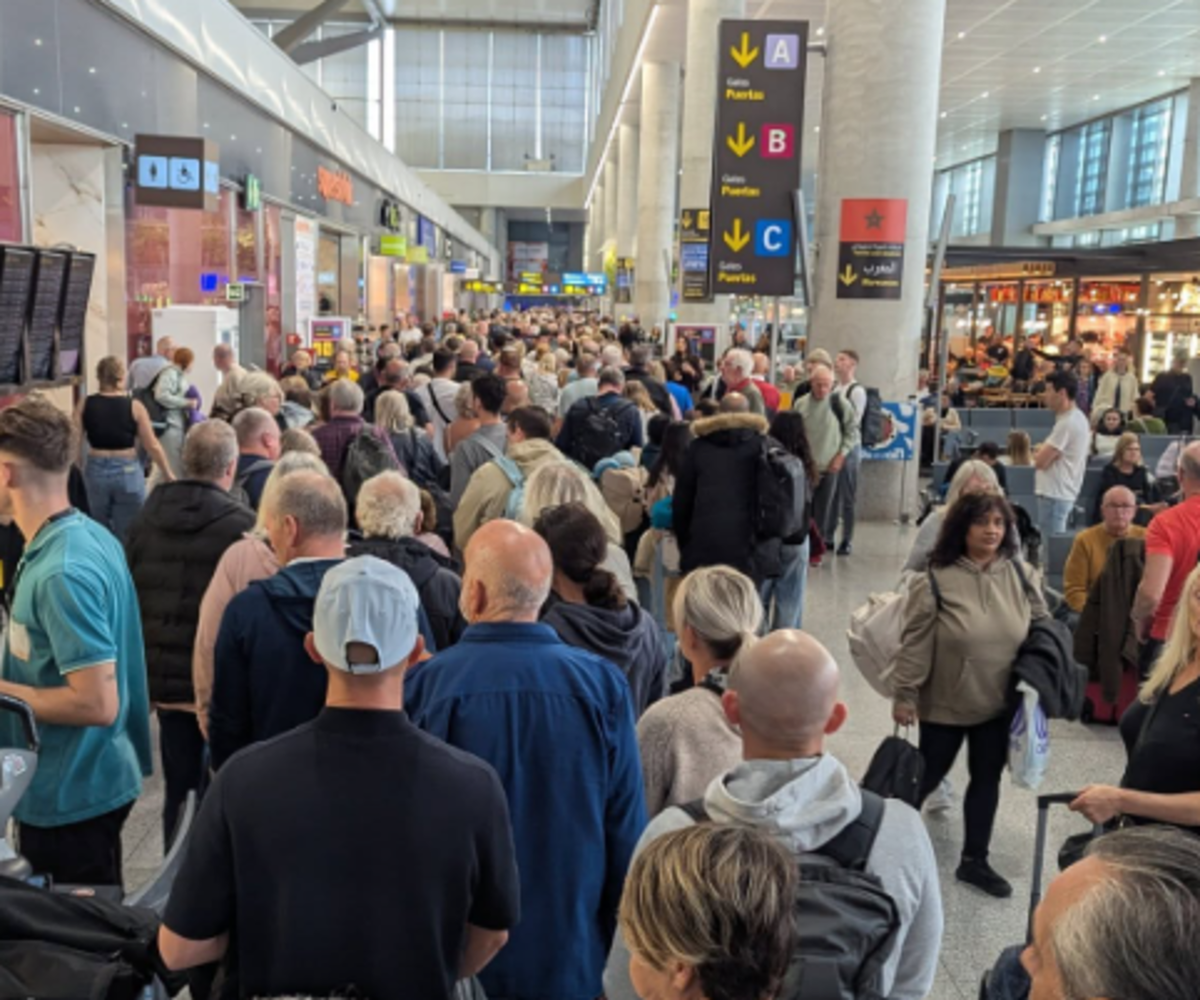
Travelling from Malaga airport – queues. Credit: Facebook, Trevor Tutt.
If you’re preparing to travel back home for Christmas, bear in mind that Spain’s transport network is entering one of its busiest periods. Last year, the Dirección General de Tráfico (DGT) forecasted more than 20 million road journeys between 20 December and 6 January. So far this year, they are forecasting 5.7 million journeys expected for the Constitution-Immaculate Conception long weekend.
At the same time, Aena airports are handling record levels of passengers. Last year, 309.3 million travellers passed through Spanish terminals, a 9.2 per cent rise on the previous year (Aena annual figures). For UK-bound expats from Spain, this means crowded terminals, longer queues, and the strong possibility of delays around the festive peak.
Spain’s roads at Christmas time: What the DGT expects
The DGT’s Operación Especial Navidad spans December 20 to January 6, covering Christmas, New Year and Three Kings. Last year’s campaign registered 20.8 million trips, exceeding predictions. Tragically, 51 people died in 48 fatal accidents over the period (DGT accident bulletin).
Most Read on Euro Weekly News
Worst travel times over the long weekend in Spain (Constitution-Immaculate Conception, 2025)
According to an official press release, the busiest travel windows will be:
Friday December 5
- Heaviest traffic expected 5 pm–10 pm.
- Main congestion during the afternoon as people begin the long weekend.
Saturday December 6 (Public Holiday)
- Heavy traffic expected 10 am–2 pm.
- Many short trips to leisure, entertainment, and shopping areas near urban centres.
Sunday December 7
- Heavy outbound traffic from major urban centres in the morning and midday.
- Return traffic expected in the early afternoon.
Monday December 8
- Significant return traffic begins in the early afternoon.
- High volumes expected on:
- Major motorways and dual carriageways
- Roads leading back from mountain and leisure areas
- Later in the day, congestion will shift to access roads entering large urban centres.
Worst travel times over Christmas in Spain
- December 22-23 (6:00–9:00 pm)
- December 29 (6:00–9:00 pm)
- January 5 (7:00–9:00 pm)
- Saturday mornings (10:00 am–1:00 pm)
Quieter periods to travel over Christmas in Spain
- Early mornings (07:00–10:00 am)
- Christmas Day
- December 26
- Midweek travel.
Accident hotspots in Spain
Many accidents occur on single-carriageway national roads:
- Madrid–Valencia (A-3/N-III) – fog and heavy lorry traffic
- AP-7/N-340 Mediterranean corridor – congestion and lane merges
- Costa del Sol coastal N-roads – high local traffic density
If you’re driving north or towards airports, be cautious of the Monrepós pass in Huesca, which often sees high congestion and frequent snow alerts.
City-centre gridlock in Spain
Urban congestion is also a challenge. Malaga, for instance, has deployed more than 10,000 extra hours of Christmas traffic and crowd-control operations due to the popularity of the Calle Larios light shows.
If you’re driving into the city before catching a flight, allow extra time or switch to public transport.
Flying back to the UK for Christmas: What expats in Spain should expect
Flights between Spain and the UK are among Europe’s busiest Christmas routes, particularly between December 20-24, December 27-30 and January 2-6.
These periods align with the DGT’s “unfavourable” traffic hours, meaning airport access roads, car parks and drop-off zones may be congested.
Longer queues at Spanish airports over Christmas period
UK-bound travellers should prepare for:
- 30–60-minute queues at security during peak periods
- Passport-control delays
A recent security dispute at Madrid-Barajas produced hour-long queues, with some passengers missing flights (VisaHQ report).
Airport-specific expectations for UK flights
For recent changes affecting passport checks, especially with the EU’s Entry/Exit System, see our latest explainer:
Queues, scans and stamps: why Brits with a TIE don’t have to play the EES game.
Checklist: Travelling back to the UK from Spain this Christmas
Before travel:
- Check DGT alerts for the route to your airport
- Allow additional time for city-centre congestion
- Verify UK luggage rules
- Carry chargers, medicines and essentials in hand luggage
At the airport:
- Arrive 3–4 hours early for UK flights from Madrid/Barcelona
- Arrive 2.5–3 hours early from Málaga/Alicante/Palma
- Use Fast Track during peak morning hours where available
Upon arrival in the UK:
- Expect variable eGate queues
- Avoid tight connections (domestic flights or long-distance trains)
- Pre-book airport transfers to avoid Christmas surcharges
Travelling during Spain’s festive peak means navigating two countries’ busiest holiday periods. For expats, who often have limited time with family abroad, delays can carry emotional and financial consequences.
Understanding traffic forecasts, airport behaviour and UK arrival pressures allows British residents in Spain to avoid unnecessary risk, reduce queue times, and protect valuable holiday time.
Wishing you a smooth and stress-free journey! For more tips, check out this article: How to handle stress and anxiety while travelling.
You can also explore the cultural side of the season in our guide Christmas in Spain for expats: the good, the bad and the unexpected.