Watch the event
The 2026 FIFA World Cup, which will play out across the United States, Mexico, and Canada, will be “an overload, a true plethora of opportunities,” said the White House’s Andrew Giuliani on Thursday, “not just for American citizens that are traveling within the country, but also international visitors that are coming in to enjoy the World Cup.”
Giuliani, the executive director of the White House Task Force on the FIFA World Cup 2026, spoke at an Atlantic Council event on the importance of sports diplomacy on the eve of Friday’s World Cup draw.
“If we are able to nail this one,” Giuliani said, “I think this is going to be one of these recurring things where it’s not just going to be a decade of major sports, but a century of major sports moving forward here in the United States.”
Giuliani estimated the economic output of the upcoming tournament at thirty billion dollars. US Representative Sydney Kamlager-Dove (D-CA) also pointed to the windfall the World Cup will bring, as well as the broader impact of the United States as a World Cup host.
“When we talk about sports diplomacy,” Kamlager-Dove explained, “we’re really talking about a way to open the door to new opportunities,” particularly economic opportunities around tourism, job growth, and infrastructure.
“Sport is a great equalizer in an incredibly unequal world,” she added. “And so we have got to engage with as many folks as possible and lean into the power of sports diplomacy.”
Below are more highlights from the event, during which foreign diplomats, US officials, and figures from the world of soccer gathered at our studios to talk about the power of sports diplomacy and the opportunities sporting events bring to local communities.
How the White House plans to “nail” the tournament
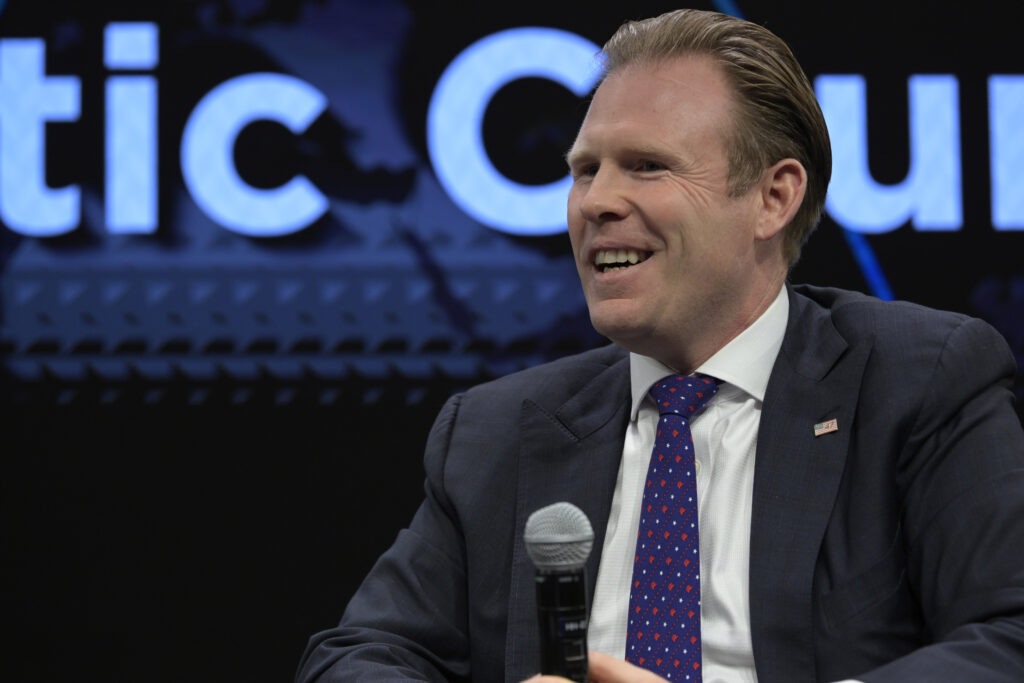 White House Task Force on the FIFA World Cup 2026 Executive Director Andrew Giuliani delivers remarks during a fireside chat on December 4, 2025 at the Atlantic Councilin Washington DC. Photo via Lenin Nolly/Sipa USA.
- Giuliani explained that his task force’s discussions focus closely on “safety” and “security,” from protecting people in stadiums to ensuring air travelers arrive safely. He said to expect an announcement in the coming weeks on the administration’s security approach.
- He also talked about the United States’ new FIFA Priority Appointment Scheduling System, which expedites visa applications for ticket holders. “I think this is a perfect example of balancing the safety and security that we want,” he argued, “not just for these games, but also for the country and for international tourists and visitors coming in, while also making sure that we are welcoming and opening a front door.”
- That welcome, he argued, is important. “This is a great opportunity,” he said, “to show off to the world American exceptionalism, our first 250 years, the true greatness of the United States of America, and the hope and promise of the next 250 years.”
- Major League Soccer Commissioner Don Garber added that, with the World Cup, “the entire world is going to see that the world’s game actually lives here in our country,” as demonstrated by the growth of women’s soccer and the high interest among the country’s youth.
The world’s equalizer
- Kamlager-Dove, who introduced the bipartisan American Decades of Sports Act to create a US sports diplomacy strategy, explained that sports offer a doorway for connection with other people. On the other side, “we can then engage on other important issues like clean water, like solid infrastructure, like feeding starving children,” she said.
- FIFA’s Victor Montagliani—who leads the Confederation of North, Central America and the Caribbean Association Football—added that “football is one of the most reliable, neutral spaces,” so “nations that may disagree politically still meet on the pitch. Cultures that may clash still follow the same rules.”
- “Football is not just entertainment, it’s not just business, and it’s not just competition,” Montagliani said. “It really is . . . the most diplomatic platform that this globe has.”
- Princess Reema Bandar Al-Saud, the Saudi ambassador to the United States, agreed, adding that soccer is “about human engagement.”
- “There are wars all around the world, but this is the pitch where people can come and forget all of that and say, ‘I’m your equal,’” she explained.
A global unifier
- Giuliani noted of the 2026 World Cup participants: “You have three countries that might have different politics, different beliefs, different ideas, but they all banded together.” Montagliani similarly argued that “through a football-first philosophy,” the type of collaboration that seemed “laughable” became “entirely achievable.”
- “The beauty about North America,” Montagliani argued, is that attendees from around the world have “a piece” in the region: “They may have a relative, they may have a friend, somebody that’s come here and immigrated here,” he explained. “Football is a sport of immigrants, no different than the countries that were built by immigrants.”
- Moroccan Ambassador to the United States Youssef Amrani highlighted how the 2030 World Cup will see, for the first time, two countries on different continents (Morocco and Spain) co-hosting. “It is a strong message,” he said, adding that the cooperation “is important for as far as security, migration issues, [and] economic development.”
- But soccer also “unites the people inside the same country,” Amrani argued. Kansas City Mayor Quinton Lucas echoed that message, explaining how his city snagged a spot as a World Cup host thanks to collaboration between “political figures from across the political aisle”—and Lucas said such collaboration is continuing to prepare the city for the global sporting event.
- With the World Cup preparations, “we have seen commonalities and relationships that don’t exist regularly in American politics,” Lucas said, “and I think foundationally it shows the power of the World Cup, and it shows the power of sports.”
A propeller for economies
- The legacy of this World Cup, Garber argued, “will be all the great things that’ll happen in the community,” including the expansion of job opportunities.
- Al-Saud explained how the opportunity to host the World Cup in 2034 has required her country to invest more in Saudi soccer teams, programs, and infrastructure—and, ultimately, in young people. “This industry is an industry that uplifts people everywhere it goes,” she argued.
- Amrani agreed, saying that the soccer industry in Morocco has unleashed “opportunity for jobs, for investment, for infrastructure,” such as more modern trains and solar panels. He also highlighted the sport’s role in fostering “social inclusion.”
- Montagliani pointed out that women’s soccer is growing “at a record pace,” which has created additional pathways for sports diplomacy.
- Al-Saud noted that regulatory shifts and investments have played a role in accelerating women’s soccer in Saudi Arabia, but she argued that the most powerful force has been an “understanding as a nation that a young woman’s right to compete is equal to a young man’s right to compete.”
- She appealed to the private sector for more investments in women’s soccer: “Help us catch up,” she said. “The young ladies deserve it. They have the skill, they have the talent, they are just seeking the opportunity.”
Katherine Golden is an associate director of editorial at the Atlantic Council.
Watch the event
Further reading
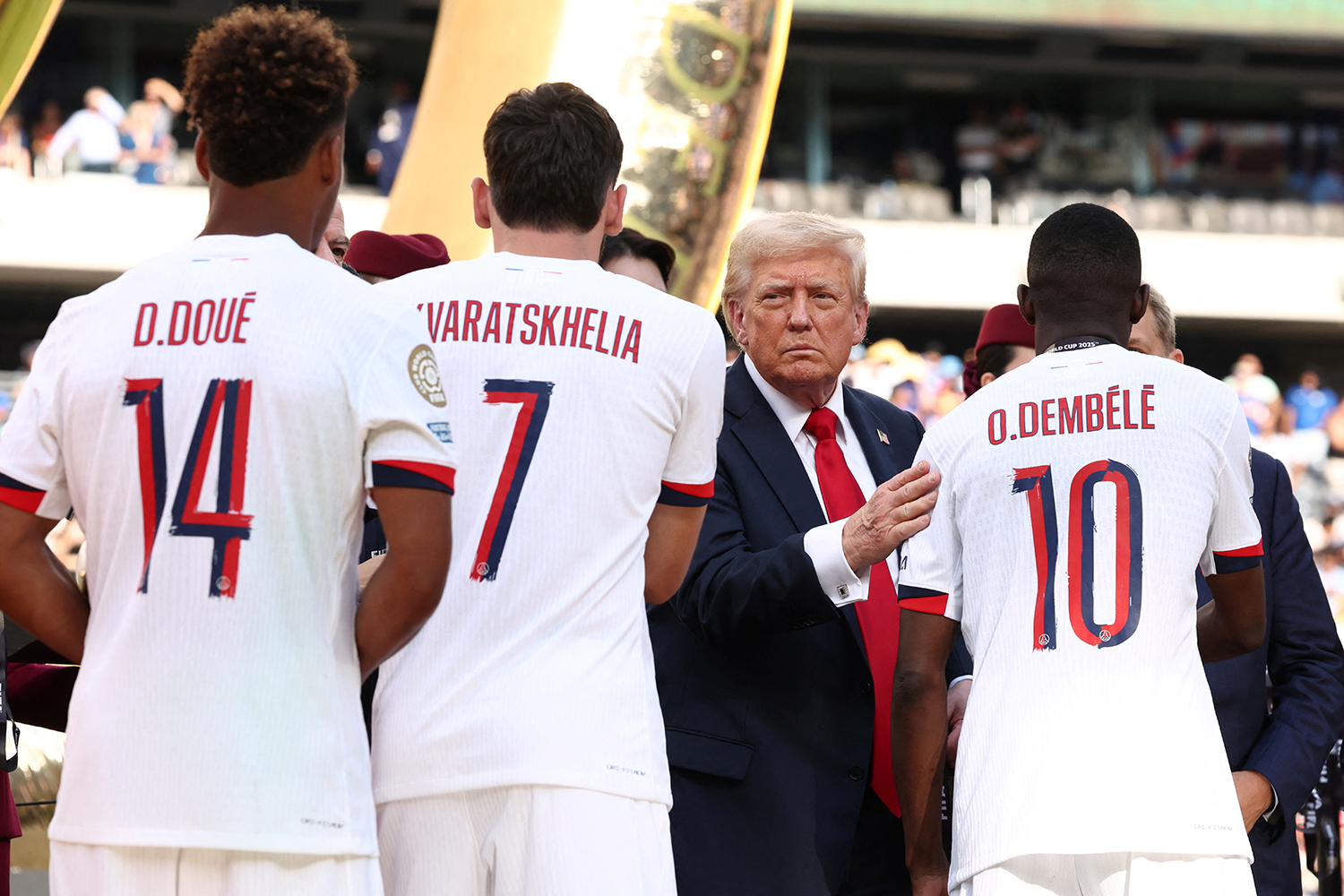
Image: US President Donald Trump looks on as he presents Paris St. Germain’s Ousmane Dembele the runners up medal after Chelsea won at the MetLife Stadium in East Rutherford, New Jersey, on July 13, 2025. Photo via REUTERS/Kevin Lamarque/Pool.