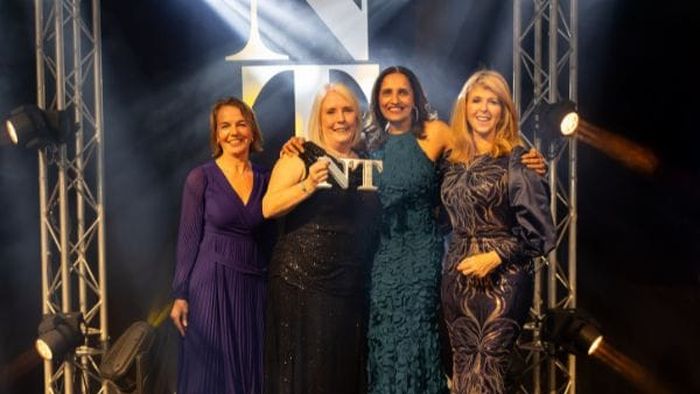
INNOVATIVE CARE: Sarah Rollins (2nd left) and Kam Singh (2nd from right) pick up their Nursing Times Awards
Nurses at Sheffield Teaching Hospitals NHS Foundation Trust have won a national award for their work in developing an innovative, personalised post-treatment follow-up pathway for patients with gestational trophoblastic disease (GTD), a group of rare pregnancy-related cancers.
The team at Weston Park Cancer Centre, led by Nurse Consultant Kam Singh, won the Ingrid Fuchs Cancer Nursing Award at the 2025 Nursing Times Awards, beating off stiff competition from multiple entries from healthcare organisations across the UK.
GTD is the umbrella term for a rare, but highly treatable group of pregnancy-related tumours that appear when cells in the womb start to proliferate uncontrollably.
However, the impact of the disease extends far beyond the challenges of a cancer diagnosis and its treatment, with patients also experiencing the trauma of pregnancy loss and the emotional distress associated with fertility loss. This makes the journey even more complex and life-altering.

The team created an innovative follow-up service that looks after the whole person, not just the medical side, supporting women’s physical, emotional, and personal needs after diagnosis and treatment.
A pioneering web-based clinical assessment tool has enabled women to self-report symptoms and comment on quality of life alongside biomedical follow-up. This has improved research into the disease’s effects and helped women address sensitive topics like sex, fertility, and mental health after treatment.
The tool – which is the first nationally and internationally to capture real-world outcomes that matter to GTD patients – also lessens the questionnaire burden for patients.
Nurse-led hybrid clinics offer in-person or virtual appointments at three weeks, six weeks, three months, six months, and annually for five years after treatment. Psychological support is available via online groups, while all patients are offered one-to-one counselling sessions with specialist nurses.
The judges described the pathway as “setting a new standard of follow-up care” for women facing complex physical and emotional challenges. Previously follow-up care was centred on the detection and management of the cancer, which could be done remotely through blood and urine samples sent from home. As a result, little was known about the short- and long-term effects and psychological impact of the condition.
It is the second consecutive time a cancer nursing team from Sheffield Teaching Hospitals NHS Foundation Trust have won the Ingrid Fuchs Cancer Nursing Award at the Nursing Times Awards, with the Late Effects nursing team winning the award last year.
Kam Singh, GTD Nurse Consultant at Sheffield Teaching Hospitals NHS Foundation Trust, said: “It’s an incredible achievement for our team and means so much to be recognised for the work we do. This award represents our dedication to nursing and our commitment to giving patients a voice – because they are who truly matter. Empowering patients to take ownership of their health and care is at the heart of everything we do.”
Professor Chris Morley, Chief Nurse at Sheffield Teaching Hospitals NHS Foundation Trust, said: “We are proud of all our nursing teams, and it is a wonderful achievement and worthy recognition of the strength of our teams that as well as the GTD nursing team, the Sheffield Teenage and Young Adults Cancer Service were also shortlisted in the same category.
“Unfortunately, though, there can only be one winner, and the GTD nursing team have excelled in innovating in a specialist area to make a huge difference to the lives of women living with and beyond diagnosis and treatment of this rare condition in Sheffield and beyond.”
Camilla, 46, who lives in Driffield, underwent chemotherapy from April to December last year after being diagnosed with Gestational Trophoblastic Neoplasia. She said the team fully deserved their award.
“There isn’t a lot of knowledge surrounding the disease because it’s rare, but my nurses were able to answer every possible question that I had. I had two procedures to remove the pregnancy tissue following my miscarriage, and was then told I could possibly be facing a hysterectomy.
“‘How could this happen? How can you be pregnant one minute and diagnosed with cancer the next? How on earth can you go from being so happy to so distressed?’”
Camilla, who finished her treatment just before Christmas last year and decided against the hysterectomy, said the team were “brilliant”.
“I was picking up my life again and then I was dealt another blow, which was very hard having thought I had put it all behind me. The team went through everything with me, and I was put onto weekly monitoring.
“Despite the follow-up blood test showing a spike, my levels have since returned to normal without further treatment. The GTD team are an incredible team. They talk to you about everything, treatment, family, friends, life in general. We’re all so busy and they give you time to talk, it’s so precious,” she said.
Sheffield Teaching Hospitals NHS Foundation Trust is home to one of only three specialist national centres caring for women with gestational trophoblastic disease.
Location: Sheffield, South Yorkshire