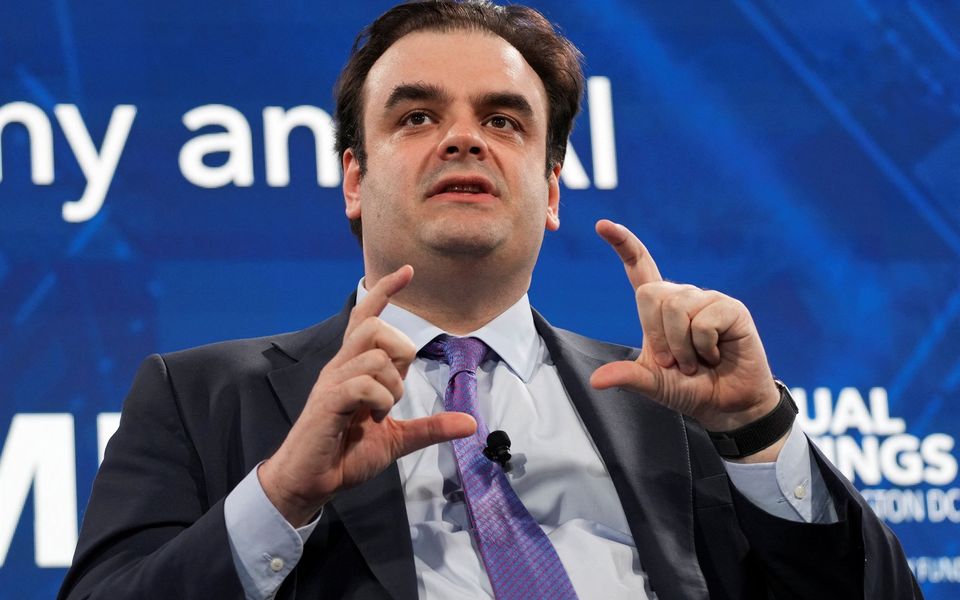
Finance Minister Kyriakos Pierrakakis, seen in a recent photo. ‘Today, German interlocutors and parts of the press are lavish in their praise of Athens’ economic and fiscal policy achievements,’ the author says. [Reuters]
These days, praise for Greece from German politicians is hard to miss. The message is always the same: Germany, the argument goes, can now learn how to govern effectively from the very country it once had to rescue. The occasion is a dense series of bilateral meetings currently filling the political calendar. “Relations between Greece and Germany are stronger today than ever before,” Greek Finance Minister Kyriakos Pierrakakis declared during his recent visit to Berlin.
There he met his German counterpart, Vice Chancellor Lars Klingbeil, and used an appearance at a leading think tank to present his country’s reform record to a German audience. “The roles have been reversed,” his hosts remarked – a pointed reference to the days when Greek politicians arrived in Berlin with downcast eyes to plead for support. Today, German interlocutors and parts of the press are lavish in their praise of Athens’ economic and fiscal policy achievements.
The mood has shifted fundamentally – and not without reason. Politically and economically, Greece is barely recognizable a decade after the peak of the debt crisis. The radical left plays no role in government policy; since 2019, the conservative-liberal New Democracy has governed with a stable majority, and Prime Minister Kyriakos Mitsotakis presents himself as a pragmatic modernizer. After years of economic contraction and the deepest crisis the country has faced in living memory, Greece is experiencing a widely noted recovery. The European Commission expects growth of 2.3 percent this year and a similar rate in 2026. The debt ratio is falling faster than in any other EU member-state, and loan repayments are proceeding at a brisk pace.
The government’s ambitious digitalization program has also drawn attention. “Greece shows how consistent digital transformation can succeed – and under the same data protection rules as in Germany,” said Boris Rhein, the premier of the German state of Hesse, after a visit to Athens. Technology, he noted, is not the problem – many solutions were developed jointly with German companies. What matters is the “mindset.” In this respect, Greece could be “a genuine role model.”
This enthusiasm for digital transformation is shared by Manuel Hagel, a party colleague of Rhein’s, who visited Athens around the same time on an almost identical itinerary. At 37, Hagel is a comparatively young senior politician who has set his sights on winning the state elections in Baden-Württemberg for the Christian Democratic Union (CDU) this spring. Gaining experience on the international stage is never a disadvantage in an election campaign, which may also explain why a contingent of German journalists accompanied the candidate.
Greek reporters, by contrast, showed little interest in the visit of a politician who is still scarcely known even at home. As a result, Hagel’s striking appeal that “we Germans must subject ourselves to the same things we subjected the Greeks to back then” elicited virtually no public response. And indeed, the appeal can hardly have been meant in earnest. It is difficult to imagine a German government voluntarily adopting a program that – like the one once imposed on Greece – would trigger socioeconomic devastation and plunge the country into a crisis from which, despite all official reassurances, Greeks have still not fully recovered.
In the call for Germans to take the same bitter medicine that Germany and other Europeans prescribed to the Greeks 10 years ago, one can hear frustration – even despair – over a political system in Germany that has been grappling for years with a severe economic (and societal) crisis and has manifestly failed to push through the urgently needed structural reforms.
That many of the recent hymns of praise come from the CDU’s orbit is no coincidence. For six months now, Germany has been governed by Chancellor Friedrich Merz, who has discovered sooner than expected how tightly constrained he is by the realities of coalition politics. Much of what was announced has stalled. In Athens, the situation is different: Mitsotakis can govern without having to accommodate a recalcitrant coalition partner – a circumstance that clearly impresses German conservatives.
Yet this new German philhellenism leaves much out of the picture. Athens’ successes have so far reached large parts of the population only to a limited extent. Real wages remain below pre-crisis levels; Greece ranks near the bottom of the European scale in pay and near the top in working hours. At the same time, prices and living costs are rising. According to a recent survey, more than half of respondents say their economic situation is worse today than a year ago; two thirds believe the country is “on the wrong path.”
The parallels in the political mood are striking: Friedrich Merz is about as unpopular in Germany as Mitsotakis is in Greece. But while the Greek prime minister, despite criticism, commands a stable majority, Merz already faces the prospect of his coalition collapsing prematurely after just six months in office. And one more contrast stands out: While Greece is being celebrated as a new success story, Germany – beset by its structural problems – is increasingly viewed by many as the new “sick man of Europe.”
Dr Ronald Meinardus is senior research fellow and coordinator of research projects on Greek-German relations at the Hellenic Foundation for European and Foreign Policy (ELIAMEP).