
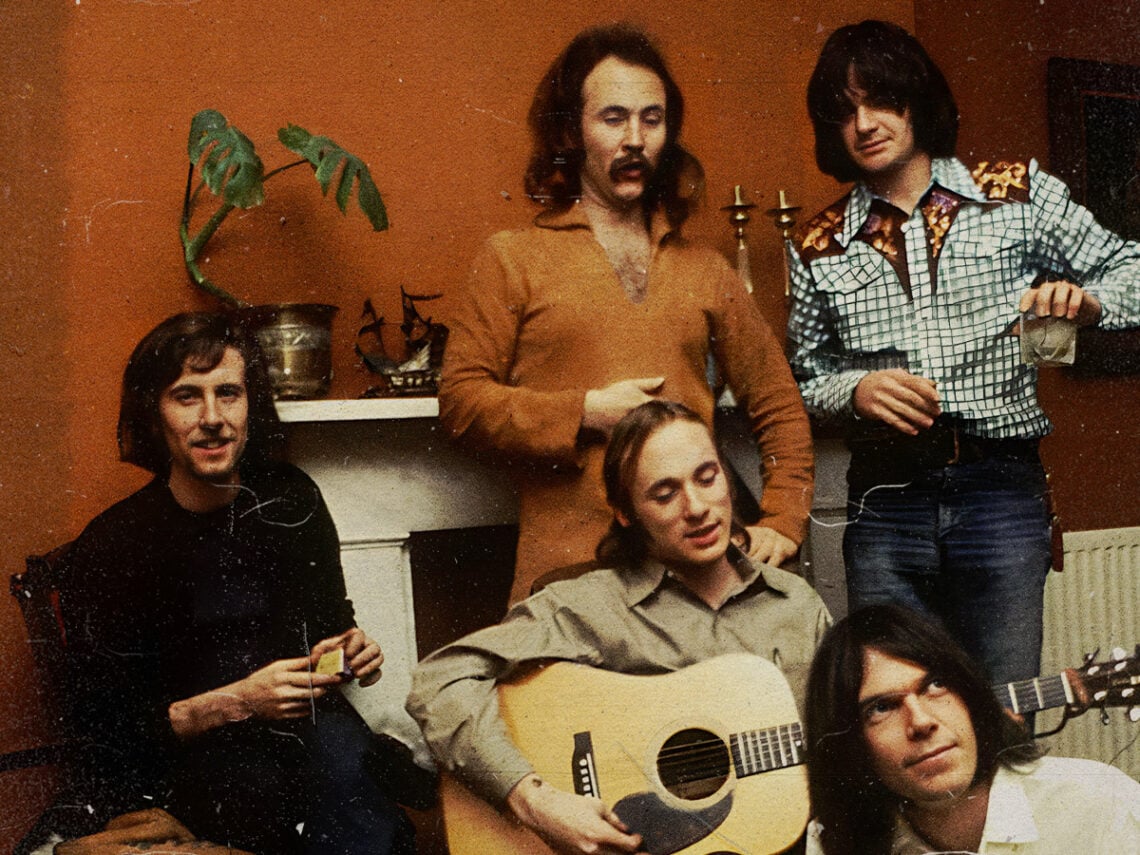
(Credits: Far Out / Alamy)
Sun 7 December 2025 21:30, UK
I’ve often mythologised what life in 1969 Laurel Canyon would be like. Living in a neighbourhood of history’s greatest musicians, in the nicest houses and under the warmest California sun, it represents the epitome of free-thinking hippy culture.
Living in the UK in 2025 feels pretty much as far away from that reality as possible, but there is one song that I regularly play as a means of mentally travelling back to that period of time. The opening track of Crosby, Stills, and Nash’s self-titled debut album, ‘Suite: Judy Blue Eyes’, feels as good a soundtrack to those days as any.
The jangling acoustic guitar introduction, which bleeds straight into the first verse of three-part harmonies, feels befitting of a song written in the green gardens of the Californian sunshine. It was, as Nash described, the perfect song to fit all of their voices and spanned across several arrangements to showcase just how in tune this new transatlantic supergroup were.
Ultimately, it fired the starting gun on an album that would follow suit. It was a triumphant debut album for the three-piece and had fans excited for what would come next. But before they could follow up with a sophomore record, Stephen Stills introduced Neil Young to the fold, toying with the creative balance these three collaborators had struck up and deciding to dangerously put faith in what could be a very different future.
Together, they got to work on Deja Vu, a record that, with Young’s guitar playing, felt as though it could have quite a different palette. Nevertheless, Graham Nash knew that what they previously had in ‘Suite: Judy Blue Eyes’ was a sonic blueprint they should be trusting. And so, he went about putting pressure on his bandmate to try and write a follow-up.
“I said to Stephen one day, ‘You know, we don’t have ‘Suite: Judy Blue Eyes’,” recalled Nash in 2021. “He goes, ‘Yeah, I know. We did it on the first record.’ I said, ‘No, no, no. We don’t have the song that guarantees that people won’t get up and take the needle off the record. And when you hear ‘Suite: Judy Blue Eyes’, and we come to the end of it, I defy you to get up and turn the record off. You wouldn’t do that. We need that kind of song.’”
Nash continued, “The next day, he comes to me, and he goes, ‘What do you think about this, Willy?’ and he played me ‘Carry On’. It shows you the genius of Stephen Stills.”
The band first released the song as a B-side to ‘Teach Your Children’, but after it quickly developed a relationship with music fans, Crosby, Stills, Nash and Young realised it was a must-have on the record’s final tracklisting.
Stylistically, you can quite easily hear the notes of influence Stills took from his 1969 track ‘Suite: Judy Blue Eyes. But on ‘Carry On’, you can quite clearly hear how Young’s introduction and his rock-infused guitar playing changed the palette. It was on a song like this that any doubts over his inclusion were quickly answered.
Related Topics