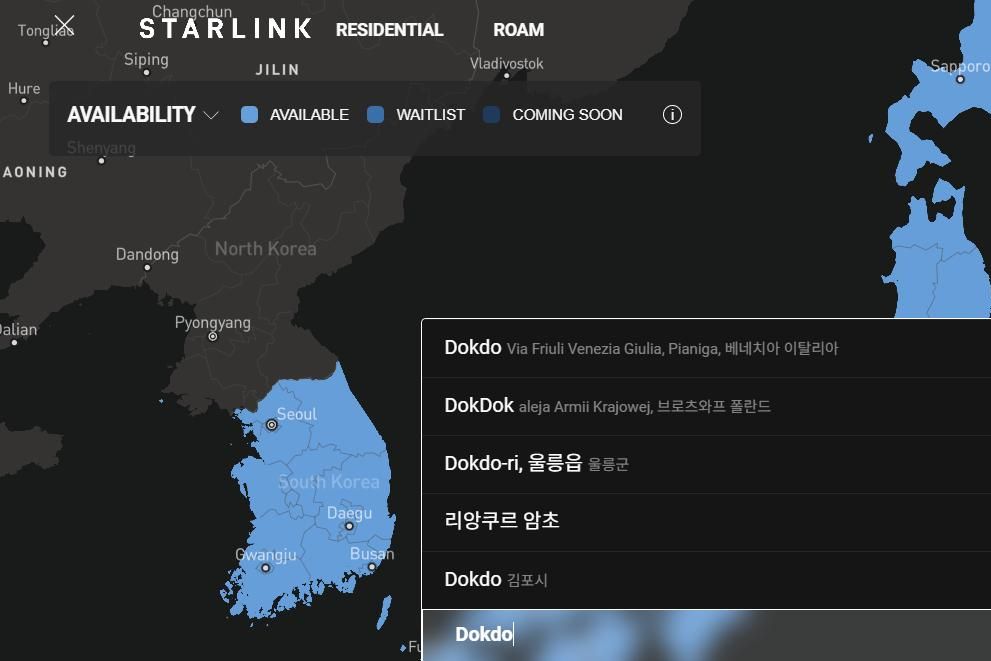
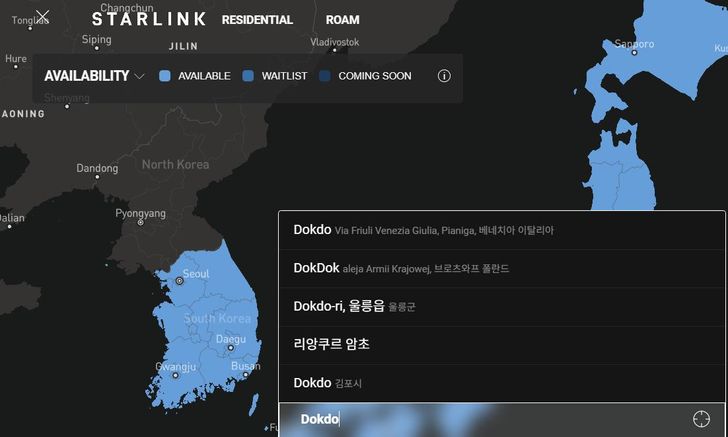
The name “Liancourt Rocks” appears in Korean search results for Dokdo on Starlink’s availability map. Captured from Starlink availability map.
Starlink, the satellite internet service operated by SpaceX, drew criticism after its availability map labeled Dokdo as the Liancourt Rocks, a designation critics said mischaracterizes the islets, which are under Korea’s longstanding administrative control. The controversy erupted just days after the service entered the local market.
The name Liancourt Rocks is taken from a French whaling ship that passed the islets in 1849.
As of Sunday, a search for “Dokdo” on Starlink’s availability map also returns the name “Liancourt Rocks.” Selecting either term does not produce a blue marker for the islets, used to identify places where the service is available.
The dispute surfaced shortly after Starlink entered the Korean market. The company rolled out two home internet plans last week, listing them at 64,000 won ($43) and 87,000 won a month.
Experts say using the French-derived name is inaccurate and ignores the established name.
“Dokdo is Dokdo — it is a proper noun,” said Seo Kyung-duk, a professor at the School of Creative Convergence Studies at Sungshin Women’s University. “Long before that French whaling ship ever spotted it, the islets were called Dokdo. It is not Takeshima (the name used by Japan), nor Liancourt Rocks.”
Seo added that he plans to formally request Starlink correct the labeling, backed by detailed evidence.
This is not the first time a multinational tech company has faced backlash over the name of the islets. In September, Seo found that Google Maps used “Liancourt Rocks” in 42 countries, including Sweden, Australia and New Zealand.
On Google Maps, the islets appear as “Dokdo” when searched in Korea, while users in Japan see “Takeshima,” reflecting the Japanese government’s position that the islands are Japanese territory.