WHO BROKE BRITAIN?
The Royals defended Andrew for too long to be able to quarantine themselves from the gathering public fury
The playwright Tom Stoppard, who died last week at the age of 88, was a patriot. In his last and heavily autobiographical play Leopoldstadt, a former child refugee like Stoppard who has grown up as an Englishman lists what makes him proud about Britain: “fair play and Parliament and freedom of everything, asylum for exiles and refugees, the Royal Navy, the royal family… oh, I forgot Shakespeare.”
The line was not without irony. In 2020, when Leopoldstadt premiered, each of these bulwarks of Britain were showing cracks. But most rocky of all the institutions was the royal family. The previous year, the Queen’s second son had given the most ill-judged TV interview of modern times, spectacularly failing to abate public suspicion about his relationship with the paedophile Jeffrey Epstein. How Tom Stoppard’s audience laughed.
Pick any list of Britain’s great institutions and it is sure to include the British monarchy. Even those of us who are monarchy sceptics recognise that it remains a central point of British cohesion. When asked recently to rank the institutions that help us define what being British means, Britons picked the monarchy as the third most popular answer, below the NHS and the English language, but above the pound, the BBC, and the parliamentary system.
Its advocates argue that it provides stability, continuity and a patriotic unity that rises above politics. This series of articles asks the question, Who Broke Britain? But Britain will only be truly broken when our monarchy is broken. The value of the British Royal Family lies in the promise to us that in times of crisis, it will remain the one institution that endures.
When the late Queen Elizabeth II addressed the nation during the worst of the Covid lockdown, she assured us “we will meet again”. We believed her, in a way that we didn’t believe politicians, scientists and doctors, because she had been with us during every public crisis of the past.
“We will meet again”, she promised us, not only as individuals and private families, but as a monarch and subjects, in an eternally renewing bond. Her dignity at the stripped-down funeral of her husband, Prince Philip, accepting with grace the limitations of a Covid-restricted funeral, showed the institution of monarchy in sharp contrast to the lawbreaking and partying which would soon be revealed to taint our political institutions.
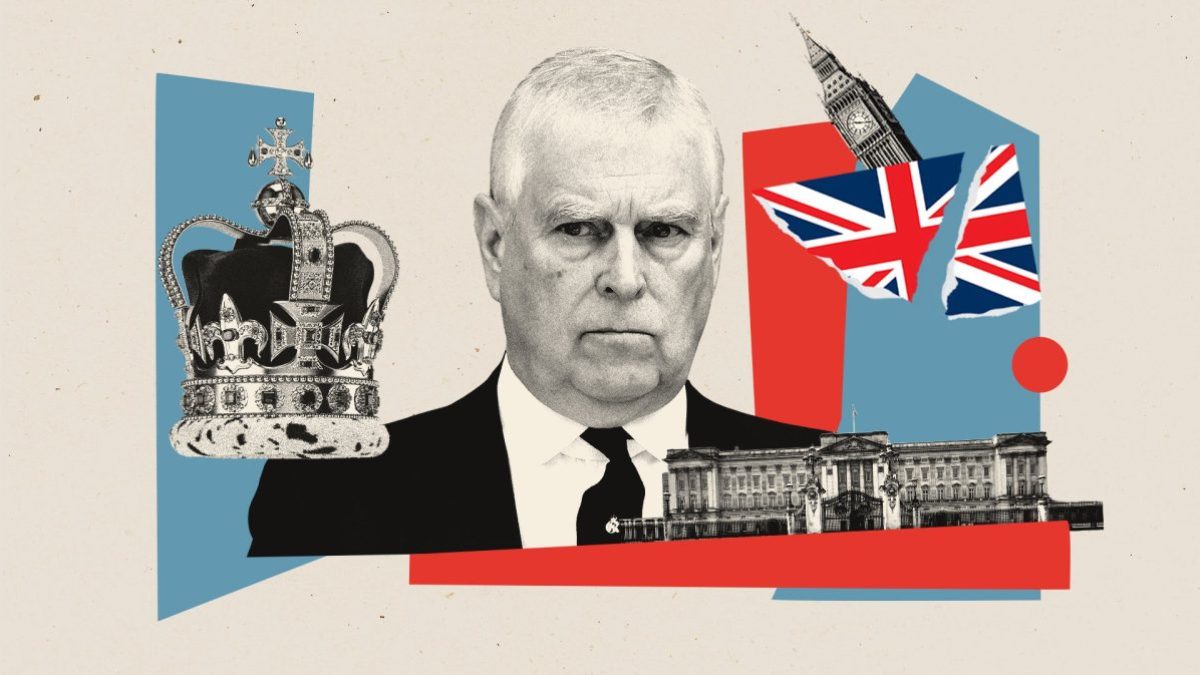
Three years after her death, however, the monarchy looks broken as never before. No one individual holds more responsibility for this than Prince Andrew, who is on a one-man mission to prove that heredity of birth is no guarantee of virtue, responsibility or moral example.
The House of Windsor has endured other crises in recent years. The death of Elizabeth II meant the loss of its most revered figure, the rise of postcolonial politics threatened its relationship with the Commonwealth, and the estrangement of the Duke and Duchess of Sussex dramatically undercut its pretence to be the model family.
But even the Sussex couple’s attacks on their family have not had a fundamental impact on Britain’s support for monarchy on the scale of the drip-drip of revelations about Andrew. The biggest bombshell they dropped on the royals was undoubtedly their interview with Oprah Winfrey. Before that interview, 43 per cent of Britons said out future would be worse should the monarchy be abolished. After the interview, 41 per cent did. Meghan had only knocked 2 percentage points off her loathed in-laws.
Andrew, however, is another matter completely. Questions have mounted for years about his friendship with Epstein, who trafficked vulnerable young women to celebrity friends for sex. Andrew has consistently denied the accusations, made by Epstein victim Virginia Giuffre, that he had sex with her under such circumstances. But it was after his interview with Newsnight’s Emily Maitlis, when Andrew defended the friendship by saying: “the people that I met and the opportunities that I was given to learn either by him or because of him were actually very useful”, that the royal family was forced to accept he could no longer represent them in public.
Throughout the now-notorious interview, Andrew made abundantly clear that he expected his status as a senior royal entitled him to be believed, even when he told us that he couldn’t sweat, or didn’t party, or that a visit to Pizza Express Woking was etched in his memory twenty years after the vital date. He did not spot that young women were being exploited in Epstein’s houses, he said, because “I live in an institution at Buckingham Palace which has members of staff walking around all the time… as far as I was aware, they were staff”. The British royal family announced that Andrew would no longer be “a working member” of the firm, immediately after he’d laid out a public demand for deference which depended on it.
This provoked a deeper existential question for the monarchy. How can the British state continue to defend structural privilege on the basis of birth, if it simultaneously acknowledges that some of those born into constitutional headship are manifestly unfit for the job?
Since 2019, this question has only become more urgent, notably when the King finally moved this year to remove the title of “Prince” from his younger brother. What is a prince, if not someone whose rank is defined from the moment of birth? It is a title bestowed upon squealing royal babies, long before they encounter adult moral questions about paying ultra-low rents on incredibly valuable properties or partying with sex-traffickers.
With the exception of soldiers who actively took up arms against this country – as in the case of two of Queen Victoria’s German grandsons – the modern monarchy has never before introduced a calculus of ethical behaviour for those worthy to call themselves a prince. Never before has it accepted the principle that birthright titles may be conditional on moral behaviour. Now that it has done so, all bets are off. We’re all wondering who’ll be next.
As widely reported at the time, King Charles’ decision to strip Andrew of his title was heavily influenced by concerns that continuing public scrutiny of his brother would only lead to further scrutiny of his own, and the rest of the family’s affairs. It was also a decision that came far too late – the Royals by then had defended Andrew, even tacitly, for too long to be able to quarantine themselves from the gathering public fury.
In any case, King Charles failed to stop the tide. Thanks to Andrew, we are now seeing a level of scrutiny over royal affairs never before seen in our lifetimes – not only scrutiny of their private lives, as in the bad old years of the 1990s – but of their constitutional position as a whole.
Since it was revealed that Andrew paid only “peppercorn” rent on his base at Royal Lodge, MPs have announced an inquiry into all royal homes owned by the Crown Estate, dragging both Prince Edward and the Prince of Wales into their crosshairs.
A number of royal biographers have lined up to argue that the late Elizabeth II enabled and protected her son, raising damaging questions about what she knew about Giuffre. Most dangerously, when Andrew paid a final settlement to Giuffre in February 2022 – in which he admitted no fault – it sparked an avalanche of speculation about how the royals financed themselves.
That led in turn to the Sunday Times revelation, in June of that year, that the then-Prince Charles had in 2015 personally accepted a suitcase stuffed with €1m in cash from a Qatari politician, intended for one of his charities. It was one of three such cash donations totalling €3m – another was stuffed into carrier bags from Fortnum and Mason. In response to the story, Clarence House said that the money was “passed immediately to one of the prince’s charities”.
The Andrew avalanche continues. This month, a major new series by David Dimbleby launched on the BBC, which asks sceptical questions about the King’s ability to remain above politics. In the first episode, released last week, we watched Dimbleby confront royal courtiers over the King’s attempts as Prince of Wales to lobby for specific political campaigns. (On the famous ‘black spider’ memos, Dimbleby tells the camera: “They don’t tell us that Prince Charles as Prince of Wales was able to influence government policy. But it does tell us that he was determined to do so, if he could”.)
Your next read
It is extraordinary to see an establishment figure of Dimbleby’s background – his brother counts the King as a friend – turn on the monarchy in this way. Some conservative commentators have lamented that it would never have happened in the lifetime of the late Queen. They’re looking at it from the wrong end. This full-frontal attack by the BBC would have never happened before the fall of Andrew. The nation has collectively recognised that deference to the House of Windsor can do more harm than good. This is the climate caused by one man – Andrew Mountbatten Windsor – who tried to push that deference to the limit.
In ancient times, royal families based their claim to rule on the principle of the Divine Right of Kings. If we still believed this, we’d accept that God chooses the individuals born into the House of Windsor – and that’s an end of it. In the years since absolutist faith abated, monarchists have tried a more humanist version of the same argument: that a childhood within the royal family is the best possible education for a life in public service. Disraeli made a version of this argument, when he wrote in 1872: “The nation is represented by a family — the Royal Family; and if that family is educated with a sense of responsibility and a sentiment of public duty, it is difficult to exaggerate the salutary influence they may exercise over a nation.”
Nothing about Prince Andrew suggests that he has been “educated with a sense of responsibility and a sentiment of public duty”. The exposure of just how far his sense of entitlement goes reflects not only on himself, but on his often revered mother, the late Elizabeth II. The man has single-handedly proved that being born a prince is no guarantee that he deserves to be one. That revelation is all it takes to break a monarchy. Break a monarchy, and you break the mirror of a state.