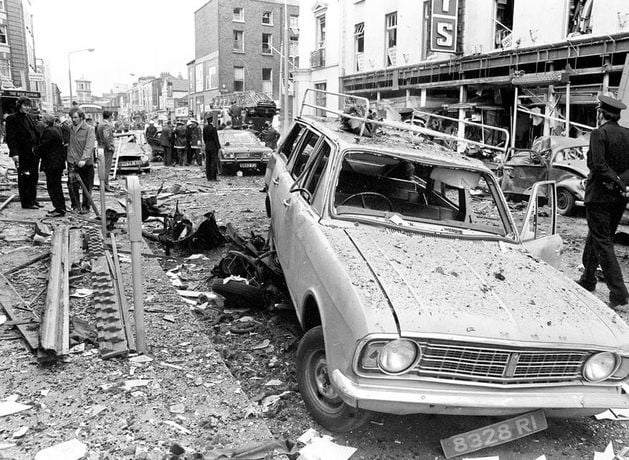
The attacks, which killed 33 people – one of them nine months pregnant – and injured hundreds more, remain the deadliest single day of the Troubles.
Despite a UVF admission of responsibility in 1993, no one has ever been brought before a court.
The Belfast Telegraph previously exclusively reported that there was no evidence of state force collusion.
The conclusions appear in the final Operation Kenova report and within Operation Denton, the strand examining a series of UVF attacks historically linked to what has long been referred to as the Glenanne gang.
Kenova final report: Details of Stakeknife’s recruitment revealed


Denton investigators said there are no “realistic opportunities” for any new, full investigation into the bombings.
The review acknowledges that “legitimate questions” have persisted for decades about the absence of intelligence recovered immediately after the attacks, and the limited information shared with victims’ families over the years.
These gaps, the report notes, have underpinned allegations of collusion. However, investigators said they did not uncover evidence that the security forces were involved in the planning or execution of the bombings, though they were careful to add that collusion “cannot be categorically excluded”.
According to the findings, the bombings were conceived and carried out by senior UVF figures based in the Shankill area of Belfast.
The report says the organisation had the expertise, resources, and access to materials to assemble and plant the bombs without external assistance. While the RUC and Army later held intelligence pointing towards individuals suspected of involvement, the report emphasises that no actionable intelligence existed beforehand that could have disrupted or prevented the attacks.
Denton also examined wider claims about the so-called Glenanne gang, which has been linked to around 120 killings throughout the 1970s.
These include the 1975 Miami Showband massacre, in which three musicians were shot dead after being ambushed by a UVF unit that included members of the security forces.
The review reiterates that this grouping was often portrayed as a distinct organisation, but investigators said an “easily-defined discrete ‘Glenanne gang’ did not exist”.
Instead, the report concludes, Glenanne farm was one of several rural properties used by the UVF to store explosives and weapons, and to plan operations. Other farms and premises were used in similar ways across the Mid-Ulster and Armagh areas.
While Operation Denton did not find evidence that the British state colluded in the Dublin and Monaghan bombings, the review is explicit about the role of individual members of the security forces in other loyalist activity.
Investigators identified “clear evidence” in multiple cases of soldiers or police officers actively assisting loyalist paramilitary groups. These activities included bomb attacks, shootings and the passing of intelligence.
Intelligence assessments reviewed by the Denton team also showed that loyalist organisations routinely received information from serving personnel, and that UVF sympathisers were present across the UDR, the RUC, the RUC Reserve and the Territorial and Army Volunteer Reserve.
The report states that these individual cases “undoubtedly evidence collusion”, even though no proof has been found that such collusion played a role in the 1974 bombings.