
Russian disinformation is highly visible in Italian social media. The flat, open, and porous nature of the platforms offers fertile ground for such influence to spread and normalize.
December 10, 2025 –
Stefano Braghiroli
– 
Analysis

Photo: DC Studio / Shutterstock
In a 2023 article, The Guardian described Italy as “a success for Kremlin propaganda,” reflecting the unfiltered presence of pro-Russian voices in televised debates, the widespread tendency to draw moral equivalences between aggressor and victim, and a fertile political context common to other Southern European states. This environment combines longstanding anti-American and anti-western sentiments (particularly within parts of the historical left) with authoritarian nostalgies on the conservative side. The result is a dangerous cocktail that has made Italy one of the European countries most susceptible to Russian disinformation.
The convergence of these factors – and their manifestations in media and public debate – was recently examined in this outlet by Aleksej Tilman in “Italy and Russia: a Never-Ending Love Story.” Over the past decade, pro-Kremlin narratives, crafted directly from the hybrid warfare playbook, have been increasingly normalized in Italian public discourse. This trend has been facilitated by the limited attention paid by Italian elites to counter-disinformation and foreign information manipulation initiatives (FIMI).
While the initial shock and reaction to Russia’s full-scale invasion of Ukraine in 2022 briefly curbed the most blatant expressions of these narratives, it did little to alter their systemic foundations. On the contrary, Moscow appears to have intensified its efforts to undermine Rome’s support for Kyiv. The most evident – and yet only superficially examined – domain in which the impact of Russian disinformation and the prominence of Kremlin-aligned narratives can be observed is social media, whose flat, open, and porous nature offers fertile ground for such influence to spread and normalize.
A (non-)representative single-case study?
To illustrate how deeply pro-Kremlin narratives have penetrated everyday discourse, I conducted a small experiment. Using AI-assisted tools to trace macro-flows of online conversation, I processed more than one thousand anonymized comments responding to a relatively ordinary news post related to Russia’s ongoing aggression against Ukraine, published by one of Italy’s most mainstream newspapers, La Repubblica.
The Facebook post in question shared an interview with NATO Secretary General entitled “Rutte warns allies: ‘Putin could strike Rome too’,” reporting on a statement by Mark Rutte, who warned that Russia’s most advanced missiles could reach European capitals within minutes. Nothing unusual in today’s climate of geopolitical instability. Yet the discussion that unfolded beneath the article offers a revealing window into a discursive space where Russian messaging not only finds fertile ground, but increasingly dominates. It exposes the discursive linkages, logical fallacies, and cognitive mechanisms of manipulation drawn straight from the Kremlin playbook.
Before delving into this “feed rabbit hole,” two caveats are in order. Firstly, among more than a thousand comments, the presence of bots or trolls is not only possible but highly probable. However, the size of the sample likely mitigates their overall impact relative to genuine user engagement. In addition, this does not exclude the influence of cognitive biases – both exogenous and endogenous to the platform – that tend to amplify negative and critical reactions to the article’s content. Secondly, while this post and its related discussion were selected precisely for their normality within the broader universe of debates about Russian aggression and the full-scale invasion of Ukraine, they do not necessarily constitute a representative case. They do, however, illustrate a set of generalizable discursive dynamics and narrative patterns that shed light on the normalization of pro-Russian sentiment in Italian social media discourse.
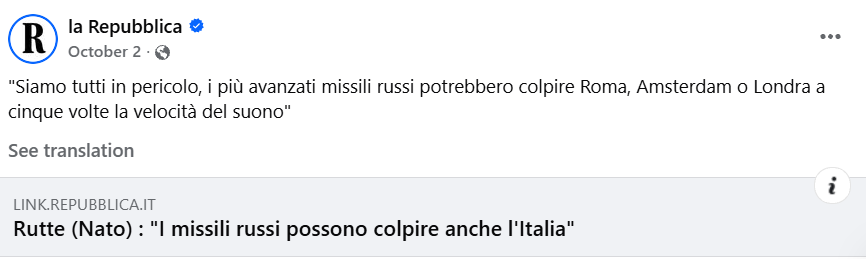
“We are all in danger, the most advanced Russian missiles could hit Rome, Amsterdam or London at five times the speed of sound.” Source: Facebook (accessed on October 5th 2025)
Dissecting the feed
Across more than a thousand user comments, recurrent patterns and consistent emotional registers resurface: anti-NATO sentiment, hostility toward and ridiculing of European leadership, denial or minimization of the Russian threat, and a deep sense of betrayal by western elites. The main themes and central narratives are presented below.
Inversion of Aggressor and Victim
The dominant narrative in a large number of comments is the inversion of the aggressor–victim dynamic. NATO, not Russia, is cast as the principal threat to peace. Commenters accuse the Alliance of provoking Moscow, spreading fear, and pushing Europe into war for U.S. interests. The language is emotionally charged and often mocking – NATO becomes a “warmongering (guerrafondaia) association,” a tool of “western imperialism,” or a vehicle for “psycho terrorism,” designed to restrict freedoms and justify militarization.
This framing extends naturally to the European Union, NATO, and its leaders. Figures such as Mark Rutte and Ursula von der Leyen are depicted as corrupt, reckless, or absurd – loschi figuri (shady characters) and pagliacci (clowns). The EU itself is portrayed as hypocritical and strategically impotent, an organization serving foreign or corporate interests rather than citizens. Many comments contrasts European alarmism about Russia with its muted response to Israel’s conduct in Gaza, calling the EU’s behaviour “an enormous disgrace.” This frequent juxtaposition is central to the pro-Kremlin playbook: by highlighting perceived double standards, it undermines the EU’s moral legitimacy in its stance on Russia and Ukraine.
Ukraine as a “Distant” and “Irrelevant” War
Across the comment sections, Ukraine is rarely depicted as a victim. Instead, the conflict is framed as a bilateral quarrel between two states — “a war between cousins,” “a conflict that has nothing to do with us.” This narrative – perfectly in line with the Kremlin playbook – strips the invasion of its moral and geopolitical dimensions and recasts it as an internal “family feud”. Such framing absolves Russia of responsibility while justifying Italy’s passivity and withdrawal of support.
Several users express open fatigue toward the subject, suggesting that “Italy has already done enough” or “should stop sending weapons.” Others portray Ukraine as a corrupt puppet of western interests or a source of unnecessary risk for ordinary Italians: “We are risking World War III for a war that is not ours.”
At the same time, Zelenskyy’s image is consistently de-legitimized. He is described as a “puppet,” “actor,” “drug addict,” or “servant of Washington,” often in tones that blend mockery and disinformation. The overarching message is that support for Kyiv is not an act of solidarity, but a costly error driven by elite hypocrisy.
This perception of Ukraine as distant and morally ambiguous reinforces the sense of western corruption and fatigue – a key element in the Kremlin’s disinformation strategy. By encouraging the idea that the war is “none of our business,” disinformation succeeds in transforming indifference into complicity.
Fearmongering and Manipulation
Another recurring strand accuses NATO, the EU, and the media of manufacturing fear to justify skyrocketing defence budgets. References to the Cold War – “even then Russia could hit Italy” – or to exaggerated missile capabilities trivialize the threat and portray the current warnings as cynical scaremongering. Several commenters explicitly describe the purpose of such statements as “instilling fear” and “limiting people’s dreams,” while others link it to the enrichment of arms industries or political elites by boosting war economy at the expense of citizens’ welfare.
Russia as Rational and Reactive
A strong flow of commentary denies that Russia poses any real danger. Putin, many insist, “has said 150 times” that he does not intend to attack Europe. This repetition of official Kremlin talking points positions Moscow as rational, restrained, and reactive — responding only to NATO encroachment. Some commenters even invert the fear hierarchy, claiming to fear “American missiles more than Russian ones.” The missile threat is therefore interpreted not as a reflection of geopolitical reality but as western propaganda.
🎙️ Listen to the latest Talk Eastern Europe podcast episode:
Blame on western Leadership and Elites
The tone of resentment toward western political elites is pervasive. Italian and European leaders are portrayed as self-interested and war-hungry, dragging the continent into another catastrophe to bolster national GDPs or the defence sector. Historical analogies abound – references to the world wars, the Spanish Civil War, and the Balkan conflicts serve to depict Europe as inherently bellicose. References to the Brussels as an expression of contemporary nazism and fascism are not rare. The EU, in this view, is the real danger: bureaucratic, disconnected, and complicit in Washington’s strategy.
Anti-Americanism and Domestic Frustration
Anti-American sentiment underpins much of the discourse. The US, despite Trump’s potentially appeasing role, is repeatedly cast as the puppet-master – the hidden force “behind” NATO and the EU, orchestrating wars for profit or hegemony. This blends easily with domestic frustration: anger at Italian politicians and cynicism about democracy – “better a dictatorship like Russia than a democracy like Italy”, and fatigue with foreign entanglements – “we had become a colony of Brussels”. Sarcasm often turns into dark humour: “Let’s hope the missiles hit Parliament first.” For many, the war in Ukraine is simply “their war,” not Italy’s.
Parallels with Palestine, Iraq, and Ukraine
While explicit references to Palestine appear sporadically, they carry symbolic weight. Commenters contrast Europe’s outrage at Russia’s invasion with its silence on Israel’s actions in Gaza or the US invasion of Iraq, invoking the false “weapons of mass destruction” narrative to equate today’s missile warnings with past lies. One commenter goes “the only drones I’ve seen so far were the Israeli ones hitting the flotilla [to Gaza]. Not a word of commendation from Giorgia [Meloni].” These analogies aim to erode the moral clarity of the West’s position: if the West has lied before or tolerates violence from its allies, why believe it now?
This moral equivalence – central to Kremlin information strategy – reframes the conflict in Ukraine as a local dispute (rather than as a war of aggression) into which Europe foolishly inserts itself and contributes to fuel instead of working for peace.
Emotional and symbolic connotations
The emotional landscape of the discussion reveals a striking asymmetry in perceptions of key actors. Despite the tangible reality of Moscow’s war of aggression, Russia rarely appears as the villain. NATO and the EU, by contrast, are consistently cast as dangerous and illegitimate. Kyiv is depicted as a corrupt artificial state deprived of any agency and led by puppet of the West.
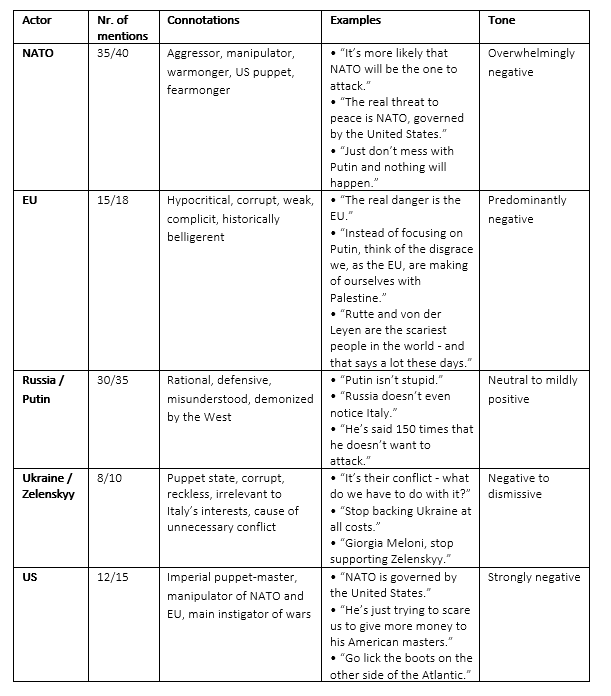
A quantitative overview based on an assessment of the most frequent connotations identified in the analysis of the feed highlights a very clear and skewed pattern. Roughly 90 per cent of comments carry negative sentiment toward NATO, the EU, or western institutions. Around 7-9 per cent are neutral or sceptical, questioning the missile threat without taking sides. Only 0-3 per cent express any sympathy for western positions or for Ukraine. Russia receives very few explicitly negative mentions and is often defended indirectly or directly or alternatively is identified as the “lesser evil.”
How to crack the code? The first step to solving any problem is recognizing It
More than providing ready-made solutions, this piece aims to shed light on a problem of massive scale – one that, while perhaps more pervasive in Italy, is certainly not absent elsewhere in Europe. This brief “autopsy” of an average social media feed demonstrates how disinformation thrives in the mainstream by exploiting cynicism, fatigue, and distrust. It also shows how pro-Russian narratives, if left unmitigated, trickle down from public discourse and traditional media into social media and from there to society by undermining its democratic resilience.
The goal here is not to prescribe cures, but to expose the condition. Recognizing the problem is the first necessary step in cracking the code of Russian disinformation. The very visibility of these narratives – their rawness and ubiquity – provides a diagnostic window into the fault lines of Italy’s public debate and, by extension, into the vulnerabilities of advanced liberal democracies facing interference from hostile authoritarian powers. Understanding the patterns through which ordinary users – often unconsciously – reproduce Kremlin framings allows policymakers and analysts to target not only the symptoms but also the social conditions that sustain them.
The antidote to normalization lies in recognition and exposure: seeing how hybrid warfare colonizes everyday discourse, particularly in the unfiltered ecosystem of social media, is the first step toward reclaiming that space for healthy democratic debate. In that sense, the feed dissected here is not merely a portrait of an uneven battlefield of ideas – it is also a mirror. And in that reflection, uncomfortable as it may be, begins the path to resilience.
Stefano Braghiroli is the Associate Professor of European Studies and Master’s Programme Director at the Johan Skytte Institute of Political Studies, University of Tartu.
New Eastern Europe is a reader supported publication. Please support us and help us reach our goal of $10,000! We are nearly there. Donate by clicking on the button below.

disinformation, italy, Russian influence, social media, Southern Europe