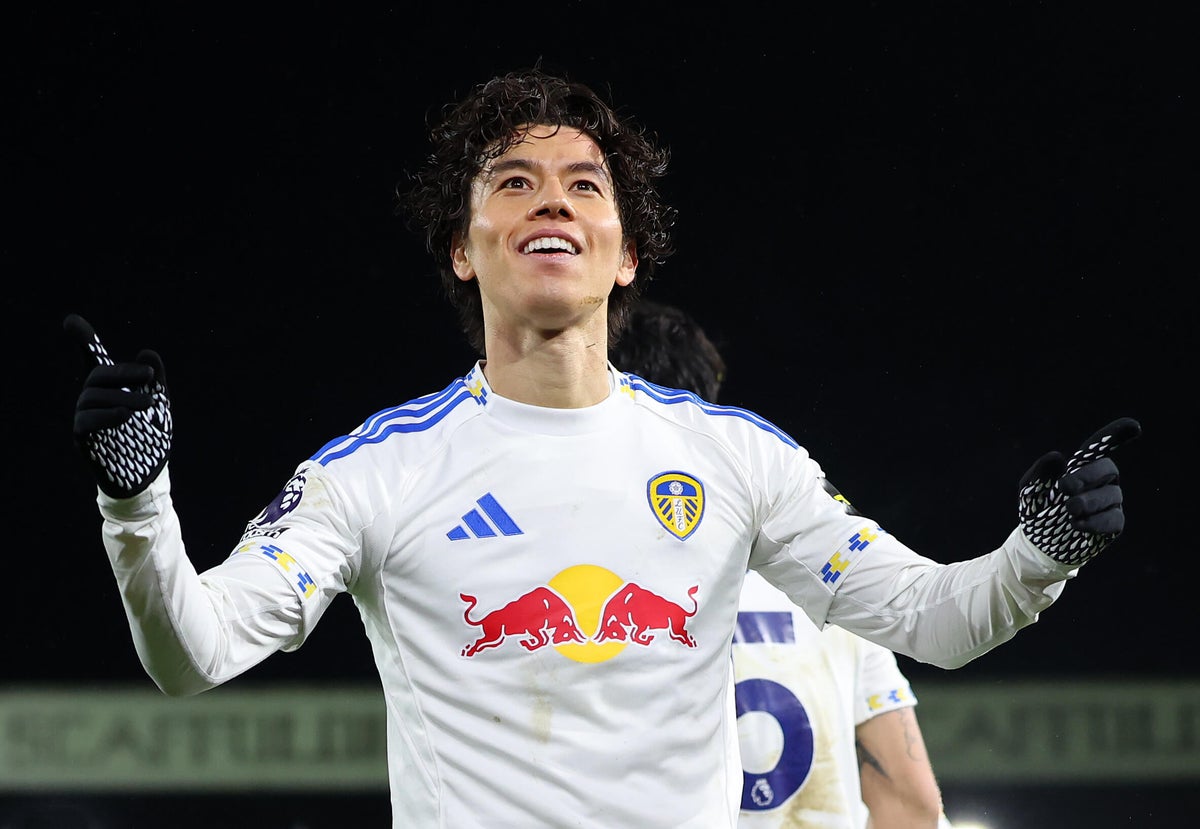
Ao Tanaka has not had many weeks at Leeds United better than the one just past. The Japan international was at the heart of the four points taken from Chelsea and Liverpool under the lights across two riotous nights at Elland Road.
It was the 27-year-old’s 20-yard drive into the corner which killed Chelsea’s hopes before half-time and his 96th-minute back-post finish which salvaged a late draw against Liverpool. In these moments, as the fans chant his name to Ramones’ ‘Blitzkrieg Bop’ or recreate Freddie Mercury’s ‘Ay-Oh’ chant from 1985’s Live Aid concert, Tanaka feels like Elland Road’s conductor.
His popularity on the terraces has soared rapidly since he arrived in August 2024. Last season, manager Daniel Farke said Sam Byram, a club veteran of 221 games, was only half-joking when he pointed to the injustice of Tanaka getting dedicated chants before him, despite his long service.
Tanaka was a revelation in last season’s Championship, after arriving with only 84 appearances in Germany’s second tier as his European experience. He was voted by his Championship peers into the 2024-25 team of the year, in addition to winning the club’s in-house goal of the season and players’ player of the year awards.
The central midfielder was evidently ready to test himself at this higher level, but the club could neither assume he would adapt nor be available for all 38 matches. They strengthened and introduced fresh competition for Tanaka in the shape of Sean Longstaff and Anton Stach.
They each have far more top-level club experience than Tanaka and bring a more imposing, physical profile in what was, as we now know, a summer recruitment drive focused on taller, stronger players ready for a Premier League fight.
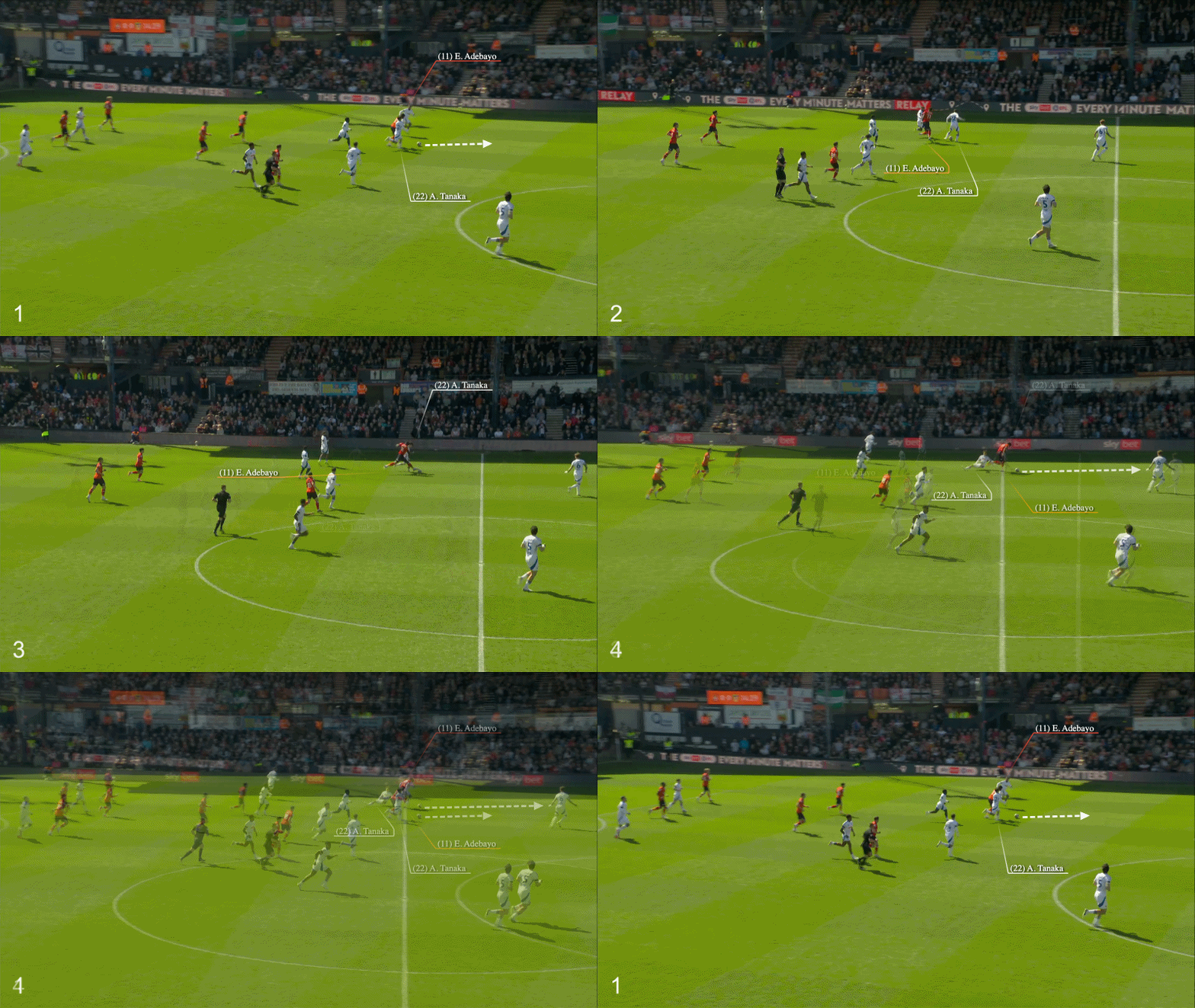
There was one notable incident at Luton Town last season when Tanaka was bulldozed by Elijah Adebayo, who then created the hosts’ only goal of the game. This was just one high-profile example, from a long season, of the midfielder dithering on the ball and being found wanting in a crucial spot.
The Japanese would edge out Longstaff to start the opening match of this season against Everton. Tanaka was immense on that Monday night and gave early signs he could make the step up, but a medial collateral ligament (MCL) injury in his knee after the subsequent Arsenal fixture killed any early momentum.
He was back on the bench by the time Leeds visited Fulham, but the door had been left ajar for Longstaff and Stach to make those berths either side of Ethan Ampadu their own. They barely put a foot wrong until the German was pulled out of the XI for West Ham United’s visit and Tanaka returned, playing a key role in a third win of the season.
Tanaka has found himself in an odd place. He is immensely popular with the supporters, proved himself as one of the best players in the Championship, faced fresh competition for his place in the summer and is now — despite largely impressing while playing in three of the club’s four wins — lagging well behind in minutes played.
While Stach and Longstaff have played 1,001 and 878 league minutes respectively, Tanaka is still only on 552, with six starts from the club’s 15 games. The knee injury had an impact, but there has also been an element of pragmatism in Farke’s selections.
In the home games, where a touch more guile or ball progression may be needed, Tanaka can be the key to unlocking the door. When away from home or in tougher home matches, more physicality might be needed in the shape of a Stach or Longstaff.
While we must bear in mind how small the sample size remains for Tanaka, the data does show how important his progressive passes (passes forward of at least 10 yards or any completed pass into the penalty area) can be. Nobody in the Leeds squad is ahead of Tanaka’s average of 4.75 per 90 minutes.
He is also well placed among his team-mates for completed passes into the final third, not including set pieces. Only Pascal Struijk and Ampadu have bettered his 3.77 per 90.
Interestingly, though, for all of Tanaka’s forward passing, they do not often lead to shots or create chances. He seems to provide the pass before the assist or killer ball. Seven other Leeds players average more than his 0.82 key passes per 90.
Without the ball, there is a clear weakness which Farke may be mindful of. Tanaka has a tackle success rate of only 29.4 per cent.
Across 90 minutes, he attempts 2.79 tackles and completes only 0.82 of them. Nobody at Leeds loses more challenges per 90 than Tanaka at 1.97, though Longstaff is not far behind at 1.94.
Where Tanaka has proved impressive is in his interceptions and recoveries. Only James Justin, who has an even smaller sample size, can better his 1.97 interceptions per 90, while only Justin and Ampadu are ahead of his 5.08 recoveries per 90.
While the statistics suggest Tanaka’s tackling could be better, there is no doubting his keenness to put his foot in and prove he can rise to those physical battles. The best recent moment was arguably his thundering challenge on Chelsea’s Malo Gusto, which created Lukas Nmecha’s disallowed goal.
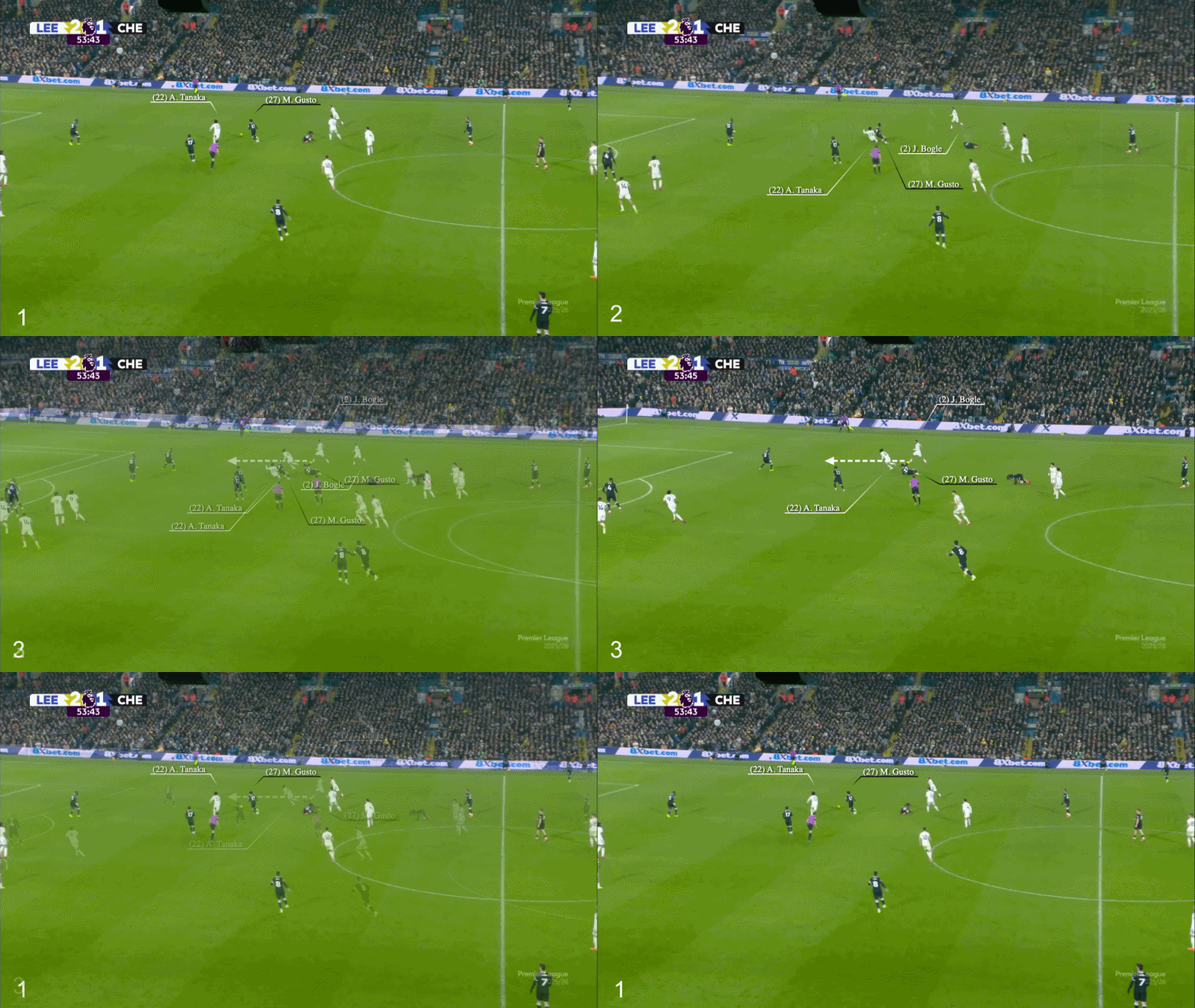
Struijk had put a prior challenge in, deep in the Chelsea half, which the crowd rose to, and then Tanaka went in for the 50-50 with Gusto, winning that and bringing thousands more to their feet. Jayden Bogle ultimately delivered the cross and the flag was eventually raised against Nmecha, but this was everything Leeds needed to see from Tanaka in the engine room.
There was also the bizarre situation against Aston Villa, when Tanaka was substituted on and off in the same game. There were crunching tackles on Ollie Watkins and Boubacar Kamara (for which he was cautioned) before he then tried to deny John McGinn as Villa countered.


Referee Robert Jones plays the advantage as McGinn comes away from Tanaka with the ball, but Farke would later say the fourth official warned him his midfielder could be sent off for the next big tackle he made. Therefore, the manager felt he had to remove him.

For all of the joy around his late equaliser against Liverpool, Farke had earlier been furious with Tanaka for his role in the visitors’ third goal. As Dominik Szoboszlai celebrated, Farke was apoplectic in the technical area.
“Against the ball, before it was 5-3-2 and then later on, it’s 4-5-1, and we never stepped out of the centre, but with all these emotions, 82nd minute, 2-2, we stepped out of the centre, opened the passing gap and Liverpool are a world-class side,” Farke said in his post-match press conference.
“Two passes, they find the player in between the lines, he could then play the final through pass. I was annoyed we lost the nerves in this moment.
“I can’t hide it. Ao stepped out and opened the gap, but it’s a bit how we are. We are perhaps not perfect and sometimes even a bit naive and need to adapt to this top level.”

You can see above where Tanaka breaks away from the midfield bank of five Farke wanted. He presses Curtis Jones, but they pass around him and it gives Ryan Gravenberch space to break into with Tanaka out of position.
Before his eventual strike against Chelsea, Tanaka also had an odd series of dire efforts at goal. In the third minute, he spooned Dominic Calvert-Lewin’s pass wide, then, in the 23rd minute, from a similar position to his later goal he dragged the ball miles wide.

Then there was the third, and hardest, chance in the 41st minute when his half-volley from a cleared corner meekly bounced twice before going out 15 yards wide of the goal. Yes, the outstanding strike eventually came, but these precursors kept showing how Tanaka finds good positions, but has to do better with his finishing.
Tanaka is not perfect, just like the rest of the team, as Farke keeps saying, but he has this talismanic quality with the Elland Road crowd. He seems to straddle the bizarre dichotomy of being undroppable, but also primed for necessary rotation with the different skill sets of Stach and Longstaff.
It’s horses for courses, even with an Elland Road thoroughbred like Tanaka.