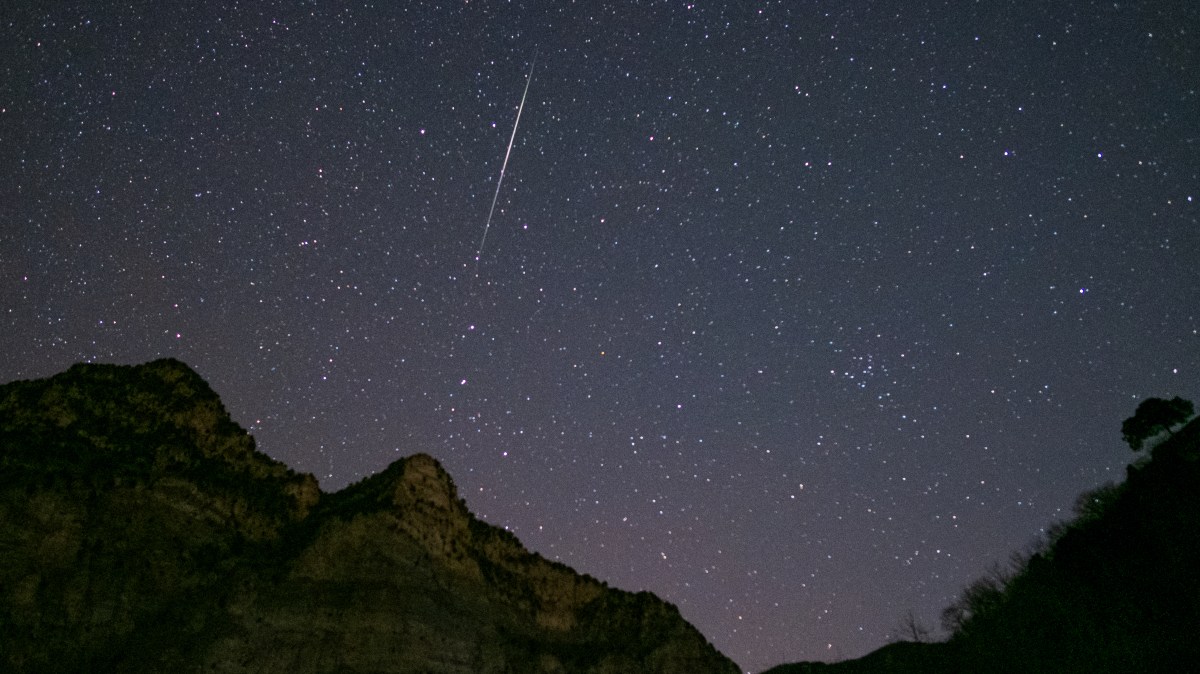
Cross your fingers for clear skies. The most reliably spectacular meteor shower of the year reaches its peak on Friday night, offering skywatchers the chance to see up to 100 shooting stars an hour — clouds permitting.
The Geminids should remain visible until December 20 but the strongest activity is expected overnight from Friday into Saturday.
According to Dr Shyam Balaji of King’s College London, the best time to see them could be about 2am, when the radiant point from which the meteors appear to originate is highest in the sky. “However, you can start watching from mid-evening onwards,” he added.
• December night sky: Brilliant Jupiter stands out
The meteor shower is caused by debris shed by an asteroid-like object known as 3200 Phaethon, possibly several thousand years ago when it collided with another chunk of space rock.
As the Earth passes through this stream of material, tiny fragments enter the atmosphere at speeds of about 81,000 mph, burning up almost instantly and creating bright streaks of light.
Meteors from the shower can appear anywhere in the sky but their trails seem to radiate from a single point in the constellation of Gemini, near the bright star Castor.
Castor appears to move from east to west as the Earth rotates. At 10.30pm it will be in the eastern sky; by 2am it will be close to due south.
“The great thing about a meteor shower, including the Geminids, is that the naked eye is the best way to see them,” said Dr Robert Massey, deputy executive director of the Royal Astronomical Society.
“If you get a telescope or a pair of binoculars you’re automatically restricting your view of the sky, and with a meteor shower what you want is the widest possible view. You want to be lying down, looking up at the broad panoply of stars, and watching for meteors.”
He said observers should expect “a short streak of light that generally lasts maybe half a second or so”. They are “usually so quick it’s impossible to point out to someone you’re with, so you need to keep your eyes up,” he added.

A meteor streaks over Yosemite National Park in California in December 2023
TAYFUN COSKUN/ANADOLU/GETTY IMAGES
Under dark, clear skies, the rate can be impressive. “You can expect to see perhaps up to 100 meteors an hour, so that might be one or two a minute, which would be a brilliant view. It is one of the strongest showers of the year,” Massey said.
If cloud cover spoils the view at the peak, the shower will continue at lower intensity until December 20.
Light pollution is one of the main obstacles to seeing the display. “The best view is if you’re away from sources of light pollution, so try and get away from at least direct lights in towns and cities, ideally out in the countryside,” Massey said. “Obviously you also need a clear sky — if it’s cloudy you’re not going to see anything.”
The Geminids were first observed in 1862 and are thought to be intensifying each year. They are also known for their vivid colours, often displaying a greenish hue rather than appearing white. This colouring is caused by their chemical composition: elements such as magnesium and nickel glow as they burn up in the atmosphere.