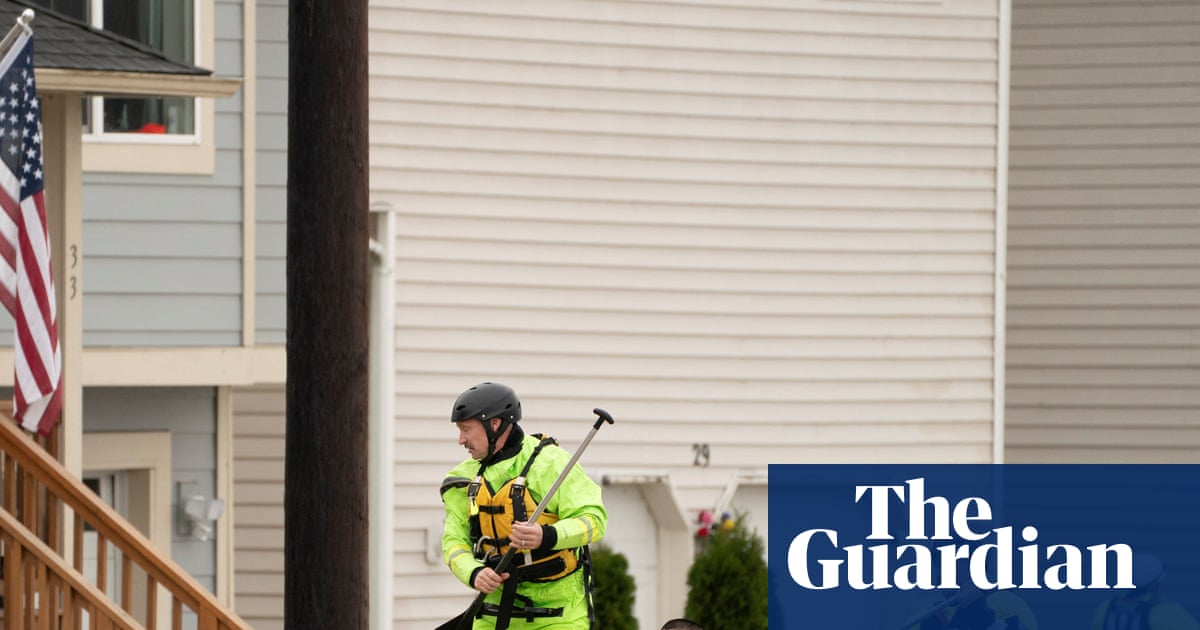
The Pacific north-west is reeling from catastrophic flooding that inundated communities across the region this week, forcing tens of thousands of people to evacuate and prompting a federal emergency declaration.
Torrential rain rapidly filled rivers and triggered flooding on Thursday from Oregon north through Washington state and into British Columbia, causing mudslides and tearing homes from their foundations. Authorities have closed dozens of roads in response to the emergency and issued evacuation warnings for 100,000 people. More rain is expected over the weekend and through next week.
Bob Ferguson, the governor of Washington, on Friday morning warned that flooding “remains extremely unpredictable” and rivers were expected to continue to rise. He declared a statewide emergency on Wednesday in response to the weather, and Donald Trump on Friday approved the state’s request for an emergency declaration, Ferguson said.
The Washington national guard has been deployed to affected areas and helped to rescue residents trapped by floodwaters. Meanwhile, California announced it would send 150 emergency personnel, including search-and-rescue teams, to the state to assist with the response.
The intense rain began earlier in the week with a storm system meteorologists call an atmospheric river, a vast airborne current of dense moisture funneled inland from the Pacific Ocean, that inundated the region with water.
Western Washington state bore the brunt of the storm, with flood watches posted for the Cascade and Olympic mountains and Puget Sound, as well as for a northern slice of Oregon, home to some 5.8 million people, according to the US National Weather Service. In recent days, authorities have rescued people from rooftops and submerged vehicles. The Associated Press reported that in Snoqualmie, a herd of elk could be seen swimming through neck-high water on a flooded football field.
The same storm system has also brought heavy showers and flooding to western Montana and an edge of northern Idaho.
A sign partially covered by floodwater from the Snohomish River on 11 December. Photograph: David Ryder/Reuters
Early on Friday morning, all the residents of the small city of Burlington, in western Washington, roughly halfway between Seattle and Bellingham, a total of around 10,000 people, were told by the authorities to evacuate. National Guard were going door to door and shelters were being prepared, local media outlets reported.
In addition, roughly 100,000 residents across wider western Washington on Friday were under level 3 evacuation orders urging them to immediately move to higher ground, the bulk of them in rural Skagit county north of Seattle, said Karina Shagren, a spokesperson for the state emergency management division.
About 3,800 evacuees were believed to be in need of temporary shelter, Skagit county emergency chief Julie de Losada said.
First responders have rescued several people, including by helicopter in King and Whatcom counties in recent days.
The worst flooding was reported along the Skagit, Snohomish and Puyallup rivers. More than 30 highways and dozens of smaller roads were closed due to flooding across the region, state officials said. In some communities, residents have been urged to boil water to ensure it is safe to consume.
Several lengthy segments of the BNSF Railway, a major freight line serving the Pacific north-west, were washed out or closed due to flooding, the company said, citing reported rainfall of 10 to 17in or more in many areas.
Some rivers have been cresting several feet above record levels and on Friday morning had not receded. The forecast is for lighter rain on Friday and a mostly dry Saturday but meteorologists predict more heavy rain on Sunday for the region.
Scott Uderitz and Tod Uderitz watch the rising floodwaters of the Snohomish River from the offices of the Snohomish United soccer club in Snohomish, Washington, on Thursday. Photograph: David Ryder/Reuters
In British Columbia, five of the six Canadian highways leading to the Pacific port city of Vancouver were shut down due to floods, falling rocks and the risk of avalanches, local authorities said on Thursday.
“This situation is evolving and very dynamic,” said the transport ministry of British Columbia.
Access to Vancouver relies largely on a limited highway and railway network that crosses the Rocky Mountains.
While such storms are not uncommon on the US Pacific coast, meteorologists say they are likely to become more frequent and extreme over the next century if global heating from the human-induced climate crisis continues at current rates.