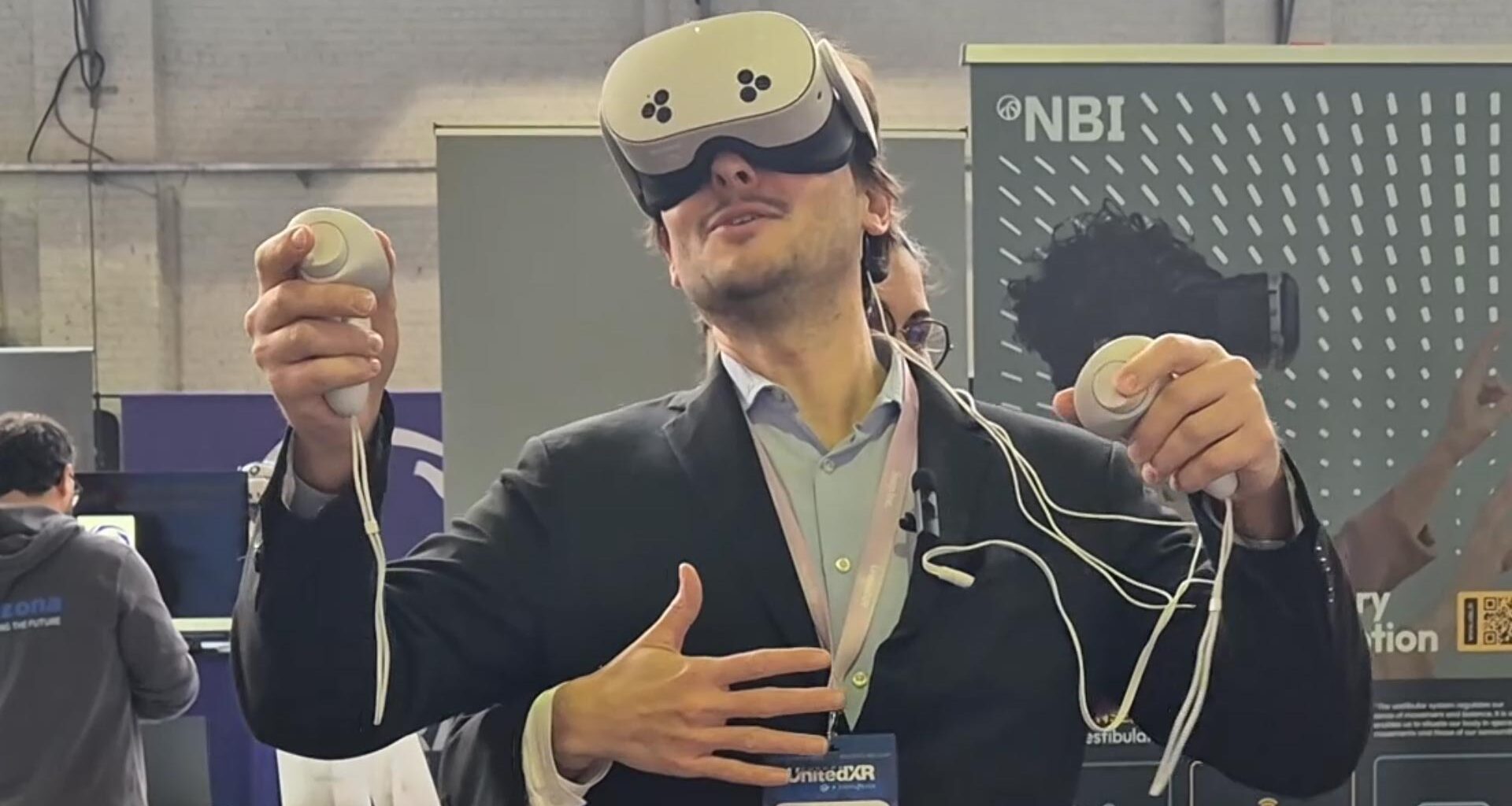
Today at United XR Europe, I’ve just tried the GVS solution from Neural Balance Innovations, and I can say this is the craziest technology I’ve tried in 2025 and one of the best experiences I’ve had in my career in XR. You must read this article… or alternatively watch the video below!
This video is both fun and informative, I promise!
Motion sickness and GVS
To talk about what Neural Balance Innovations (NBI) works on, we need to take a step back and talk about motion sickness. Motion sickness happens because when you are in VR, your eyes see that you are moving, while the vestibular system in your ear perceives that you are static: the brain notices this sensor mismatch, thinks that you have been poisoned, and makes you want to vomit to get rid of the poison.
One solution to this problem is using Galvanic Vestibular Stimulation (GVS), which sends electrical signals to your vestibular system (the part of your inner ear that manages your balance) so that the data it perceives becomes coherent with the data your eyes are seeing. GVS is not a new technology: XR people have been talking about it for many years, but no one has found a perfect solution for it, yet. And I have never had the opportunity to try it before… until today.
Neural Balance Innovations Stimbox
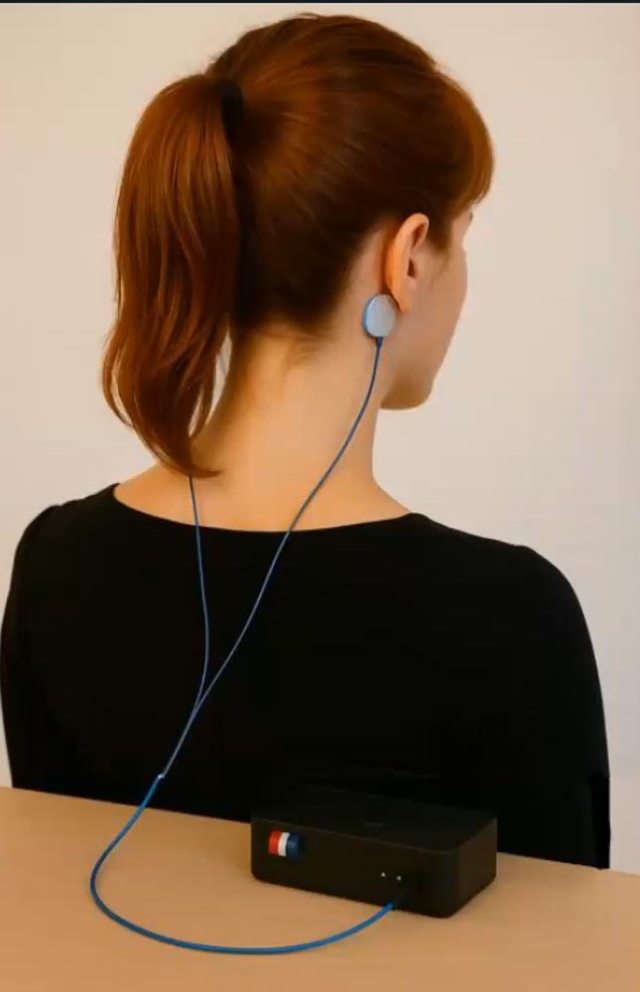 Example image of a person using the Stimbox device (Image by NBI)
NBI’s product, Stimbox, is a device that stimulates your body’s stability system via GVS. Stimbox can solve the sensory mistmatch that causes motion sickness in two ways: it can either desensitize your ear, so that the brain ignores its signals; or, even better, sinchronize the perception of your inner ear with the movements that you see in VR: in this case, you really have the feeling that your body is moving while you’re moving in VR, for decreased nausea and added realism. It seems science fiction, but it is actually reality.
To have the best performances possible, Stimbox should be calibrated for every user. Clarice Da Costa, the PhD who invented this technology, taught me that when you use GVS, there’s a threshold above which the system helps you in feeling better, and a second threshold, below which the nausea even gets worse (between the two thresholds, the effects are negligible). Calibration helps in ensuring that your experience is above the first threshold.
At United XR Europe, I’ve seen no calibration stage; I guess that’s for the sake of brevity. This means that your mileage with the experience may vary, but for many people, it was cool nonetheless.
Installation
The setup of the Stimbox looked more like a healthcare procedure than a technical one. One of the employees of the company took two electrodes and put them in the area behind my ears.
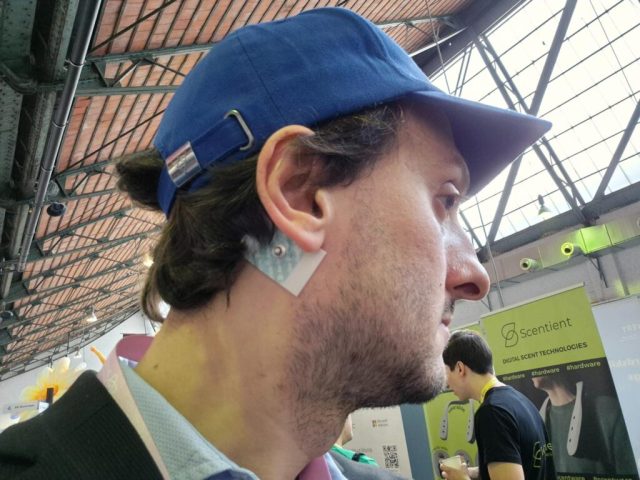 The electrode behind my right ear
After that, she took the Stimbox and then connected two cables from the Stimbox to the electrodes behind my ears. The Stimbox was lately fitted to my pocket.
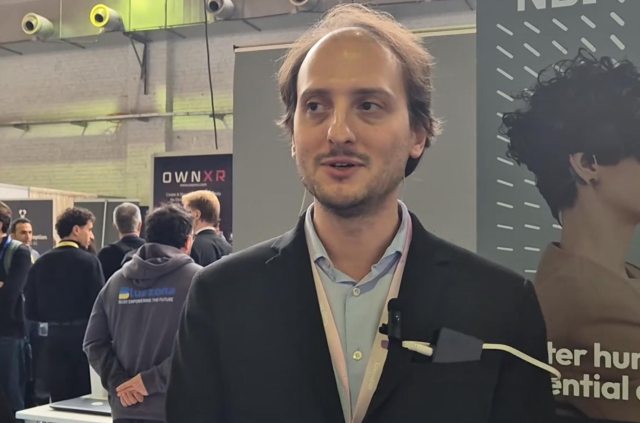 You can see the box in my pocket, with two cables coming out and going to the devices in my ear
I’m not gonna lie, seeing someone installing electrodes on your head feels a bit weird and dangerous… and that’s why I liked it. But some people may feel scared by it.
Bare body testing
NBI gave me a first demo without using any VR headset, but just my body. They put a thick, small sponge carpet below my feet, so I could feel more of my balance sensations. I was then asked to close my eyes and concentrate on the body sensations.
For a few seconds, I wasn’t feeling anything. Then I started to feel some electrical shocks behind my ears, and then something weird happened: my body slowly started swinging left to right. It was a small movement, but it was happening: I was moving a bit like a metronome. After a few seconds like that, the employee switched the electrical pattern, and I started slowly swinging back and forth. When the pattern changed again, my body started swinging in all directions, as if my head was drawing a circle around my body using my feet as the center.
Swinging in all directions because of the vestibular stimulation
It was fucking weird: it was like someone had a remote control of my body. They could decide if I could stay still, or swing, and if I was swinging, in what direction. My feet and my whole body started doing actions even if I was not giving them any instructions to move whatsoever. That was fucking insane. I never felt a sensation like that before.
Clarice explained to me after the demo that the Stimbox basically changes the perceived center of gravity of the body, and the brain commands the body to move accordingly to it: it is a bit like when you lean forward, and the brain moves your body muscles so that you don’t fall to the floor.
VR testing
After this test, which was already cool, I went for the VR test. I’ve been given a Quest 3S with the Epic Rollercoaster Application (an application that has the power to make people feel motion sick), and I started the ride. VR rollercoasters always start slow, and this was no exception: in the beginning, I was feeling no electrical stimulation, no balancing sensation from my body, and the visuals were also moving pretty slowly.
After these few seconds of boredom, I got close to the moment where the rollercoaster starts to go fast, and the team at NBI turned on the device, letting me feel the electrical tingles close to my ears. The rollercoaster then accelerated and started to make me run down, left, right, and even upside-down. The incredible thing was that, notwithstanding all these fast movements, I was not feeling any sensation of motion sickness. Literally, zero. In a way, it felt like I was not feeling any sensation at all, as if I were just doing some boring teleporting inside a flat room. I spoke with a few friends who tried the experience and are more sensitive to motion sickness than I am, and they confirmed to me that the motion sickness sensation was totally gone.
There was a side effect, though: my body started having some weird stabilization sensations. I started leaning back and forth, and my feet were contracting for no reason at all. My body was completely out of control, and I started following the sensations given by the device. Since I was doing crazy rollercoaster movements in VR, I also didn’t have any fixed reference system of the real world, so my brain couldn’t use other data to balance my body and could just rely on the manipulated data of the inner ear.
The unbalancing sensation got so strong towards the end that I completely lost it, and I was going to fall to the floor if the people at the booth hadn’t stopped my movement. I almost died, and I loved it!
Completely losing my control…
First Impressions
What the Stimbox does feels like black magic. I’ve always wanted to try GVS, and now that I’ve experienced it, I’m not disappointed at all. This technology can literally take control of your body and make it move as it wants. It is incredibly powerful.
And the most important thing for us XR people is: motion sickness disappears when you are using it in VR. Even more, the device has the potential to give you a more realistic virtual reality: if you’re seeing that you’re going down, and the GVS makes you feel going down, then you really perceive that you are going down with your all body.
Anyway, it seems a bit early for consumer adoption, and there are many things to work on, starting from two in particular:
- The electrical stimulations feel like having a needle tingling in the back of the ears. It is bearable, it is not painful at all, but it is still a bit annoying
- The device shouldn’t give stability issues. I’m a crazy guy who likes to try innovative VR solutions, so I’m pretty happy with the idea of risking falling and dying. But not all people are like me, and the safety of the users should become a priority for the company.
Anyway, I see a lot of potential for a technology like this one. You know that I rarely get excited about things, but this experience literally put me in awe.
Price and availability
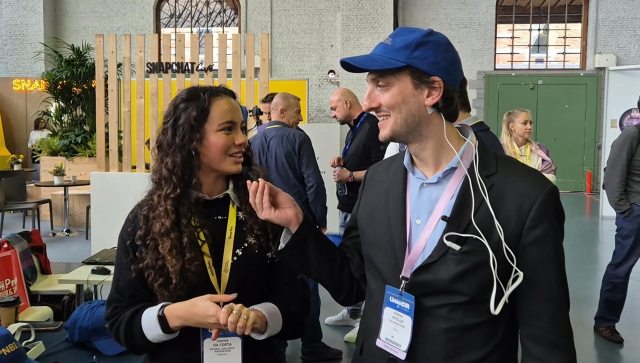 Interviewing Clarice Da Costa, the inventor of Stimbox
Clarice told me that Stimbox is already a product that companies can buy for 1200€. Currently, it is mostly provided as a tool for training, e.g., for pilots, not necessarily in VR. Now they are instead focusing on integrating this system with VR applications.
As usual, I would love to hear your impressions about this device here in the comments below or on my social media channels! Don’t forget also to share this post to make all your XR friends know about this crazy technology, and if you are at UnitedXR, run to the Neural Balance Innovations booth and try Stimbox yourself!
Disclaimer: this blog contains advertisement and affiliate links to sustain itself. If you click on an affiliate link, I’ll be very happy because I’ll earn a small commission on your purchase. You can find my boring full disclosure here.
Share this with other innovators
Related