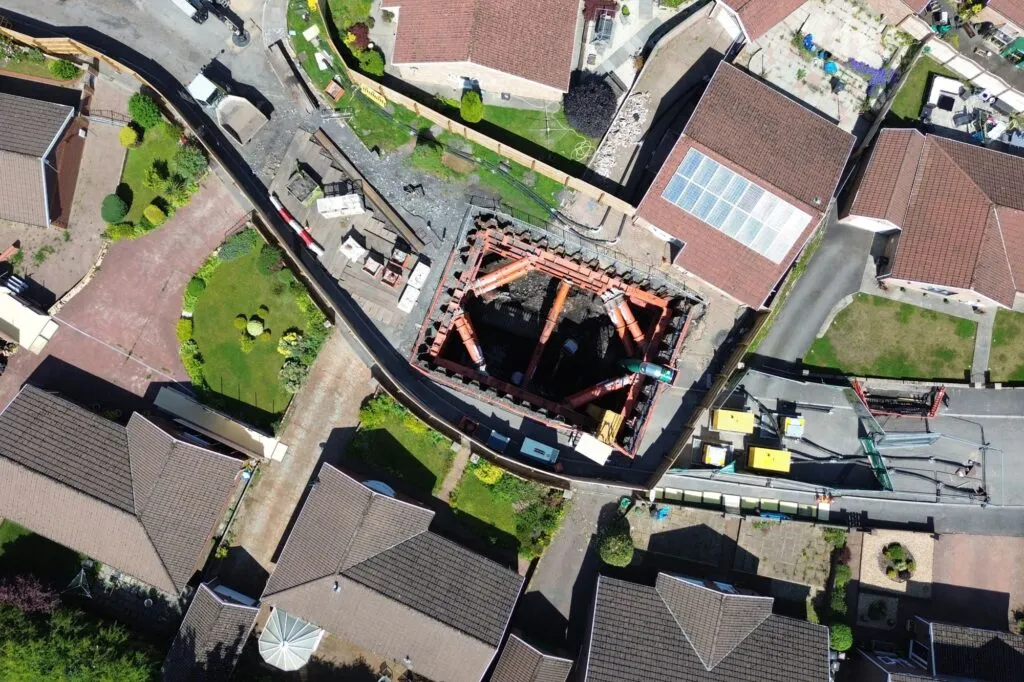
The dramatic collapse of an historical culvert beneath a South Wales housing estate last year demanded rapid stabilisation works and a complex £4M repair.
In December 2024, a South Wales village on the outskirts of Merthyr Tydfil caught the country’s attention when a large hole formed in a quiet cul-de-sac. The ground collapse on the Nant Morlais estate in Pant rapidly enlarged to at least 12m deep and 10m wide.
Residents from 29 properties on the estate were evacuated and roads in the area were closed as a safety precaution.
The cause of the hole was a localised collapse of a 19th century-built masonry culvert that carries the Morlais Brook stream that runs beneath the estate.
Reports from Merthyr Tydfil County Borough Council (MTCBC) suggested that the structure was weakened and damaged by two landslides triggered by Storm Bert in late November 2024, which sent boulders and debris through the culvert. Residents at the time reported hearing rumblings and bangs as boulders rattled down the culvert and likely initiated the collapse.
Under pressure to make the area safe and get residents back into their homes by Christmas, MTCBC engaged specialist marine and civil engineering contractor Edwards Diving Services (EDS) to carry out emergency works.
EDS was then appointed to design and build the permanent repair of the culvert, working with civil and structural engineering design consultancy Pebble Engineering as designer.
EDS initially arrived on site on 2 December 2024. The almost year-long work to repair the culvert that followed has been described as one of the largest and most complex engineering projects in South Wales this year, with the final cost exceeding £4M.
Not only was the team tasked with urgently stabilising the initial collapse and returning residents to their homes, but they also faced multiple challenges and site constraints. These included restricted access, poor ground conditions and the absence of reliable records for the existing culvert.
By working collaboratively and applying innovative engineering techniques and solutions, EDS and its partners successfully delivered safe piling, excavation and permanent repair works.
Surveys and GI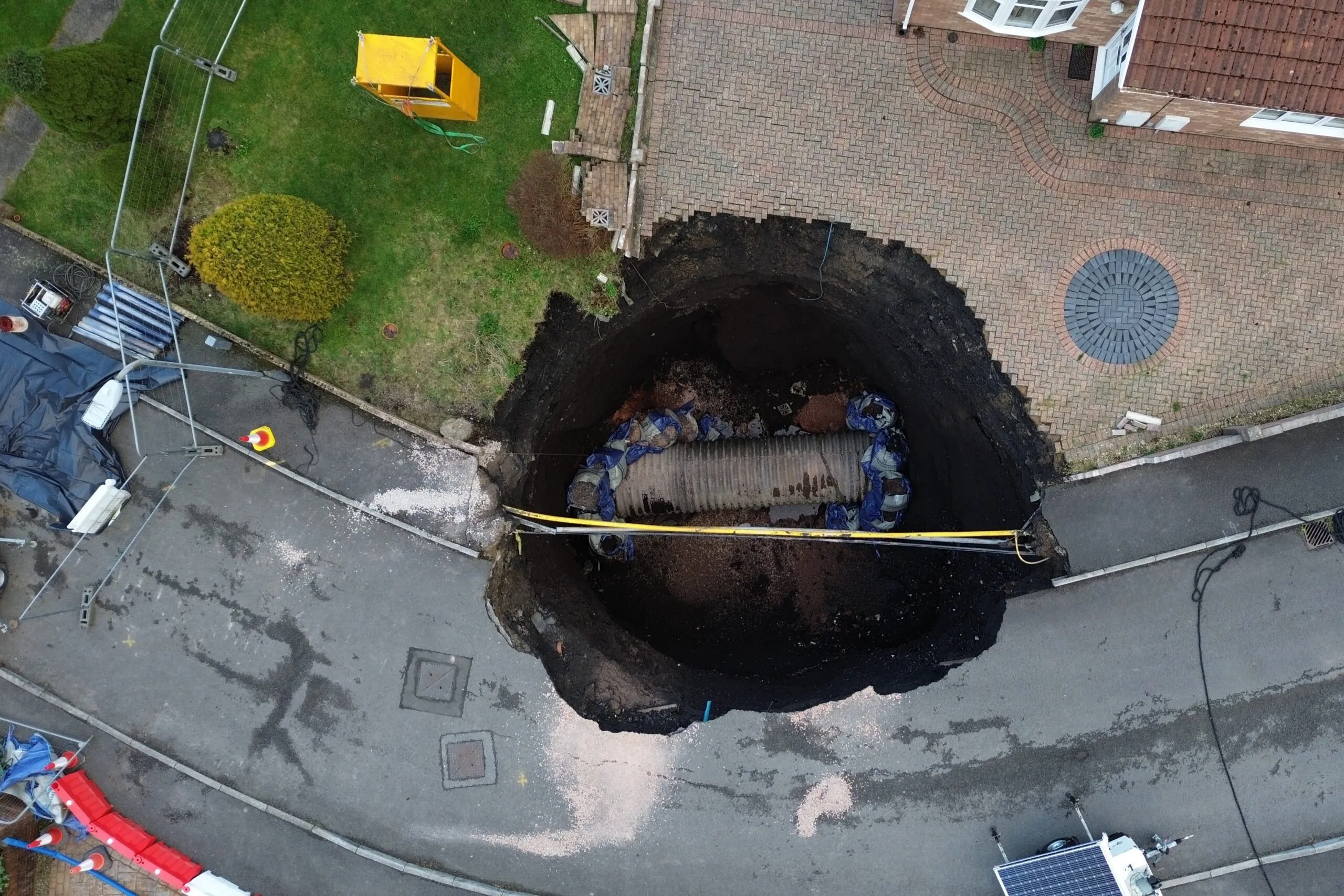
Residents were evacuated after the hole formed in November 2024
The earliest part of the culvert was constructed in the 19th century, a second phase was added between 1900 and 1910, and a final section was constructed between 1910 and 1957.
Due to the culvert’s age, phased modifications and additions, “there were no accurate or reliable records of the construction form and alignment of the structure”, says EDS projects director Nathan Walding.
The priority for the team was therefore to gather reliable information on the culvert’s condition before any emergency works were carried out on it.
EDS engaged Glanville Geospatial tosurvey and map the culvert using dronetechnology, as a person-entry confined spaceinspection of the structure wasconsidered unsafe due to the risk offurther collapse.
“The drone survey generated a 3D model of the culvert which allowed the team to determine safe crane positions and eliminate the risk of construction plant surcharge loading a potentially weakened structure and [triggering] further instability or collapse,” explains EDS project manager Jack Muldoon.
The results of the initial drone survey confirmed no additional structural concerns beyond the immediate collapse, enabling safe confined-space entry. A LiDAR survey was then carried out to precisely determine the culvert’s alignment. This information was later used by the team to position the temporary works and sheet piles, ensuring they did not strike the culvert’s wall or crown during excavation for the repair works.
EDS engaged geotechnical engineering consultancy Spectrum Geo Services to complete a geotechnical desk study and carry out a targeted ground investigation to inform the temporary and permanent works. This was necessary to establish the ground conditions for piling to construct the temporary cofferdam.
The team was unable to access the north side of the collapse as the hole had cut off access, and there was no alternative access within the cul-de-sac.
So, “the intrusive ground investigation was limited to just one borehole position in a safe location to the south of the hole”, says Walding.
Muldoon adds: “At this stage of the project, there was significant pressure to complete the temporary reconnection and filling works to enable residents to return home before Christmas, so the ground investigation scope was limited to what could practically be achieved within the available timeframe.”
The ground investigation and borehole information identified that the culvert was founded on glacial till material overlying extremely weak horizontally banded mudstone, while the filled ground around the sides and above the culvert comprised colliery spoil material.
Emergency works
The scope of the emergency works was to temporarily reconnect the two broken ends of the culvert and to stabilise and backfill the hole to limit further movement. However, one of the biggest and most pressing concerns for EDS was stopping the stream that was still flowing through the bottom of the hole.
Obstructions within the base of the channel “were further eroding colliery spoil material and enlarging the perimeter of the sinkhole”, says Walding, so the immediate task EDS faced was to “remove those obstructions and reduce the flows”.
EDS engaged pump specialist Selwoods to assist with the development of a suitable solution for over pumping the stream that considered the static lift and head losses. They initially selected a diesel pump system with four 20cm-diameter suction pumps and individual discharge lines. Each line covered a distance of around 500m through a field, down a hill, along a path, across a road, down the boundary of a school and down a riverbank to the culvert outlet, where the water was discharged.
The pump system successfully managed to slow the culvert flows. However, the existing culvert can carry up to 2,500L/s of water during peak flows, notes Muldoon, so the pumps couldn’t entirely stop the flow and at times of heavy rainfall they would become overwhelmed.
While the pumps slowed the erosion of the hole, the team then moved quickly to reconnect the two sides of the culvert. This was achieved using a corrugated steel Armco drainage pipe measuring 1.8m in diameter and weighing 5t.
Due to unsafe conditions inside the hole, the pipe was positioned into the broken ends of the culvert using cranes. Once in place, bulk bags of gravel were craned into the hole and positioned at each end of the pipe to plug the annulus between the existing culvert walls and the temporary pipe. These ends were then further sealed internally with concrete bags and grout.
Once secured, the pipe acted as a temporary measure to carry the flow of the stream from one side of the collapsed section to the other and enabled the team to fill the hole with imported stone.
“Because we couldn’t get close to the culvert with anybody, we used a large tracked conveyor system, and we remotely loaded that with stone, and tipped the stone into the void to backfill it all to surface level,” explains Walding.
Sheet piling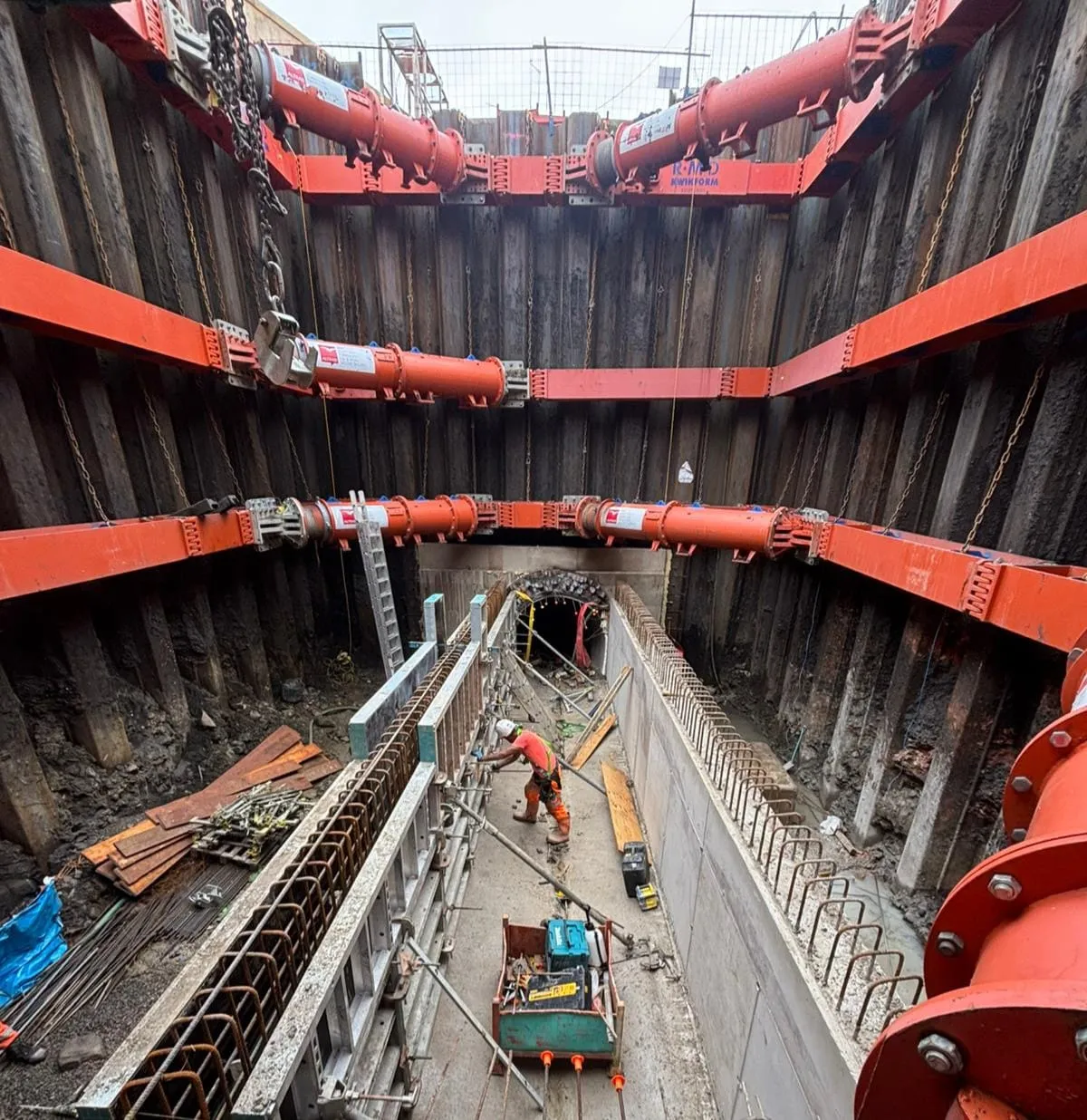
At the bottom of the cofferdam a new culvert section has been built that ties into the existing arched culvert tunnel
EDS identified early on that a sheet piled cofferdam around the perimeter of the collapse would be the “only viable method” to secure the excavation for the permanent repair works, says Muldoon.
The team developed the temporary works design for the sheet pile cofferdam over the Christmas period while preparing the site for heavy engineering works and ensuring continued access to the cul-de-sac for residents as well as emergency services.
“Whilst we were driving the sheet piles, we knew we’d have to impart construction surcharge loads on the culvert with the piling equipment because we had to effectively sheet pile parallel and perpendicular to the line of the culvert,” Muldoon explains.
To facilitate this and accommodate the extra construction surcharge loads, the team designed and then applied a shotcrete reinforcement liner to 15m either side of the collapsed section to reinforce the culvert. These works were completed in conjunction with resident access diversions.
In March 2025, work started on installing 14m long sheet piles into the ground surrounding the original footprint of the hole to create a 14m long by 9m wide cofferdam. To minimise vibrations, noise and potential further damage to the surrounding houses, the team opted to use a hydraulic Giken press – a low vibration piling method.
Due to the depth of the excavation and the position of the culvert, the temporary works design required the sheet piles to be toed into the mudstone layer as the selected sheet piles would be unable to cantilever the distance from the lowest bracing prop due to stiffness limitations.
This proved challenging due to limitations on press in force that could be achieved with the Giken press.
“Water jetting was attempted but the final toe-in could only be achieved with an impact drop hammer”, says Walding.
EDS installed vibration monitoring devices on the boundary of properties and within the culvert in advance of the piling operations to monitor vibrations. These fed back live data to the team on vibration levels from the piling works. A suitable cut-off limit for vibrations was agreed with MTCBC prior to the work and in accordance with British Standards. If these limits were exceeded the works would be stopped and the method reassessed, says Walding.
Piling perpendicular to and above the line of the culvert was particularly challenging, notes Muldoon.
“We knew that we needed to pile close to the crown of the culvert because of the ground conditions being unstable and we didn’t want to leave too much of a gap, where soil would be unsupported during the full excavation works.”
Data from drone and LiDAR surveys of the culvert fed into the temporary works design by Pebble Engineering and a level was agreed for driving piles directly above the culvert crown that balanced this risk of striking the culvert and leaving unsupported earth.
“We effectively ‘letter boxed’ the piles around the culvert,” says Muldoon. “This involved driving eight piles shorter than the rest of the piles.
“We also didn’t know the construction makeup of the original culvert,” he adds. “We assumed that there were large boulders around it used as backfill. So, there was an added danger of pressing one of those boulders through the top of the culvert during the piling operation. Hence a safe level was agreed and conditions monitored during these critical works.”
Despite significant technical, logistical and access challenges associated with the works, EDS successfully achieved the pile embedment levels.
The team then began excavation of the temporary fill material within the perimeter of the sheet piles in a phased approached. The temporary works design required bracing at three levels, so each level was excavated, and hydraulic bracing members were installed before the next phase of excavation could begin.
The bracing members were fitted with load cells, which monitored the forces against the temporary works design outputs. If any changes outside the defined parameters were encountered the works would be stopped. Muldoon notes that digging out was slow because the team had to use a crane to lift plant into the box as well as remove excavated material out of it.
Once all props were installed, the Armco pipe was removed while the stream was being over pumped. When the team reached formation level, a new mass concrete blinding slab was poured over the full footprint of the cofferdam to provide a solid foundation upon which to construct the new culvert section.
In place of the collapsed 19th century arched culvert tunnel, EDS then built a rectangular in-situ cast reinforced concrete box section, with bespoke tapered connection details at the upstream and downstream ends to tie into the shotcrete lining and existing culvert walls.
“We had lined the upstream and downstream ends of the culvert with the shotcrete lining. So, we peeled back the brickwork slightly to a point that we were satisfied with the condition of the existing culvert, and then it was a job of trying to mesh the new construction into old,” explains Walding.
Once complete the culvert was backfilled to surface level with imported and compacted engineering fill. The sheet piles were cut off at 1.2m below ground level at a height that could accommodate utility services.
EDS handed over the culvert to MTCBC in October this year. The council is now building a debris barrier further upstream that will trap boulders and prevent them from entering and damaging the new culvert.