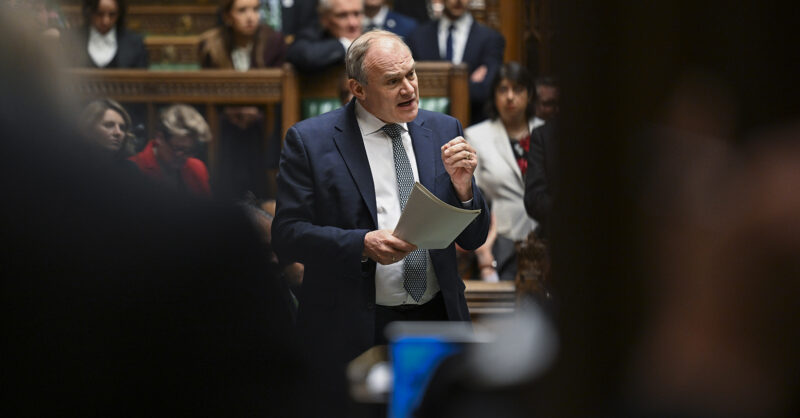
Photo by House of Commons
Tuesday 9 December was a big day for the Liberal Democrats. As parliament was beginning to wind down ahead of the Christmas recess, a little-hyped Ten Minute Rule bill brought forward by the Lib Dem spokesperson for Brexit passed in a tie-break vote broken by the deputy speaker. The bill called for the government to begin negotiations on joining a bespoke customs union with the EU.
Lib Dem leader Ed Davey called the vote a “historic victory”. It won a small news-in-brief item on the front of the Financial Times and otherwise made no frontpages; these kinds of bills are very unlikely to progress and become legislation. Still, the mood among Lib Dems was jubilant. “We’re finally getting some cut-through,” one cheerful MP remarked. This is the paradox of the Lib Dems in 2025: parliament’s third-largest party (72 MPs) struggles to attract the media spotlight, unable to land its message of sensible, pragmatic credibility in a world of insurgents and populists.
Ed Davey has the highest favourability ratings of any UK party leader and tends to win in head-to-head polls for who voters would prefer as prime minister. He won won more Lib Dem MPs in 2024 than Charles Kennedy did in 2005. By some metrics he is the party’s most successful leader in over a century. The question is: what is he doing with them?
It is Reform UK that is now treated – by the media and by voters – as the de facto opposition party. Davey chose to tackle this at the party’s conference in Bournemouth in September by framing himself and the Lib Dems in direct opposition to Nigel Farage. His speech named the Reform leader 30 times – a tactic that won him coverage, but left him vulnerable to the charges of an obsession with Reform and an inability to articulate what his own party stands for. Meanwhile the Green Party, turbocharged by their new eco-populist leader Zack Polanski, is emerging as the key challengers on Labour’s left flank. “Zack is a very bold communicator,” one activist said after a stint knocking on doors. “People are wondering, why can’t we communicate like that?” Others, however, point out that bombastic provocateur isn’t really Davey’s style. “There’s no way he could speak like Zack and sound authentic. He’s got to stick to his own style.”

Treat yourself or a friend this Christmas to a New Statesman subscription for just £2
As campaigners gear up for the 2026 local elections, politics is looking more fractured than it has ever been – with five parties (six in Scotland and Wales) jostling for contention. In a multi-party landscape, definition is everything. What do the Lib Dems stand for?
In February, Kemi Badenoch dismissed the Lib Dems in an interview with Jordan Peterson as a party of people who are “good at fixing their church roof”. Ed Davey was delighted. He framed Badenoch’s insult as a source of pride in an op-ed, and the quote was used at Lib Dem fundraising events as evidence of the different the party can make at a local level. As multiple activists noted, “People like MPs who can fix the church roof.”
For the Lib Dems, being a hyper-local party is a feature, not a bug. The party even launched a new regional media team this year, to elevate its MPs on local news stations. The relative lack of coverage on by major broadcasters is a source of frustration. (Davey attacked the BBC in September for “fuelling Reform’s rise by plastering Farage across our screens without providing the proper scrutiny the public deserves”). But, party insiders argue, local is where the real war is playing out.
They point to local success up and down the country as evidence the approach is working. Reform may have been the headline winners of the May’s local elections, but the Lib Dems were similarly able to capitalise on the unpopularity of the two main parties. In subsequent by-elections this year, the party has won more council seats than Labour, the Conservatives and Greens combined. In a single week in November, the Lib Dems beat Reform and Labour in Preston, and gained from both the Greens and the Conservatives in Surrey.
Insiders argue that this strategy can help the party at a national level too, when local issues become symptomatic of wider failings. The giant illegal rubbish pile in Kidlington in Oxfordshire is a prime example: Davey visited the site with the Lib Dem MP Calum Miller, expressing his outrage that the Environment Agency was refusing to take action. So are the recent South-East Water outages in Tunbridge Wells in Kent, where the Lib Dem MP Mike Martin has become something of a social media superstar, keeping constituents updated on the latest advice on boiling water and the lacklustre response of the company. The absence of a strong intervention from the Reform-led Kent County Council cements, in the view of Lib Dems, the efficacy of their strategy, highlighting what they can achieve at a local level while Nigel Farage hosts endless press conferences in London.
One might not think of the Lib Dems and Reform as being natural rivals, but amid dissatisfaction with the two parties that have dominated British politics for a century, the race is on to be the main beneficiary of “neither of the above”. At local government level, the Lib Dems are the main opposition to councils in Durham and Kent, painting themselves as a bulwark against Reform in the same way as Davey presented himself in his conference speech. “It’s between us and Reform,” a party source said. Another pointed out: “When it comes to real elections, we have shown time and again that the Liberal Democrats are the strongest Reform-fighting machine in British politics.”
The risk with such an approach is twofold. First is that voters know you only for what (or who) you are against and cannot articulate what you are for. Second is that you end up with “72 local MPs”, as one more critical party source put it. Badenoch’s church roof jibe may have been misjudged but, they argued, she had been pointing out a real weakness of not having a strong national message.
The irony for frustrated Lib Dem members is that their party used to have an incredibly strong top-down message: under the leadership of Jo Swinson during the peak of the Brexit wars, no one doubted what they stood for. They were the party of rejoining the EU.
That message (or, at least, the campaign around it) proved an electoral disaster in 2019. Other parties mocked the die-hard Remainers for being stuck in the trenches fighting the last war. But that was six years ago, in the days of Boris Johnson and Jeremy Corbyn, before the UK had even properly left the EU and while the impacts of doing so were not yet apparent.
Today, the picture looks very different. The cost of Brexit is becoming clear even to people who backed Leave. The House of Commons Library estimates leaving the EU is costing the Treasury £90bn a year in lost tax revenue, while other research suggests UK GDP is 6-8 per cent smaller than it would have been. Only 29 per cent of Brits would back Brexit now, according to an August survey by More In Common. Another poll over the summer, this time by YouGov, found majority support (56 per cent) for rejoining the EU, and two thirds of voters (65 per cent) backing closer ties with the bloc.
Yet in Westminster, the Brexit debate is frozen in aspic, with the Labour government petrified of reopening barely healed wounds. While Lib Dems are certainly more secure and content in their party’s direction than some of their political rivals, there has been impatience in some corners that they have not taken advantage of the public mood to remake the EU case.
Until now.
“The government is missing an open goal when it comes to growth, the cost of living, and addressing the calamity that was the Conservatives’ Brexit deal,” said Al Pinkerton, the Liberal Democrat Europe spokesperson. It was Pinkerton who brought forward the Ten Minute Rule Bill on joining a customs union.
I found his words echoed by Lib Dems in Westminster and beyond, who believe they have seized on a new argument for re-engaging with the Brexit debate: the cost of living. This is the issue that tops voter priority lists, even ahead of immigration. The Lib Dem view is that the economic arguments (such as the analysis that the UK lost £27bn in trade in the first two years after leaving the EU) are becoming so strong voters who had grown sick of the endless Brexit wars are now open to reconsidering the question.
The same applies to Labour MPs, 13 of whom broke ranks to vote for the Lib Dem customs union motion. One was Meg Hiller, chair of the Treasury Committee.
“We will keep pushing the Prime Minister to see sense and finally go for growth,” Pinkerton continued. “I expect that the number of Labour MPs supporting us will only grow.”
Is this really the winning formula the Lib Dems believe it to be? Within Westminster, it does not always feel that the party is making the most of its parliamentary cohort. Outside of Westminster, larger-than-life figures of Nigel Farage and more recently Zack Polanski have been sucking up the political oxygen. There is a view that the centrist party is essentially irrelevant, that the fragmentation of the electorate beyond the two main parties has left the Lib Dems behind and enabled Reform to seize the agenda.
But inside the Lib Dem camp, the mood is buoyant. It is worth remembering that the Tories used to refer to Lib Dem MPs winning in their areas as “Japanese Knotweed” – a stealthy but persistent weed that quietly gains ground and is then next to impossible to get rid of. Within Lib Dem circles, this insult is worn with pride.
“There is absolutely no ceiling on our ambition,” said a senior party source, looking to the year ahead. “We beat both the Conservatives and Labour last year for the first time ever and now have a massive opportunity wipe the smile off Nigel Farage’s face in May. We’re confident of making big gains both against the Conservatives in the final bricks of the Blue Wall in the south and against Labour in the Midlands and the North.”
With the new arguments on the cost of Brexit, the party thinks it has a mission. With Farage, it thinks it has an enemy against which to define itself. “In many parts of the country it’s looking like a straight fight between us and Reform.”
[Further reading: Andy Burnham may be blocked from Parliament by gender balance concerns]
Content from our partners