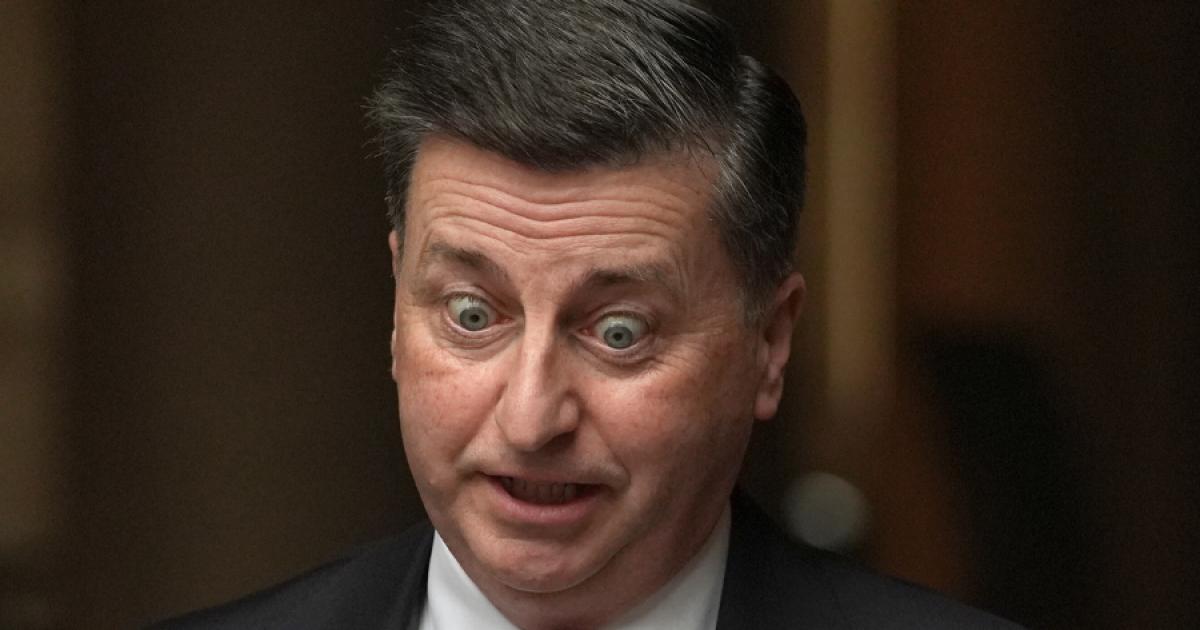
It was difficult not to be irritated this week as the Labour Government trumpeted its “upgraded” free trade deal with South Korea, with Secretary of State for Scotland Douglas Alexander among those fawning over it.
To say that the celebrations of trade deals by the current UK Government and previous Conservative administrations in recent years have been over the top does not really get anywhere near capturing the extent to which the noise exceeds the economic benefits.
All the while, the Labour Government sticks doggedly to its Brexit “red lines”. It will not rejoin the European Union, the single market, or even the customs union.
So the UK continues to be without the huge benefits of frictionless trade with its biggest trading partner and free movement of people between the UK and European Economic Area.
While shunning these huge benefits, we have heard so much hot air from the current and previous administrations at Westminster over things which deliver minuscule benefits relative to what has been lost with the Conservatives’ hard Brexit.
The free trade deal announced this week with South Korea, known officially as the Republic of Korea, is a case in point.
As well as the vainglorious proclamations at a UK level, we had a tailored Scottish version of the bigging up of this free trade deal, including comments from Mr Alexander.
The press release issued on Monday was headed thus: “Huge Boost For Scotland’s Economy As UK Lands Momentous Trade Deal With South Korea.”
Huge? Momentous? Really?
The overall boost to the UK economy from the upgraded free trade deal with South Korea appears negligible.
Prime Minister Sir Keir Starmer declared on Monday: “This is a huge win for British business and working people and marks our fourth major agreement in 2025 after the EU, India and US.
“From food to TV, music and more, Korean culture is already influential here in the UK. This deal making trade even easier between us will help boost the economy – supporting jobs and growth which will be felt all over the country.”
It will certainly not be felt anywhere near as much as the grim and very much ongoing effects of Brexit.
Mr Alexander, for his part, declared on Monday: “The UK Government is backing Scottish businesses. This deal will provide a major boost to Scotland’s economy, enabling our exporters to grow their businesses and create new jobs.
“From our iconic Scottish products like salmon and whisky to our textiles production, green energy, advanced manufacturing, life sciences and financial services, Scotland has so much to offer South Korea thanks to this deal securing permanent tariff-free access to a growing market.
“Alongside recent deals with India, the EU and the US, we are helping to kickstart economic growth in Scotland and a decade of national renewal.”
A decade of “national renewal”. Really?
Pro-Brexit supporters celebrating in Parliament Square in London after the UK left the European Union in January 2020. (Image: Jonathan Brady/PA)
UK trade minister Chris Bryant said on Monday: “Korean culture has taken off in the UK, with millions of Brits already binge-watching great Korean TV like Squid Game and streaming K-pop artists like Blackpink – but this trade deal will take our relationship to the next level, with hundreds of millions of pounds and vast opportunities unlocked for businesses.
“Today’s agreement secures the UK as a global leader in digital trade and innovation while boosting our world-class services sector, supporting iconic brands, and giving cast-iron protections to our key industries to speed up economic growth as part of our Plan for Change.”
Squid Game was compelling viewing but it is difficult to see its relevance to the upgraded South Korea free trade deal or indeed the UK economy.
And as for speeding up growth, none of the trade deals mentioned by Sir Keir and Mr Alexander is going to do anything particularly significant by way of such acceleration. The agreement this year with the EU represents progress but it is a very narrow one and the boost to UK GDP is estimated at only about 0.3% by 2040 by the UK Government, even though this is the biggest impact of the four agreements mentioned.
Read more
It is always important to put such things in context.
In this case, the most apposite context is the extent of the damage to the UK economy from the UK’s hard Brexit.
It is, of course, important to remember this was delivered by the Conservatives, when Boris Johnson was prime minister.
However, is it also crucial to realise that Labour continues to embrace the key aspects of this hard Brexit with its “red lines”.
A working paper on the impact of Brexit published by the National Bureau of Economic Research (NBER), which is based in the US at Cambridge in Massachusetts, made for very interesting reading when it was published last month.
The authors of the working paper are Nicholas Bloom of Stanford University, Philip Bunn of the Bank of England, Paul Mizen of King’s College London, Pawel Smietanka of the Deutsche Bundesbank, and Gregory Thwaites of the University of Nottingham.
The NBER is a “private, non-profit, non-partisan organisation”.
The abstract for the working paper, The Economic Impact of Brexit, states: “This paper examines the impact of the UK’s decision to leave the European Union (Brexit) in 2016. Using almost a decade of data since the referendum, we combine simulations based on macro data with estimates derived from micro data collected through our Decision Maker Panel survey. These estimates suggest that by 2025, Brexit had reduced UK GDP by 6% to 8%, with the impact accumulating gradually over time.”
In spring 2023, the then chairman of the Office for Budget Responsibility, Richard Hughes, said of Brexit’s effect: “We think that in the long run it reduces our overall output by around 4% compared with had we remained in the EU.”
This is a huge impact.
And the NBER estimate of the damage is far greater still.
What is beyond doubt is that Brexit has had an enormous impact on the UK economy.
Yet the Labour Government continues to sit on its hands on this key front and instead bang the drum about free trade deals offering piffling benefits.
For example, the UK Government estimates that annual UK gross domestic product will by 2040 be 0.13% higher than it would have been without the India trade deal.
The UK Government said of the agreement with South Korea: “The deal with South Korea, the 12th largest economy in the world, is expected to grow UK services exports by £400 million including improved access to South Korea’s expanding financial market.
“Vital automotive, pharmaceutical and food and drink industries have also been protected and global supply chains secured. Some £2 billion of UK exports were weeks away from facing costly tariff hikes but will now benefit from the deal thanks to permanent preferential access to one of Asia’s most advanced economies.”
This all amounts to a drop in the ocean.
When the India trade deal was announced, the Labour Government talked about increasing UK exports to India “by nearly 60% in the long run – equivalent to an additional £15.7 billion of UK exports to India when applied to projections of future trade in 2040”.
And the annual boost to UK economic output in the long run from the India deal was estimated at £4.8 billion – that tiny 0.13% of UK GDP.
That gives an idea of just how minuscule the effect on the UK’s overall GDP will be from the South Korea free trade agreement.
Some companies and sectors will benefit from the various trade deals agreed.
However, it is high time that politicians stop painting a picture that they somehow constitute more than a hill of beans relative to what is being lost with Brexit.