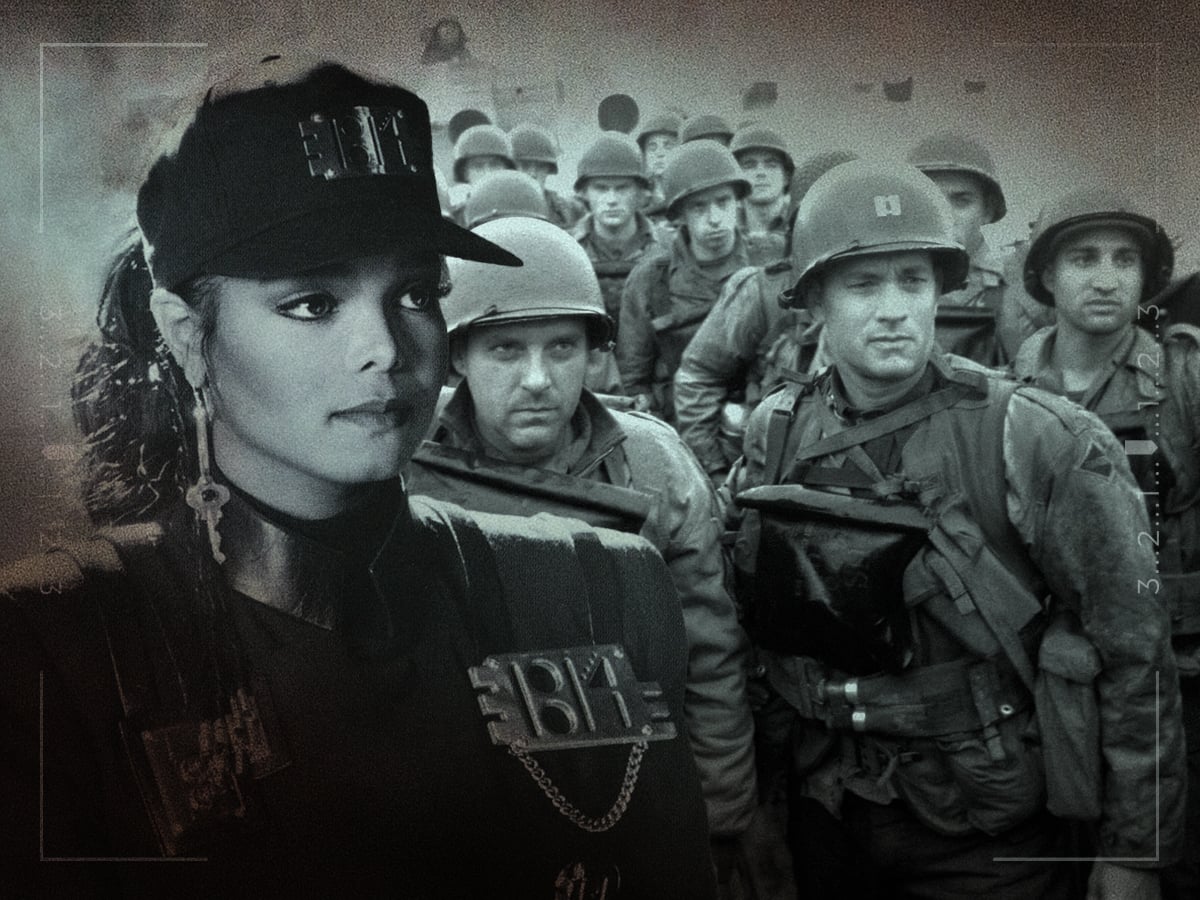
(Credits: Far Out / Album Cover /
DreamWorks Pictures / Paramount Pictures)
Sat 20 December 2025 2:00, UK
In one corner, fighting out of Hollywood, California, came Steven Spielberg’s Saving Private Ryan, arguably the greatest World War II movie ever made and, at the very least, a modern masterpiece that breathed fresh, vivid, and immersive new life into one of cinema’s staple subgenres.
In the other corner, fighting out of Gary, Indiana, the second most famous and successful member of a musical dynasty, no offence to Tito, Janet Jackson: bestselling singer, Academy Award nominee, Grammy winner, and one of the biggest and most influential pop stars of her generation.
What do the two have to do with each other? At first glance, fuck all. And yet, in a truly bizarre case of one hand feeding the other, the annual re-airings of Spielberg’s Oscar-winning classic that had become a fixture of the American television calendar were abruptly ended when everyone decided that maybe it wasn’t the best idea to screen an R-rated film laced with brutal violence and the occasional bad word.
It doesn’t sound like it makes sense, and it didn’t. However, after the uproar that followed Jackson’s Super Bowl incident with Justin Timberlake, network censors around the United States suddenly got skittish. For reasons that made sense only to them, the reverberations made it a simple decision for Saving Private Ryan to be pulled from the airwaves, with many stations refusing to show it.
Ever since it first debuted on the small screen, the Tom Hanks-led war story had been shown every Veterans Day to continue paying tribute to the armed forces, who Spielberg had been consulting and remained in contact with through every step of the process from pre-production to post-release.
In 2004, months after the infamous Super Bowl halftime show, more than 20 affiliate stations under the ABC banner yanked the ‘Best Picture’ nominee and ‘Best Director’ winner from the scheduling, citing concerns that the subject matter, authentic depictions of combat, and occasional use of bad language could potentially incite sanctions from the Federal Communications Commission.
Some stations opted to instead make “some highly targeted audio edits to eliminate only the most intense language,” but dozens opted against showing Saving Private Ryan at all. “It would clearly have been our preference to run the movie,” said one. “We think it’s a patriotic, artistic tribute to our fighting forces.” And yet, with the threat of fines or grievances looming overhead, it didn’t happen.
Strangely, ABC showed the film in its uncut entirety, despite many of its affiliates backing out, with Spielberg’s contract with the network stipulating that it wasn’t allowed to screen Saving Private Ryan in anything other than its full, theatrical, and untouched majesty, with the Charlotte-based WSOC-TV occupying a different camp after receiving complaints in 2001 and 2002.
“Now, after much concern and discussion about family viewing over past months, and with Americans at war across the world, it is the vivid depiction of violence, combined with graphic language, proposed to begin airing at 8 pm that has forced our decision,” station vice president and general manager Lee Armstrong shared. There was plenty of fallout from the Jackson situation, but nobody expected Saving Private Ryan to be caught in the crossfire.
Related Topics