For weeks, British politics has revolved around a single, oddly narrow question: should the UK seek a customs arrangement with the EU? Somehow, this has been treated as a bold strategic shift – as though the country that once belonged to the world’s largest political union is now wrestling with the philosophical meaning of a tariff.
It is a strangely constrained conversation, designed not to provoke the party base, not to reopen the wounds of 2016, not to admit that the last decade has been economically bruising. Instead, it is framed as a technical fix: a customs union to ease trade, delivered with the insistence that this is mere pragmatism, not the first step towards re-engagement.
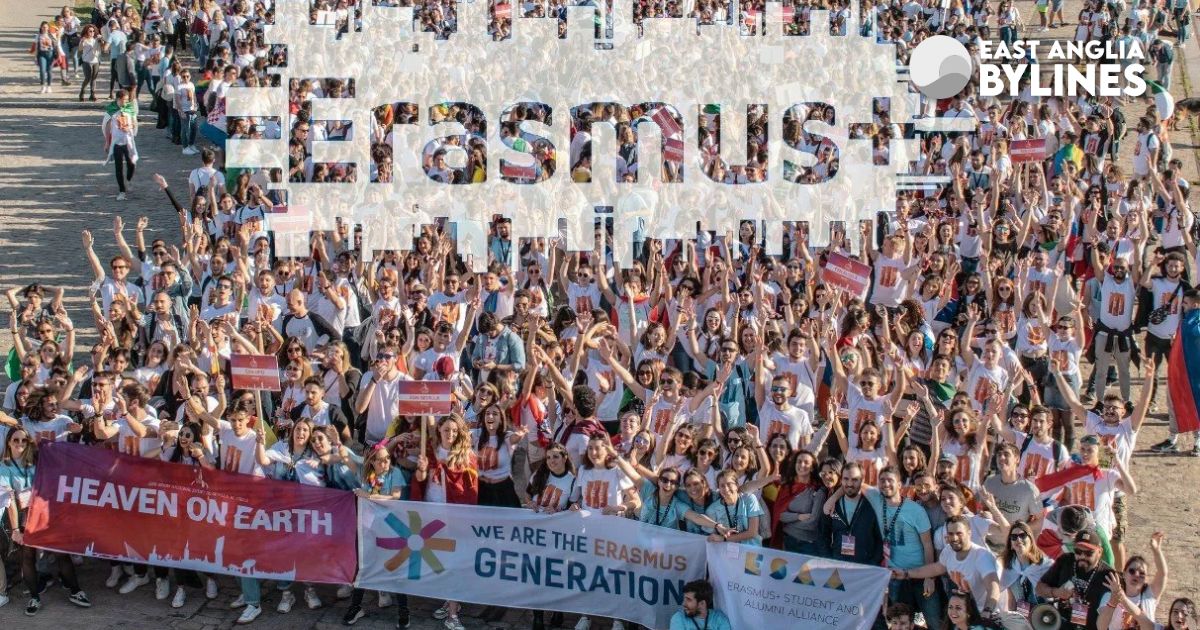
But politics rarely moves only through tariffs. It moves through people – and this is why the renewed discussion around Erasmus matters far more than it might first appear.
Erasmus is more than a programme – it’s experience
The Guardian’s report that the UK may rejoin the EU’s Erasmus+ student exchange programme has reopened a door that was never just administrative. Erasmus+ is not a funding scheme or a bureaucratic add-on; it was a lived experience of Europe.
Erasmus+ allows young people to cross borders as a matter of right, not privilege – to study, work, fall in love, argue politics, learn languages and return home changed. For decades, it quietly produced citizens who understood Europe not as an abstract institution in Brussels, but as a place they had inhabited.
A generation of British students has now grown up without that experience. For them, freedom of movement is not something lost, but something vaguely historical – a story older siblings tell perhaps, a right described in footnotes rather than lived reality.
The limits of trade deals and the power of horizons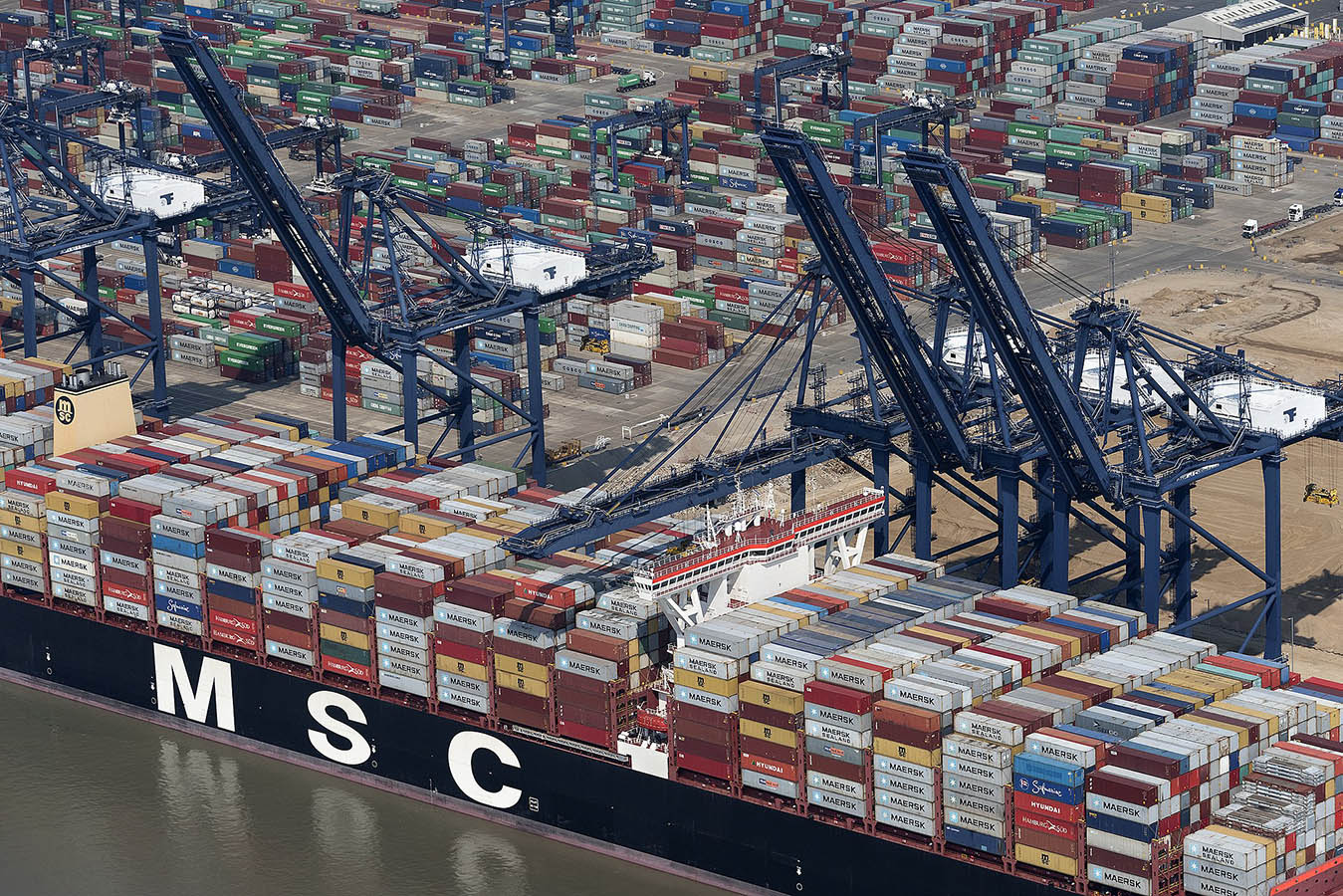 MSC Tina docked at Felixstowe. Photo by John Fielding via Wikimedia Commons (CC BY 2.0)
Rejoining Erasmus+ will not fix trade, growth or investment. But it will restore something more fundamental: a shared horizon.
A customs deal cannot do that. Trade arrangements do not recreate the emotional or cultural fabric of a continent. You cannot rebuild trust with Europe while still pretending you don’t want to. You cannot treat Brussels like a vending machine – insert a customs deal, collect stability – without acknowledging the political and cultural reality of the project you walked away from.
The EU is not just a market; it is a political community. If Britain approaches it only for convenience, it will receive only the minimum. That is not punishment. It is political physics.
Borders create bureaucracy, not freedom
Brexit was sold as a release from red tape, as though leaving the EU would free the country from an oppressive tangle of rules. But the experience of the last five years has shown something very different: outside the single market, the UK has generated more bureaucracy, not less.
Exporters who once traded seamlessly now navigate forms, inspections and queues. Small businesses that depended on frictionless movement have found themselves priced out or pushed out. British standards must be separately certified, supply chains stumble over new requirements, and industries from fishing to farming still carry the weight of unfulfilled promises.
A border that refuses to disappear
And nowhere is this clearer than in Northern Ireland when a border resurfaces where it was never meant to be. Every attempted fix has exposed the same contradiction: the region cannot be inside and outside a market at the same time.
Protocols, frameworks, and revisions differ in language but not in substance. Borders are not administrative details; they are political forces. They disrupt, they complicate, they unsettle.
Beneath all of this runs a deeper economic story: slowing growth, weakened business confidence, falling investment, labour shortages, political volatility and a persistent inflationary drag repeatedly linked to Brexit’s frictions.
The world has faced genuine shocks – a pandemic, a war – but the UK layered its own rupture on top of them, compounding every strain.
A system strained by unnecessary barriers
As an immunologist, my work is understanding barriers – how systems distinguish between “self” and “not-self,” how communication across boundaries maintains stability. Brexit always looked to me like the immunological equivalent of inducing inflammation in healthy tissue. Introduce an unnecessary barrier and everything around it reacts. The system becomes slower, more fragile, more prone to dysfunction. You can adapt, but you cannot deny the cost. Brexit’s consequences were not moral or emotional. They were structural.
I was myself an Erasmus student, and the programme shaped not only my education but my understanding of Europe as a shared civic and cultural space rather than an abstract political construct.
Which brings us back to the larger question Erasmus+ quietly answers: what does it actually mean to be European?
Being European has meant choosing cooperation over rivalry; building institutions designed to prevent conflict on a continent once defined by it; accepting that shared rules are not an imposition but a framework that allows nations to thrive together.
It has meant understanding that sovereignty, in a globalised world, is strengthened through partnership rather than diminished by it. Europe is not perfect, but it is coherent – predictable, rule-bound, and structured around the idea that countries are stronger as allies than as isolated actors.
Re-engagement requires honesty
If Britain wishes to take part in that system again – fully or partially – it cannot do so by whispering its intentions or disguising them behind customs formulas. Europe does not respond to ambiguity and trust cannot be rebuilt through technical half-measures alone. Identity follows experience. Erasmus+ understood that. Customs Unions do not.
Being European is not a slogan. It is a choice about how a country relates to its neighbours, its young people and its future.
More from East Anglia Bylines
 Friends of Bylines Network
There has never been a greater need for grassroots journalism that investigates the stories that really matter, holds power to account and champions the voices of everyday citizens. We are proudly powered by volunteers but what we do isn’t free.
STAND WITH US for independent, citizen-led journalism that makes democracy stronger, and you will even get some exclusive benefits.