This newsletter examines reversing Brexit under the Starmer government, from rejoining Erasmus and delaying elections to growing pressure to realign with the EU and the rise of Reform after conservatism.

Dear Subscribers,
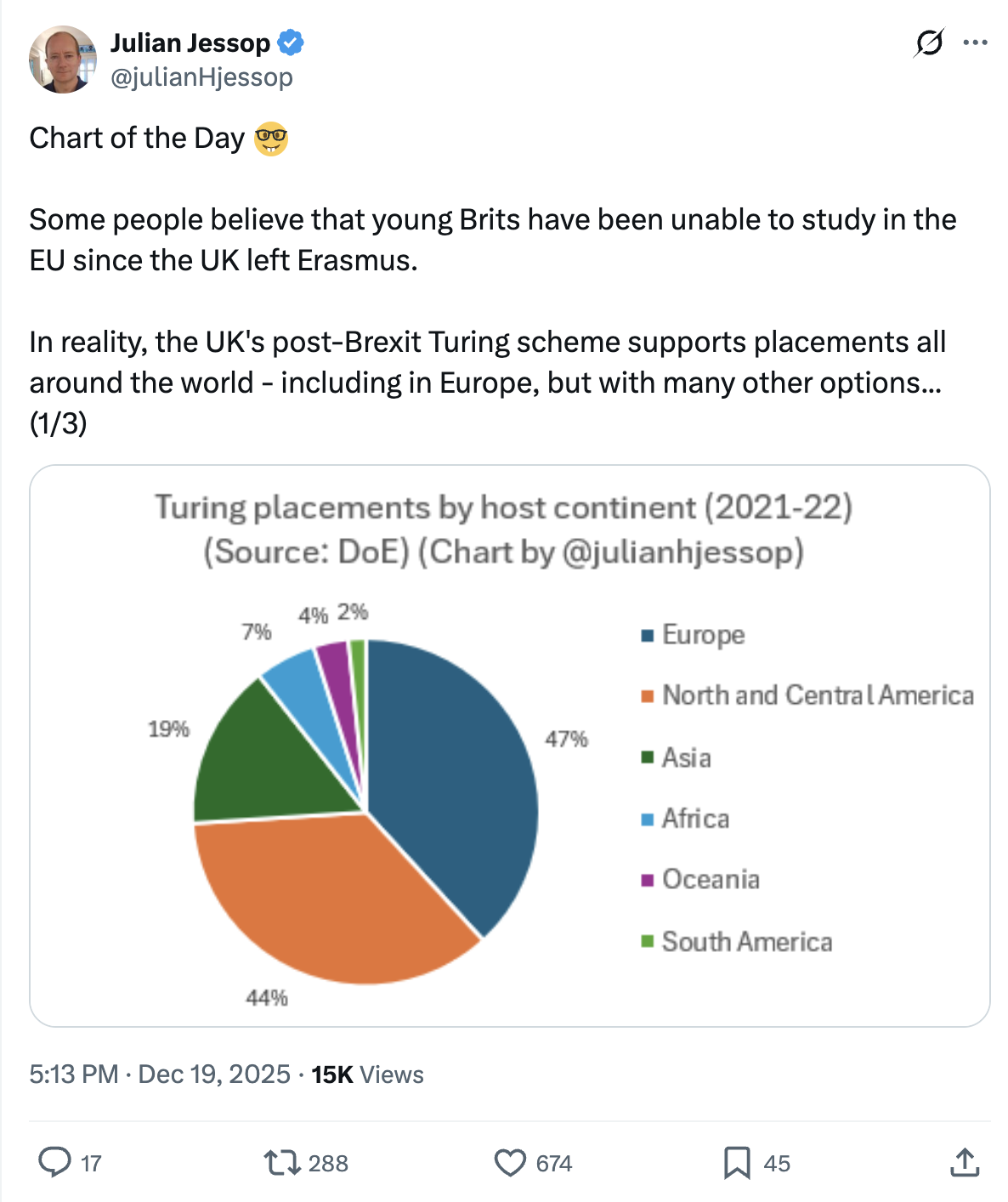
The Starmer government is continuing to unravel Brexit inch by inch. This week it was announced that the UK will be re-joining the Erasmus Scheme for the price of £570 million for the year 2027-2028. Negotiated by Nick Thomas-Symonds, this is expected to rise to £810 million in the following year. Erasmus was replaced by the Turing Scheme in 2021 which allowed British students to study in Europe and elsewhere, costing substantially less (£78 million for 2025-2026). Since the abandonment of Erasmus, it became Remainer orthodoxy to argue that British students have been denied access to European universities. This is nonsense, as Julian Jessop has shown, but has nevertheless impinged on government policy.
The government is delaying local elections by yet another year. The excuse given has been the same one used to justify the cancellation of the mayoral elections a few weeks ago: that local councils need more time to adjust to Angela Rayner’s centralising reforms. The real reason seems to be the refusal to face electoral opposition that might further undermine Starmer’s leadership. Farage has accused the Conservatives of colluding with Labour, who also face a threat from Reform in some parts of the country and the Lib Dems in others. Badenoch has deferred the Conservative response to the local councils themselves, of which East and West Sussex have welcomed the delay.
Earlier in the week, Danny Kruger announced the first phase of his plan to reform the civil service. He proposed mass cuts across the civil service: 68,500 jobs would be cut in which HR would be cut by 67 per cent, Comms by 60 per cent and policy advisers by 50 per cent. Kruger argues that this would generate £5.2bn worth of savings. From another angle, his plan seeks to incentivise high-performing civil servants by increasing their bonuses by between £500 and £700 million.
Farage has faced continual attack from the media, this week ITV, for the allegations of racism during his school days. It was also announced last week that the Electoral Commission would investigate Farage for overspending in his Clacton campaign during the last election. However, this has now been dropped due to a lack of evidence. These attacks on Farage appeared to have had no impact on Reform’s polling: the latest Find Out Now poll puts them on 33 per cent, compared with the Conservatives on 18, the Greens on 17, Labour on 14 and the Lib Dems on 11.
Blog
Irish Sea border undermining Brexit for the whole UK by Jim Allister
Jim Allister explains how Irish Sea border car imports and EU vehicle type approval rules are restricting choice, increasing costs in Northern Ireland, and pressuring the UK to align with EU regulations, undermining Brexit across the entire UK.
Media
Donald Clark on Substack: Baffling case of Erasmus
David Frost in The Telegraph: As Brexit negotiator, I vetoed the Erasmus deal. It’s a total turkey
Fred Sculthorp in Dispatch: Meet England’s new crusaders
Key Points
Inching closer to Europe
Keir Starmer’s current direction of travel seems to be leading us back to Europe – in short, a reversal of Brexit. Can this really be happening? Why, of course. For all that is said and ridiculed about Keir Starmer’s lack of existence or vision (ie, doesn’t read fiction, doesn’t dream, that voice, a ‘beta-lawyer, gamma-politician’ (Cummings) etc etc), there is a flipside to all of this. Namely, that he will grab any opportunity possible if it preserves his premiership.
He is surrounded by Remainiac sycophants – Tim Allen, Lord Hermer, Alastair Campbell and Tom Baldwin – in a kind of Blairite hanger-on hellscape to which de Goya couldn’t have done justice. And as Starmer’s political stock plummets further, what’s to say rejoining the Customs Union doesn’t look like political salvation? Technically, there is no need to have another referendum: it is easily forgotten that Heath entered the UK into the EEC without any such manifesto commitment or public vote in 1973. Instead, it was enacted as policy. (See Enoch Powell’s characterisation of this in a speech during the 1975 Referendum.)
The main obstacle to this inside No. 10 is Morgan McSweeney. McSweeney has drawn the ire of metropolitan liberals because he understands how much of the nation doesn’t want to re-open Brexit, doesn’t want open borders and is anti-woke. With such realism, he ‘masterminded’ Starmer’s election campaign (meaning, he instructed Starmer to do nothing and let the Tories implode). The Remainiacs near Starmer want McSweeney gone. If he gets the sack, rejoining the Customs Union will become a more tangible reality; if he stays, the progress of reversing Brexit might be prolonged, if not halted.
After Conservatism
In a lecture given in 2022 titled After Conservatism (echoing the late Alaistair MacIntyre’s After Virtue), Peter Hitchens restated his decades-old argument about how the Conservative party ceased to be conservative: it became latitudinarian, accommodating rather than opposing Blairism and marginalising conservatism, embodied by the ‘Toff at the Top’, David Cameron. The lecture was given in memory of the conservative philosopher Roger Scruton (and has since been renamed the Oakeshott lectures in memory of the earlier twentieth-century conservative philosopher Michael Oakeshott).
The lecture makes for good listening, for it is humorous, cynical and deeply felt. It is also important listening for those trying to make sense of the political terrain which Reform is gradually inhabiting. So, what exactly does Reform represent?
The very name ‘reform’ implies that it wants to do something, to try to fix things and solve problems. It believes in drafting plans for reducing the civil service, supporting the City and small businesses, and in reversing mass migration. It also wants to make legal reforms, in a Great Reform Act (inspired partly by historian David Starkey), that undoes the Blairite constitutional settlement and decouples Britain from the ECHR. These are – so far – Reform’s reforms.
They are not conservative. Conservatism, Oakeshott said, is derived from a human disposition ‘to prefer the familiar to the unknown, to prefer the tried to the untried, fact to mystery, the actual to the possible, the limited to the unbounded, the near to the distant, the sufficient to the superabundant, the convenient to the perfect, present laughter to utopian bliss.’
No, this is not quite Reform. But Oakeshott was philosophising during the 1950s: and this is, as he acknowledged, a very different activity to ruling or policymaking and they were very different times. To be sure, in 2025, we are in a sense living after conservatism, as Hitchens said three years ago.
Much is said about the collapse of liberalism and the rise of populism. By contrast, very few have noticed the disappearance of conservatism. The nails were set in conservatism’s coffin by various liberal Conservative prime ministers during the 2010s and early 2020s: Farage and Reform now wield the hammer and are navigating a political landscape after conservatism.
This is the final Newsletter of 2025 – we will be back in the New Year.
Wishing you a Merry Christmas and a Happy New Year!
Related