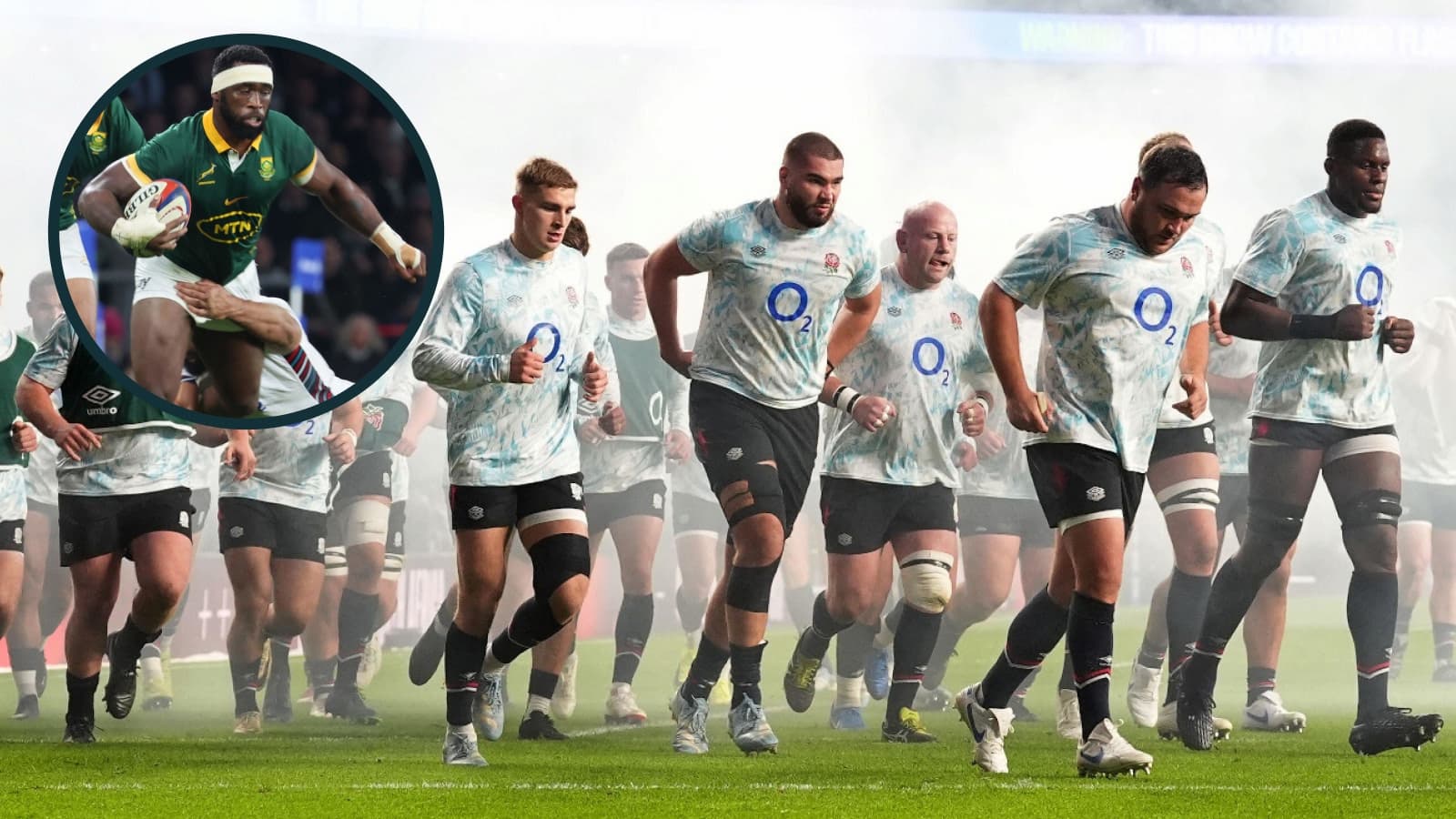
There’s something quietly revealing about the fact that large sections of the South African rugby public have been calling, almost restlessly, for another crack at England. The noise has been there since the World Cup final dust settled, a persistent undercurrent of ‘when do we play them again?’, of a rivalry that always feels unfinished despite the medals and the margin of Bok dominance.
The answer, of course, July 4, 2026. A long way off, long enough for form to fluctuate, for new narratives to take hold, for the memory to soften and for any perceived certainty to blur at the edges.
But it’s the question itself that’s interesting, because world champions don’t usually look back in this way. They tend to look forward, or inward, or occasionally over their shoulders at rivals who have beaten them; they don’t often fixate on opponents they’ve already overcome, and yet England occupy a curious place in the Springbok psyche, not as victims and not quite as rivals in the traditional sense, but as a reference point, a side who, for all their inconsistencies, have an awkward habit of forcing South Africa to confront themselves.
That discomfort tells you something.
Breaking it down
Elite rugby has a habit of being reduced to individual ingredients, particularly in moments of reflection. One team wins because they’re mentally tougher. Another loses because they didn’t want it enough. Someone points to selection, someone else to tactics, someone else to culture, as though performance at the highest level can be traced back to a single, isolated cause.
It’s the sporting equivalent of judging Christmas dinner on one mouthful taken out of context.
Coaching, particularly at the elite end, teaches you to distrust that instinct very quickly. Rarely is one thing the issue. More often, it’s the interaction between elements, the tension between competing demands, and the consequences of decisions made for perfectly sound reasons that only reveal themselves when pressure compresses time and space.
That’s why polarised views are so dangerous. They simplify what is, by nature, complex, and they encourage certainty where none really exists.
When Siya Kolisi spoke after the World Cup final about, as a kid, dreaming not of trophies but of dreaming where his next meal was coming from, the quote landed with the emotional force it deserved. It was honest, raw and reflective of a lived experience far removed from the relatively comfortable pathways that many elite players elsewhere have travelled.
But there is a risk in how that line is sometimes used, particularly when it becomes shorthand for the idea that South Africa win because they have suffered more, and that England, by extension, cannot possibly compete with a mentality forged in genuine deprivation.
It’s an understandable narrative, but it’s also an incomplete one.
Hardship does not automatically produce elite performance. If it did, the global sporting landscape would look very different. What hardship can produce, when it is processed and channelled effectively, is clarity. Perspective and a sense of meaning that cuts through doubt and noise when the stakes are highest.
Kolisi’s story matters not because it makes him harder than anyone else in some abstract sense, but because it anchors him. It removes ambiguity. When pressure arrives, he knows precisely what matters and what does not, and that certainty has a stabilising effect not just on him but on those around him. Teams feel it. Systems align around it.
That, more than background or biography, is what South Africa do so well.
England disruptors
Which brings us back to why Springboks supporters keep circling England.
England, for all their fluctuations, remain a side who can disrupt South Africa’s sense of order. They are not easily dismissed as chaotic or unfocused, and on their day they are physically capable, tactically abrasive and mentally awkward to play against, as they proved in the World Cup semi-final in 2023. They don’t always win, but they have a habit of forcing South Africa to be precise, and that precision is hard work.
England’s problem historically has not been talent, nor even desire; it has been clarity of identity, sustained over time. England have oscillated between versions of themselves, sometimes between seasons, sometimes between tournaments, occasionally within the same campaign. Each version has made a degree of sense in isolation, but the cumulative effect has been uncertainty.
And yet, when England are clear, properly clear, they become an uncomfortable opponent for anyone.
Physicality is the starting point, as it always is. It’s the expected centrepiece, the thing without which nothing else really matters. England have never lacked physical players, and size, power and conditioning have not been the missing ingredients in recent years.
The difference emerges when games tighten, fatigue dulls skill and the environment becomes hostile. This is where decision-making under pressure becomes decisive, not because it is perfect, but because it is owned.
Planet Rugby once discussed Owen Farrell with Eddie Jones, and what stood out was not talk of technique or temperament, but of mental clarity. Farrell’s ability to see a picture early, choose a course of action and commit to it fully. Jones admitted that sometimes that commitment was to a decision that, with the benefit of hindsight, might be questioned, but it was driven through with such conviction that the team aligned around it, and that alignment often mattered more than theoretical correctness of the initial tactic.
At elite speed, a good decision made early and owned will usually beat a perfect decision made late and doubted – drift erodes trust far faster than error.
South Africa understand that and England are starting to understand it too, albeit intermittently. The difference lies in how well clarity is protected when pressure mounts.
Communicate to win
Communication sits at the heart of this, and it is almost always misunderstood from the outside. Elite communication is not about volume or charisma, nor is it about emotion or rhetoric. It is about organisation, concision and rehearsal, about language that has been agreed in advance so that, in the moment, nobody is deciding what to say; they are simply executing a shared code.
The best teams don’t talk more, but they organise earlier. Like all great leaders, they speak less, but with greater effect.
South Africa’s communication systems are excellent. Rassie Erasmus is the arch-planner, a man of huge detail – so calls are clear, authority is accepted, and debate ends when the game begins. That does not make them inflexible; it makes them efficient and that’s often seen by the way Erasmus uses his 23-man squad. England, at times, have suffered from competing messages, from shifts in emphasis and identity that create noise, and noise under pressure is corrosive.
This is why the anticipation around July 2026 is so interesting. It’s not bravado from South Africa, nor is it insecurity; more so it’s curiosity. A recognition that England, if they ever fully settle on who they are and commit to it without apology, remain one of the few sides capable of disrupting South Africa’s rhythm and are a side that have similar, if not as well matured, qualities.
Want more from Planet Rugby? Add us as a preferred source on Google to your favourites list for world-class coverage you can trust.
By the time that match arrives, plenty will have changed. Form will rise and fall. Players will come and go. Narratives will evolve. Arguments will be had, not least around Christmas tables, and just as quickly forgotten.
What will not change is the underlying truth that elite rugby is not decided by hunger alone, nor by hardship, nor by heritage. It is decided by clarity; of purpose, of decision-making, of communication; and by the courage to live with that clarity even when it invites criticism.
South Africa have that now, whilst England are still refining it.
When they meet again, it won’t be about who suffered more or who wanted it more. It will be about who knows, with greater certainty, exactly what they are trying to do, and who commits to it when the pressure is highest.
That is why the wait matters.
READ MORE: Sacha Feinberg-Mngomezulu makes ‘massive’ decision on Stormers future